



Deepal E07 Multitruck 2026: Australian first drive
Weird, wacky, but wonderful? Oddball electric ute-cum-SUV offers a peculiar never-before-seen answer to a question we’re not sure anyone asked
Imagine for a second you’re an executive in a boardroom in Chongqing, China, brainstorming ideas to shake up the automotive industry. The goal? Create a fresh niche, one that could prove as successful as BMW’s ‘Sports Activity Coupe’ creation with the X6 in 2008.
Except, instead of working towards the answer merging two genres, you ask your proprietary AI software — let’s call it the Automatic Vehicle Generator 9000, for argument’s sake. ‘Create the perfect, multi-function, environmentally friendly family vehicle that is comfortable, spacious, affordable and indulges an outdoor lifestyle’, reads the prompt.
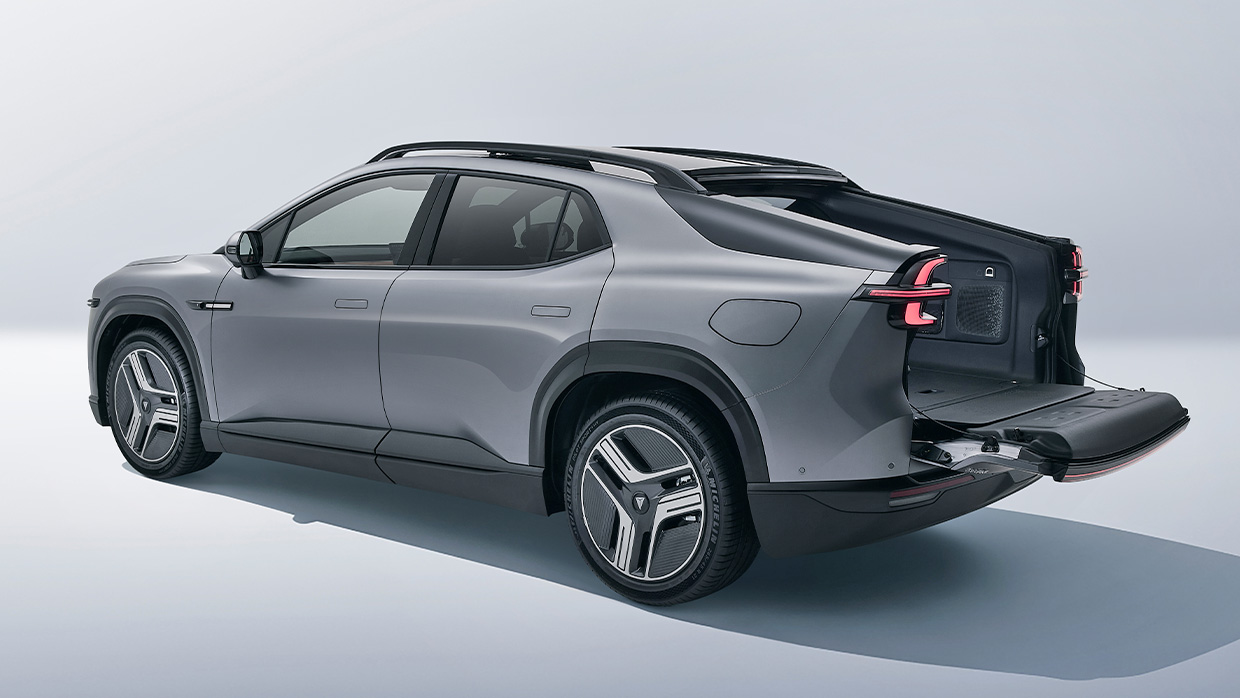
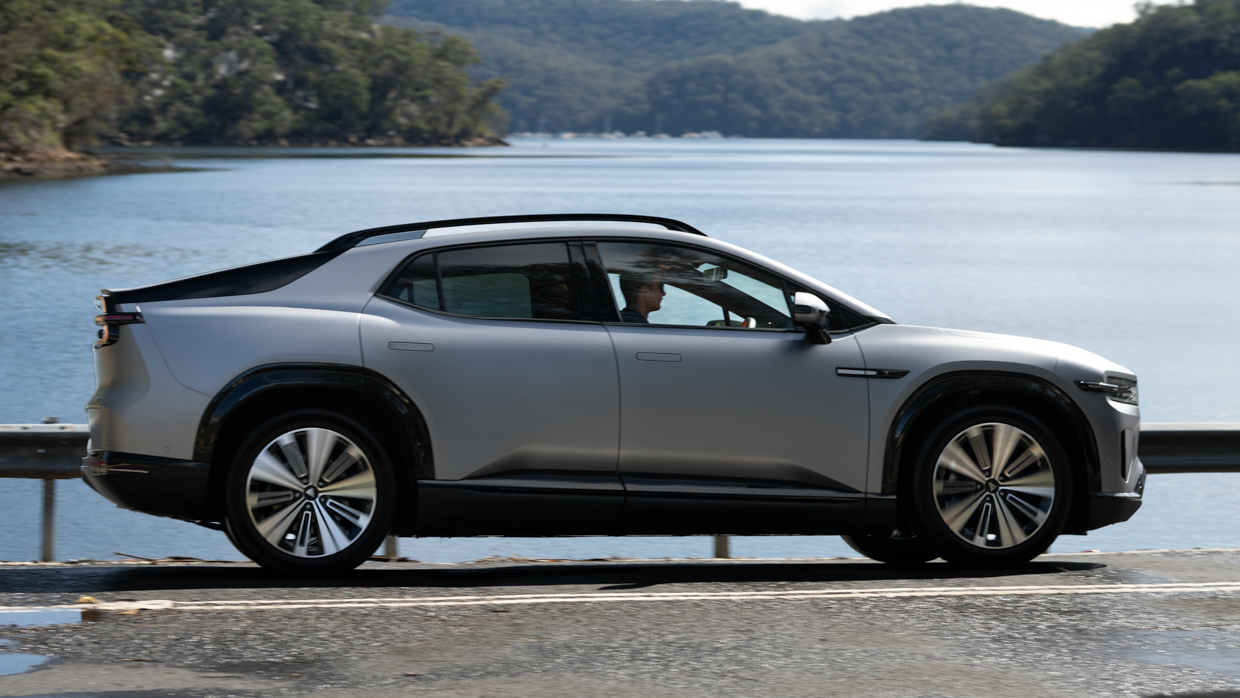
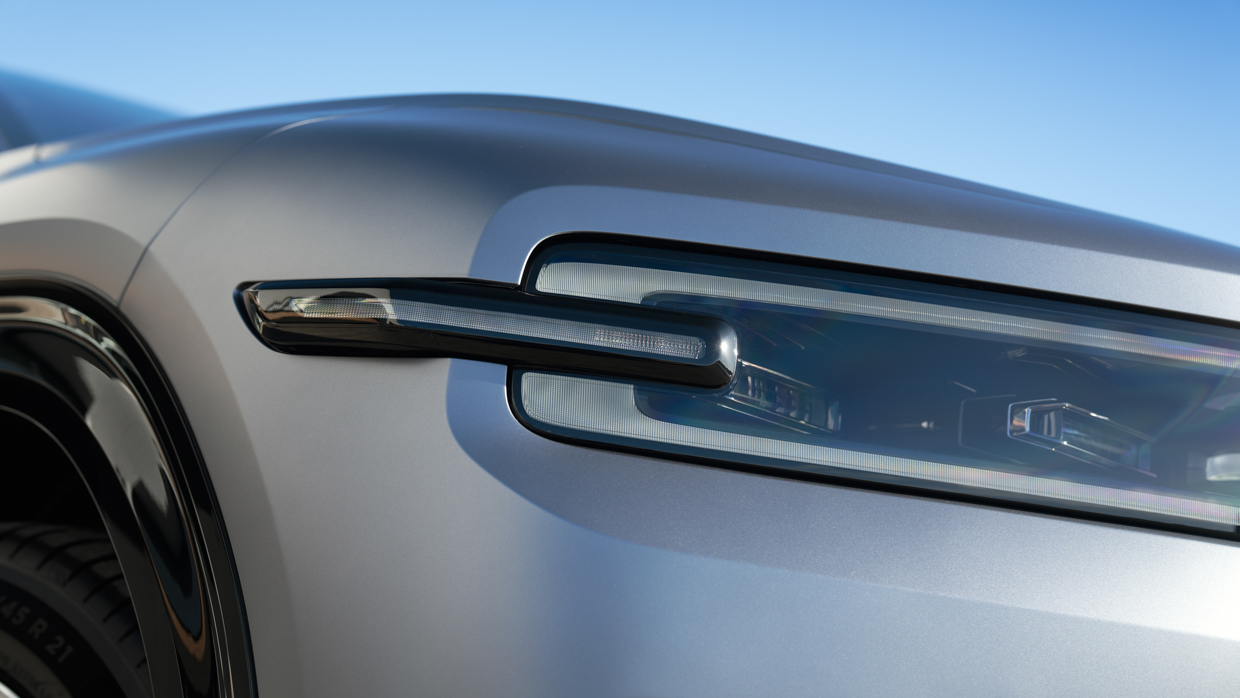
The result could be sheer gold: meet the peculiar, genre-bending Deepal E07 ‘Multitruck’. It’s an all-electric ute-cum-SUV-cum-coupe that seems to have taken inspiration from everywhere — from Subaru Brumby to Tesla Cybertruck and everything in between — hence the AI-generated theory.
It’s the second model from Chinese brand Deepal following the middling S07 medium SUV. Imported here by Inchcape, a name you might associate with Citroen and Subaru, Deepal is keen to expand.
Another medium SUV called the S05 is next on the list, with more EVs and plug-in hybrids down the line. Deepal’s giant parent company Changan offers all manner of vehicles to choose from, but nothing else quite as strange as the E07 is so far planned for Australia.
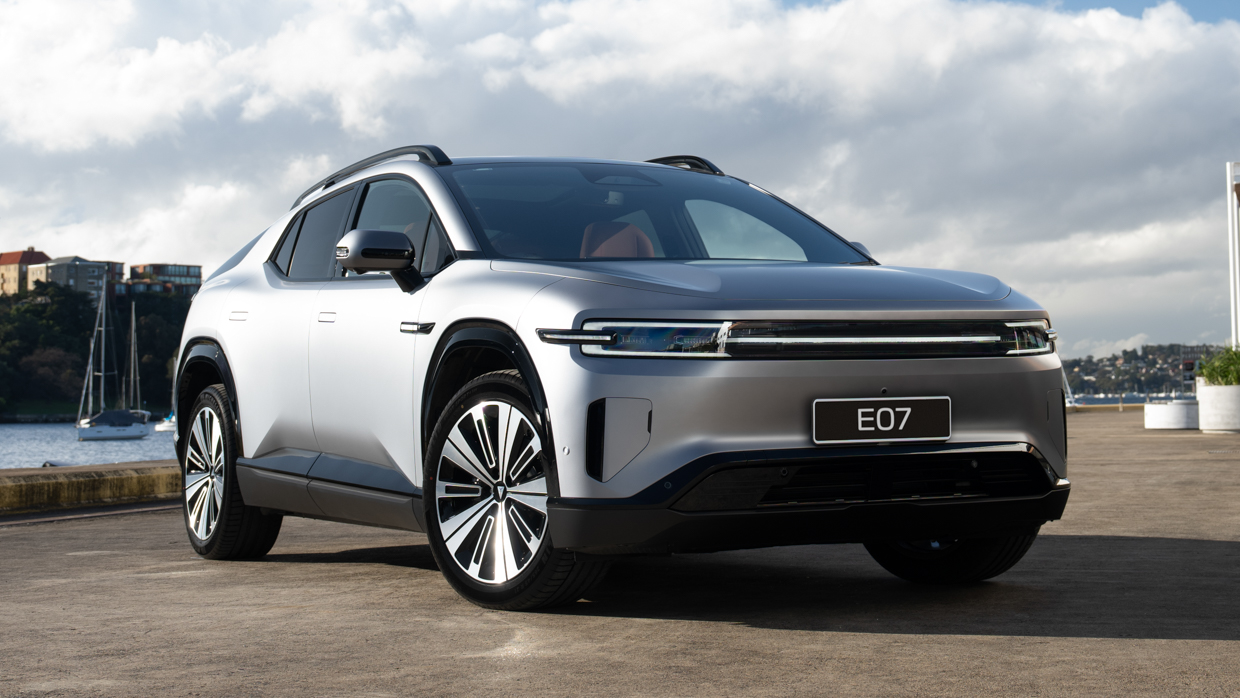
Chasing Cars attended the Deepal E07’s national media launch with a drive from Sydney to the Hunter Valley for a first sample of this genre-bender with one question at front of mind: is the E07 low-quality AI-like ‘slop’, or a genuine game-changer for outdoorsy families?
First thing’s first, Deepal has managed to squeeze an awful lot of lines onto the E07’s spec sheet and some of it is encouraging.
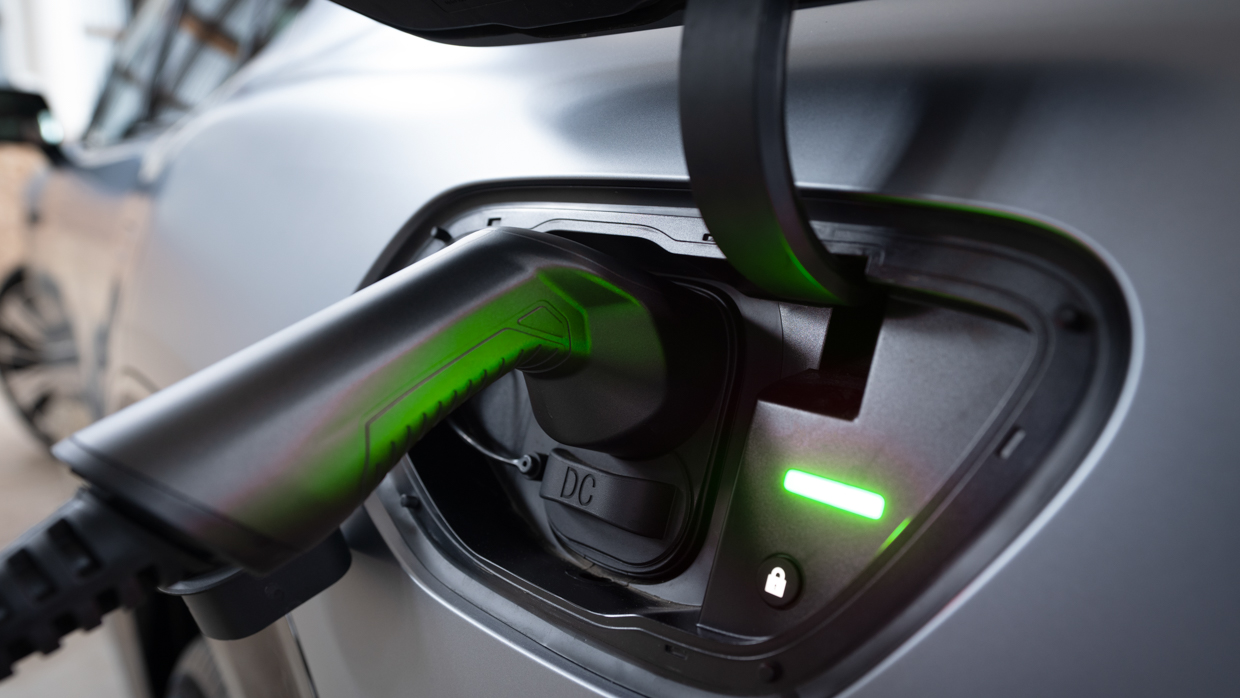
Features such as the E07’s 800-volt electric architecture for 240kW DC fast-charging (30-80 percent in 15 minutes) and active air suspension bode well, and are thrown in for as little as $64,900 (before on-road costs) in the entry E07 RWD trim.
It scores a single, rear-mounted electric motor (as its name suggests) good for 252kW and 365Nm and a 0-100km/h sprint in 6.7sec (claimed). With this configuration, the 90kWh NMC lithium-ion battery gives a WLTP driving range claim of 550km.
Those who want a weirdburger ‘ute’ that’s quicker than a HSV Maloo might want to step up to the E07 AWD for $73,900 list, which gets an additional motor on the front axle, 440kW and 645Nm, and a ridiculously quick 0-100km/h sprint of 3.9sec. This corresponds with a drop to 510km WLTP range claim — still respectable.
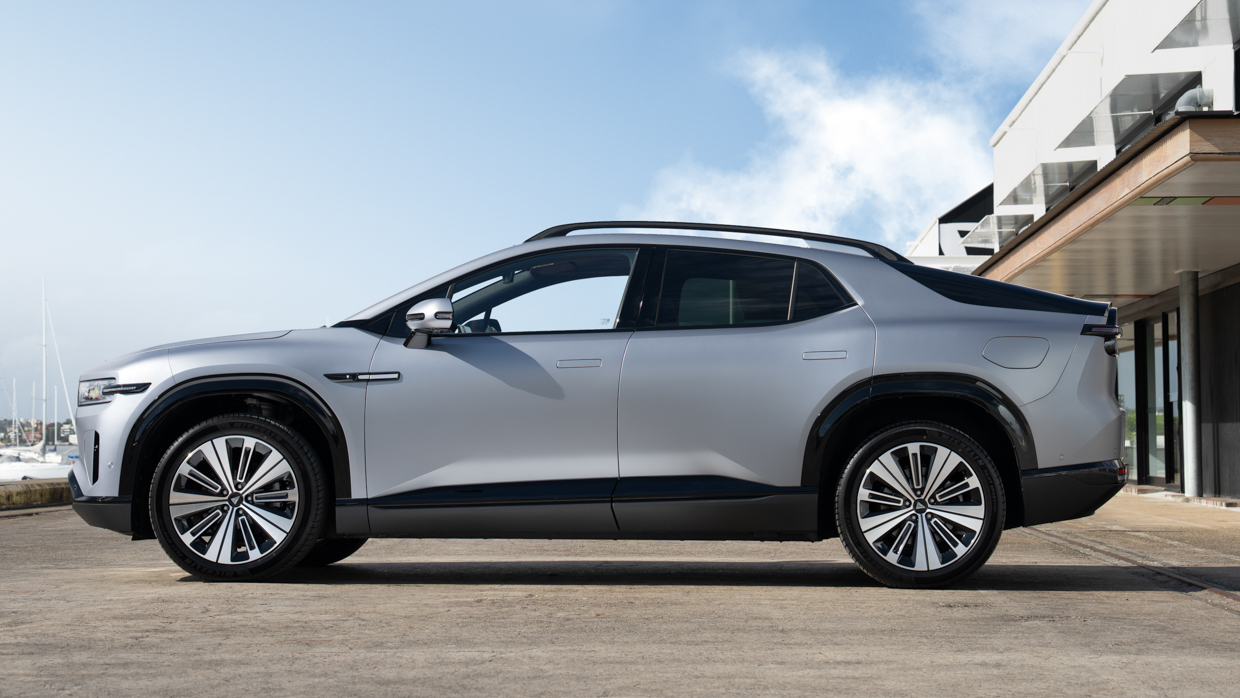
The Deepal E07’s measurements put it firmly in the large SUV category, as much as it wants to fight boundaries. It measures 5045mm long, 1996mm wide, 1680mm tall and rides on a 3120mm wheelbase.
Off-road capability bolstered by raising and lowering air suspension give it a maximum 223mm ground clearance and 600mm wading depth.
There’s an expansive feature list, too, including:
- 21-inch alloy wheels
- Vehicle-to-load (V2L) up to 6.6kW
- Tilting 15.4-inch touchscreen
- Wireless Apple CarPlay/Android Auto
- Hi Deepal voice assistant
- 14-way Driver & Front Passenger Seat Adjustment with Zero Gravity
- Nappa leather upholstery
- Heating and ventilation for front, and outboard rear, seats
- Front seat massage function
- Power-adjust steering column
- 50-watt wireless charging pad
- Panoramic 360-degree camera
- Power-adjust rear seats
- 18-speaker sound system with 2x exterior speakers
- 256-colour ambient lighting
- Head-up display
- Insulated glass
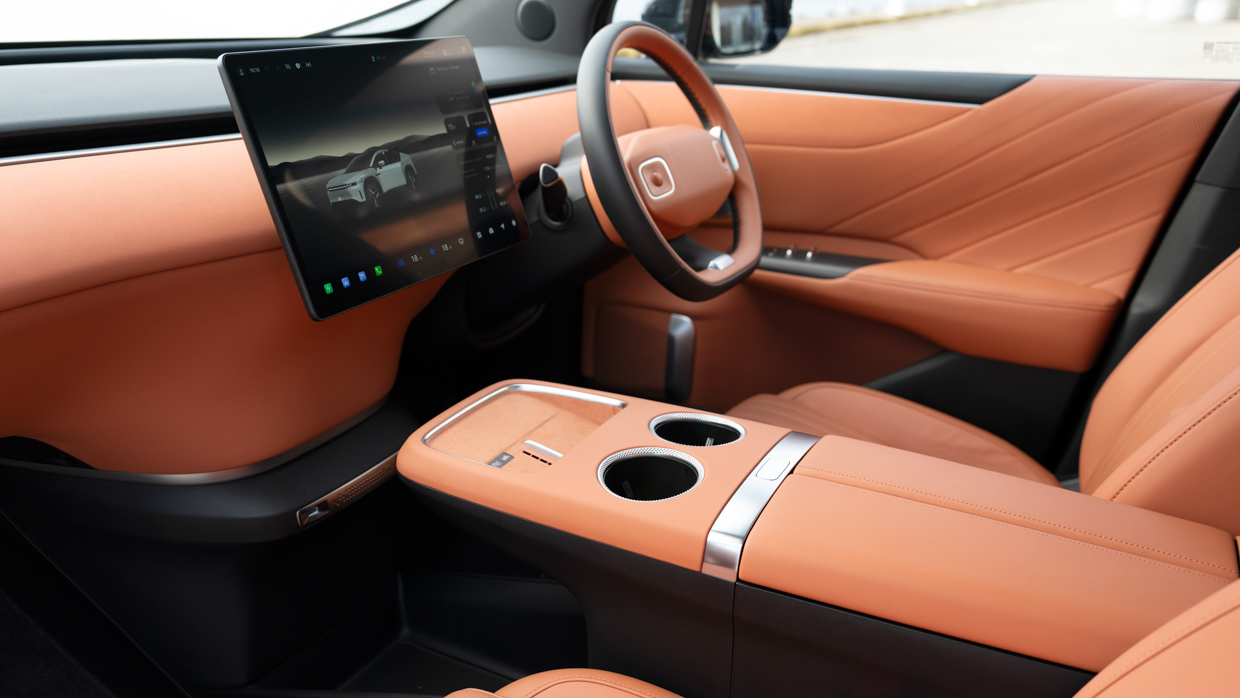
Not that you’d know it inside because the Deepal E07’s cabin is a vast, rather featureless space with only the huge 15.4-inch tilting media touchscreen (which responds by twisting to the not-very-helpful ‘Hi Deepal’ voice assistant) and a head-up display for front passengers.
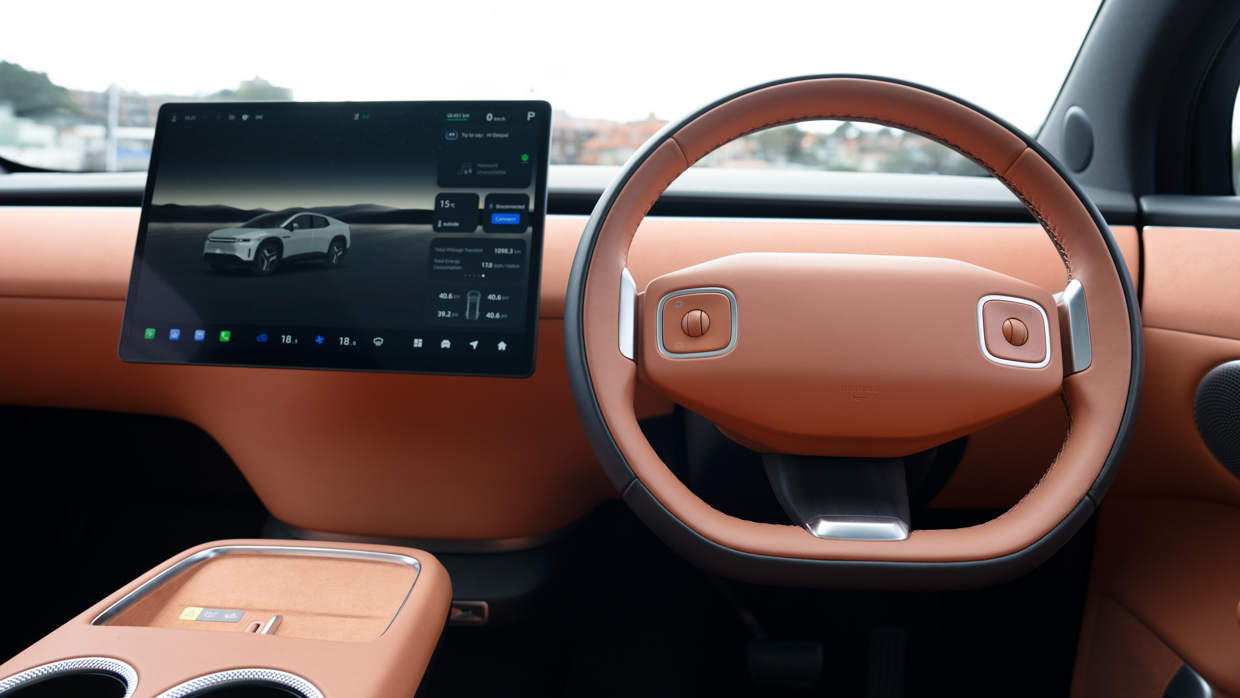
There’s no Deepal badging to be seen either (adding to the feeling of peculiar, Temu-like anonymity) as this vehicle’s sold as the Changan Nevo E07 in its Chinese homeland.
In relying solely on a touchscreen, the Deepal E07 suffers a familiar fate of overloaded controls that is rapidly overwhelming for occupants.
We were two-up on launch, and I had to get my co-driver to perform some critical functions, including defeating safety aids, HVAC adjustment, and mirror angle due to the sheer number of sub-menus. Doesn’t help that the E07’s screen isn’t as snappy as the best in market, like a Tesla Model Y’s.
Similarly, the sound system was a let-down. It promises a lot with 18 interior speakers, in excess of six modes and bewildering customisation of tone and delay we’ve never encountered in a car. However, none of the modes fixed the hollow mids and tinny highs we experienced.
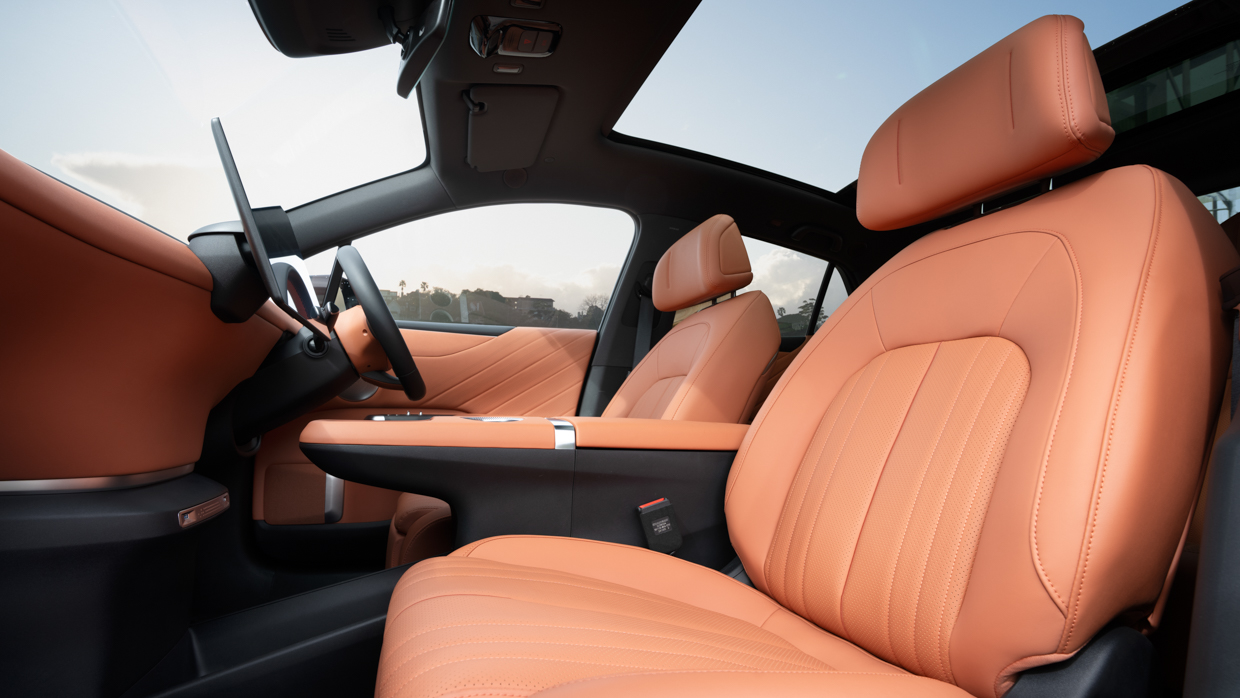
At least the cabin is well appointed and put together. Chinese carmakers have quickly nailed repeatable build quality in cars and the Deepal E07 is no exception. The optional orange upholstery, which appeared to have had too many layers of spray tan, was soft and high quality.
The seats are comfortable, too, offering much electric adjustability and the ability to lie nearly fully-flat. There are also eight massage programs from ‘Relax’ to ‘Buttocks’ in three levels of intensity. They work better than most massage seats, too.
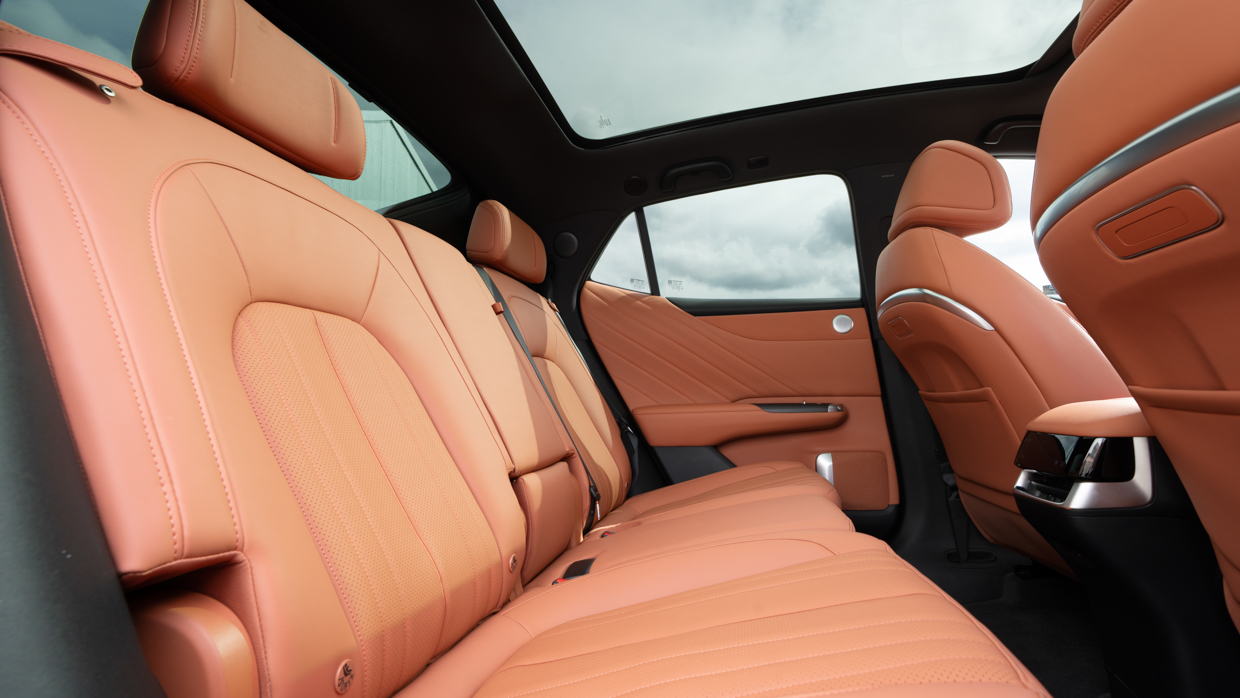
As a family vehicle, the E07 makes a strong case for itself with a spacious second row that’s just as well appointed as the front. It’s arguably the nicer place to be (generally passengering is best in the E07) with heating plus ventilation for outboard seats, and a good view through the windows.
It’s the boot, or ‘modular rear cargo and cabin space’, that’s the Deepal E07’s most novel feature. It starts out underwhelmingly, with a small piece of glass receding into the tailgate when you request the ‘boot’ to open.
This builds, with the rear glass hatch moving out of the way, then the tailgate drops. Here, you now have a spacious 524L luggage compartment that’s sealed from the cabin, like a sedan…but also a ute because you can drive in this configuration without beeps and bongs.
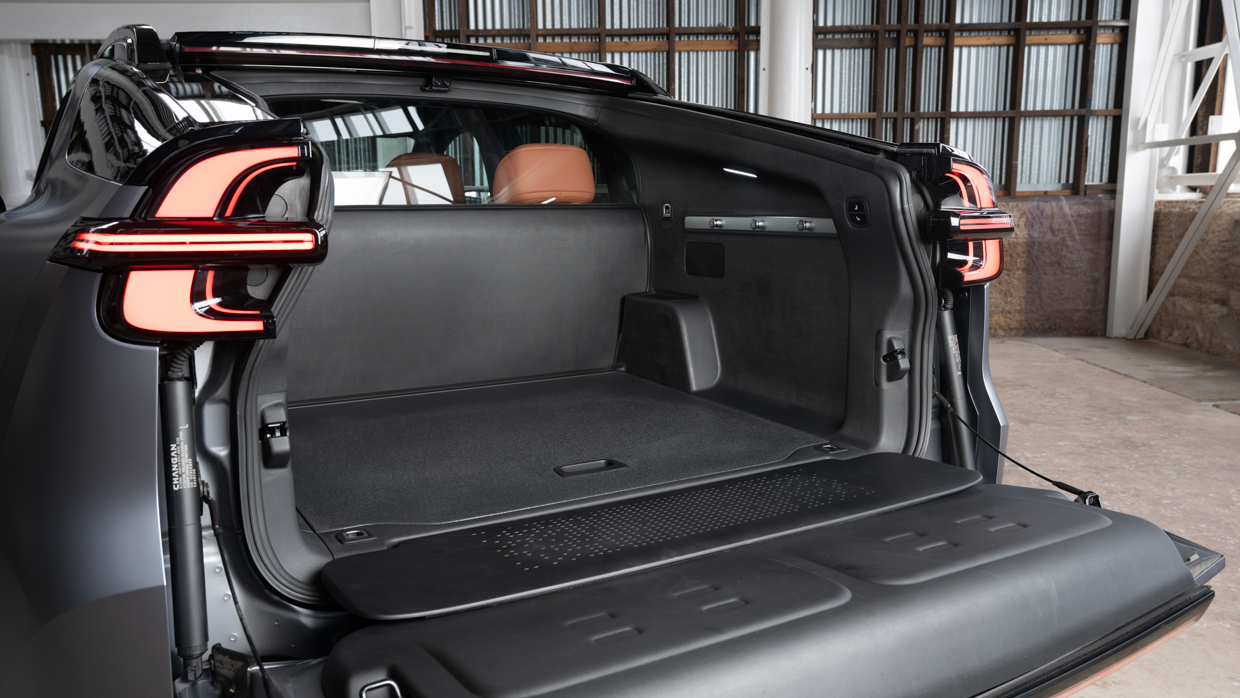
The real trick comes with the press of another button: a glass partition winds its way down, the second row folds forward, and the rear bulkhead slowly lowers itself (not always seamlessly) for a near-flat load space.
Fully extended, the load bay has a 15-degree tilt, measures 1865mm long and 1100mm wide. Deepal showed a neat ‘queen’ camping mattress with cut-outs for the strut towers. There’s also a tent that attaches in China, though it’s not yet clear how many accessories Deepal will offer for the E07 in Australia.
You can run appliances via the E07’s vehicle-to-load (V2L) set-up, and keep the cabin climate controlled while you snooze and the fixed glass roof doesn’t stop you installing roof racks for carrying bikes or surfboards. It really is a novel concept.
In contrast to the unique packaging, and quite despite the rapid on-paper pace of the AWD, the E07 driving experience is rather forgettable, but gently positive.
Ride quality is pillowy and not at all sporty — Deepal calls it ‘Magic Carpet’ though it’s still no S-Class — which suits most aspects of this car. The 21-inch alloy wheels with quality Michelin Pilot Sport SUV tyres do a good job covering any cornering sins, with surefooted grip in dry conditions.
Steering feel is typically vague and some sharp-edged hits reveal body shimmy through the wheel rim — a symptom of poor body rigidity, which makes sense with all the E07’s moving panels — but we didn’t notice any trim rattles or creaks. In fact, it’s a quiet and serene drive.
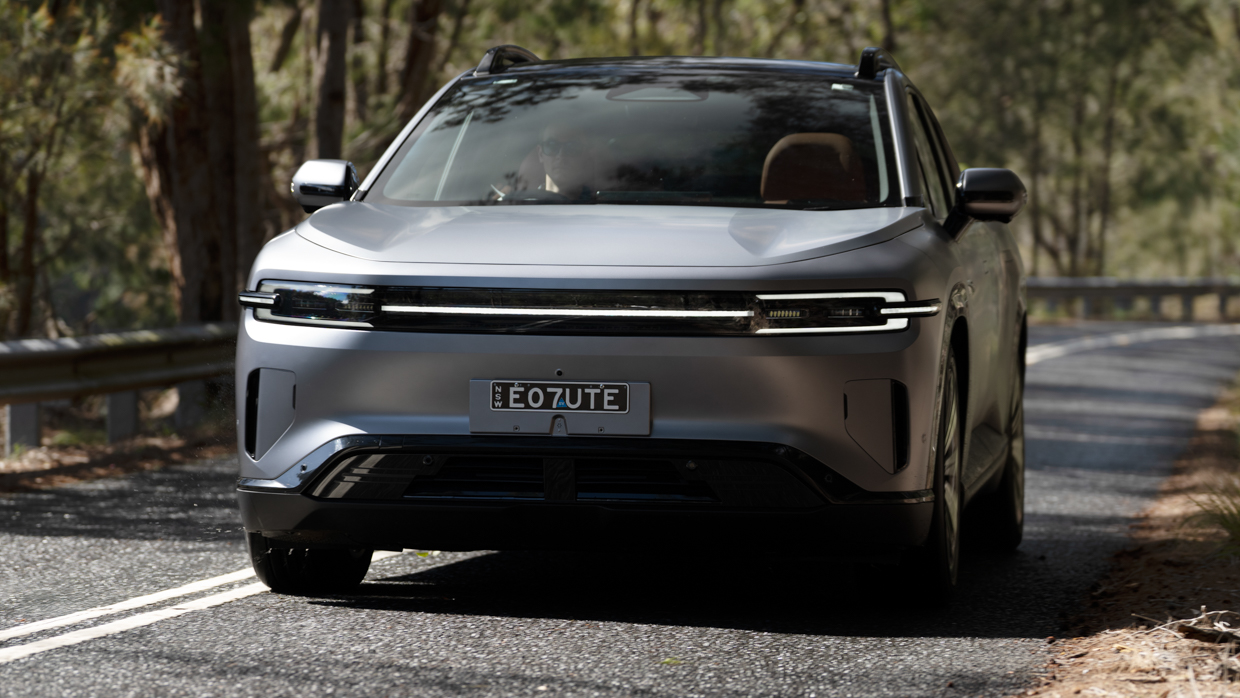
Adding to the laid-back experience is the accelerator response. This is no Tesla, with software-dulled response making the E07 feel much slower than on-paper numbers suggest. It also runs-on when you lift off the right pedal, which can be disconcerting.
There are various drive modes with more customisation than this car needs. Steering can be Light, Normal or Heavy; the powertrain response Soft, Normal or Strong; energy recovery Weak, Strong or Custom; brake mode Normal or Sport; suspension height Low, Medium, High or Self-Adaptation; damping in Comfort, Normal, or Sport.
Having one setting that just worked would be ideal in the E07, which can feel overly soft and pondorous in Comfort yet slightly jiggly in Sport. But there is potential.
We didn’t get to try the E07 on unsealed surfaces to evaluate traction control and ESC efficacy.
Driver assistance systems behaved themselves well enough, though the lane-keep assist was pretty quickly defeated. The E07 is much better behaved than the early, beeping and bonging S07. Deepal claims it has completed local evaluation of suspension and driver-assist systems for the E07, and that seems to ring true.
Efficiency was strong, our hilly and twisty countryside test route seeing the RWD return 17.9kWh/100km for about 500km driving range. Everyday driving would see this range figure improve.
Our main gripes with the Deepal E07’s electrical package are the limited 7kW AC charge rate and that there’s no plug-in hybrid version offered. This would surely make more sense for exploring vast countries like Australia and China; imagine an E07 with 1200km combined driving range. Now that would be clever.
To ease the nerves of customers looking at an unknown brand in Australia, Deepal’s warranty is quite strong. The E07 is covered by a seven-year./160,000km warranty and eight-year/240,000km battery warranty.
Roadside assist is included for the first 12 months and servicing is capped in price for the first seven years. Maintenance is due regularly for an EV, every 12 months or 20,000km at a cost of $1911.63 (RWD) or $1984.40 (AWD) for the first five years.
Strong after sales promises, a soft ride, and decent efficiency married to a deeply interesting vehicle concept that has serious potential, is this going to be a runaway success?
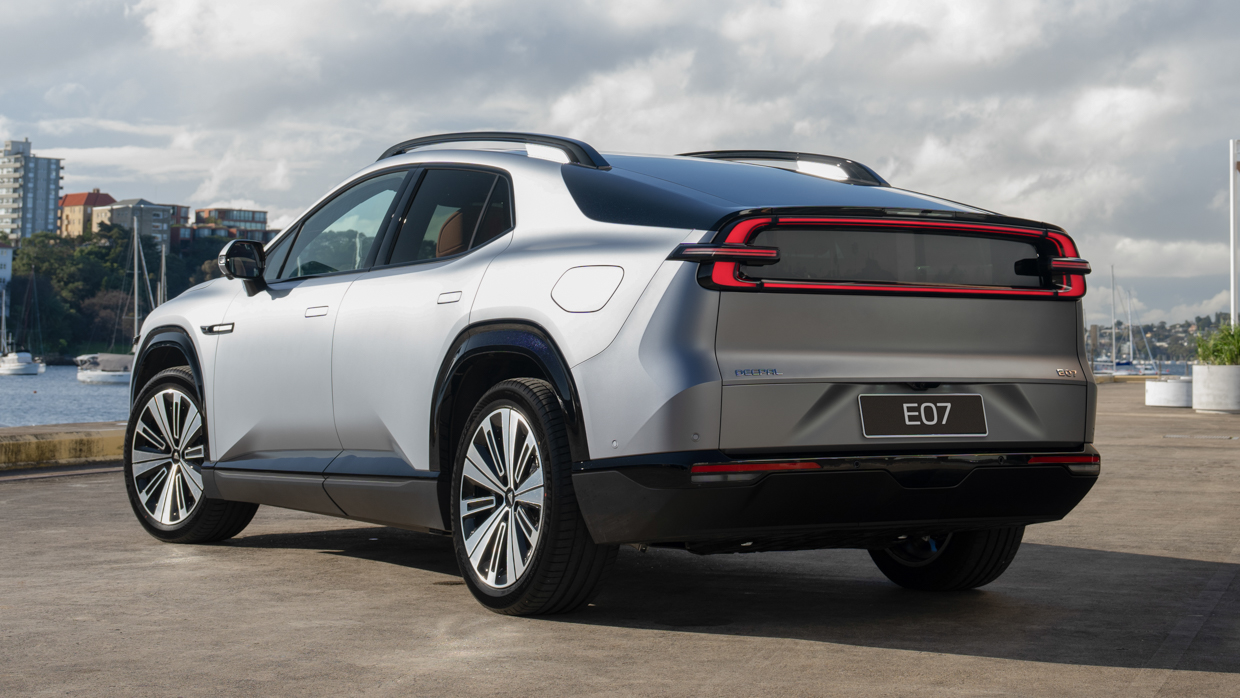
The Deepal E07 is a challenging (in a good way) halo product not unlike the BYD Shark 6, something many new, as-yet unknown brands would kill to have in their showrooms rather than just another blobby Tesla Model Y rival.
Execution may be a little wide of the mark — E07 is an acquired taste to drive, look at and interact with. And a plug-in hybrid powertrain would surely broaden its appeal further.
One thing’s certain, though if Deepal manages to shift even a few hundred of these, it’ll be enough to get people talking about the brand. It’s better than AI slop, then, and the E07’s will be an interesting storyline to follow.
Nissan Ariya 2026 review
1 month ago

Almost four years since it began production, the Nissan Ariya has finally reached Australia, filling an important EV niche in Nissan’s expanding enviro-friendly line-up
Good points
- Well-constructed interior
- Steering and handling consistency
- Evolve’s strong dual-motor performance
- Uncomplicated controls
- Better-than-expected real-world range
- Warranty coverage if dealer serviced
Needs work
- Abrupt ride quality
- Relatively high rear floor
- Noticeable wind noise
- Leisurely charging times
- Tardy acceleration of FWDs
- Lacking a genuine USP
Nissan will always go down in history as the OG OEM for mainstream EVs – even though it wasn’t the first. Its original-generation Leaf (2010-17) was the world’s best-selling electric vehicle for many years and it was essentially classless – driven by both celebrities and grannies alike.
But the second-gen Leaf failed to enjoy the clear air of the first generation – instead engulfed by the Tesla movement and every other new-to-EV manufacturer.
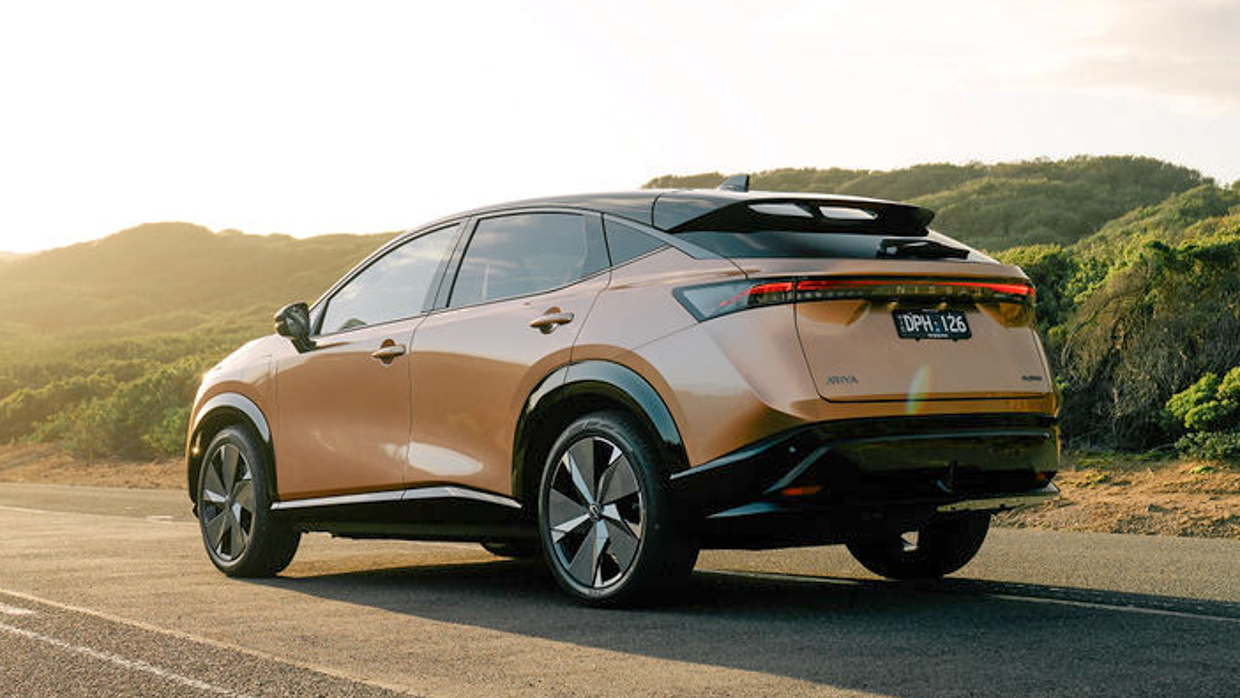
And the introduction of the larger Ariya midsize SUV – revealed way back in July 2020 – became a victim of multiple Covid-related supply issues and didn’t start production until January 2022…
… all of which leads us to the belated September 2025 launch of the Nissan Ariya in Australia, finally filling the EV gap left by the departed second-gen Leaf, but acting as a precursor to the expansion of Nissan’s electric line-up once the all-new Leaf arrives in late-2026.
So it would perhaps be unfair to expect the Nissan Ariya to be at the cutting-edge of EV technology.
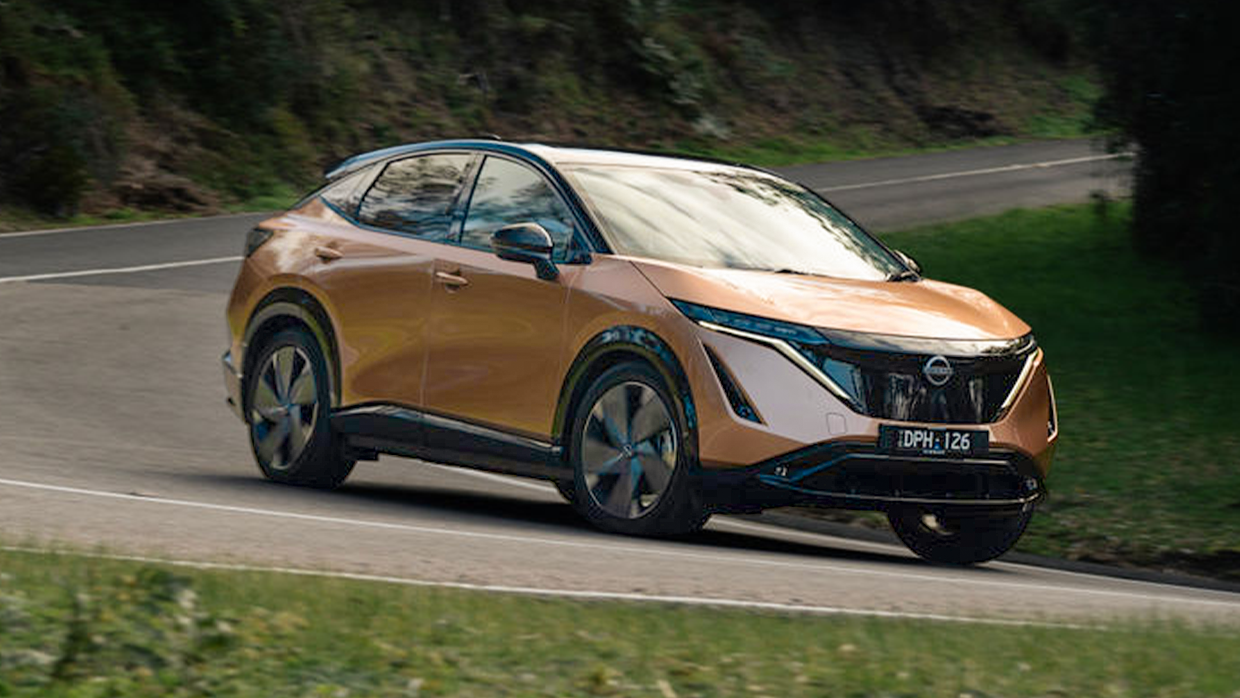
And it isn’t. Unlike cars such as the Polestar 2 liftback, which has been comprehensively upgraded over its five-year lifespan to remain competitive, the Ariya is essentially the same today as it was back in 2022 – though it’s a much better EV than what you might think.
What that comes down to is this – despite the rather anaemic 385km of WLTP range quoted for the cheaper 63kWh Ariya variants (the $55,840 Engage and $59,840 Advance), and the relative age of this now four-year-old car, the Ariya’s real-world range proved substantially better than expected, and likewise its driving ability.
We achieved 557km on test from an 87kWh Advance+ ($63,840 before on-road costs) compared to a quoted WLTP for this bigger-battery FWD of 504km, while in an Evolve e-4orce AWD ($71,840 before on-road costs), we saw 473km real-world compared to 487km WLTP.
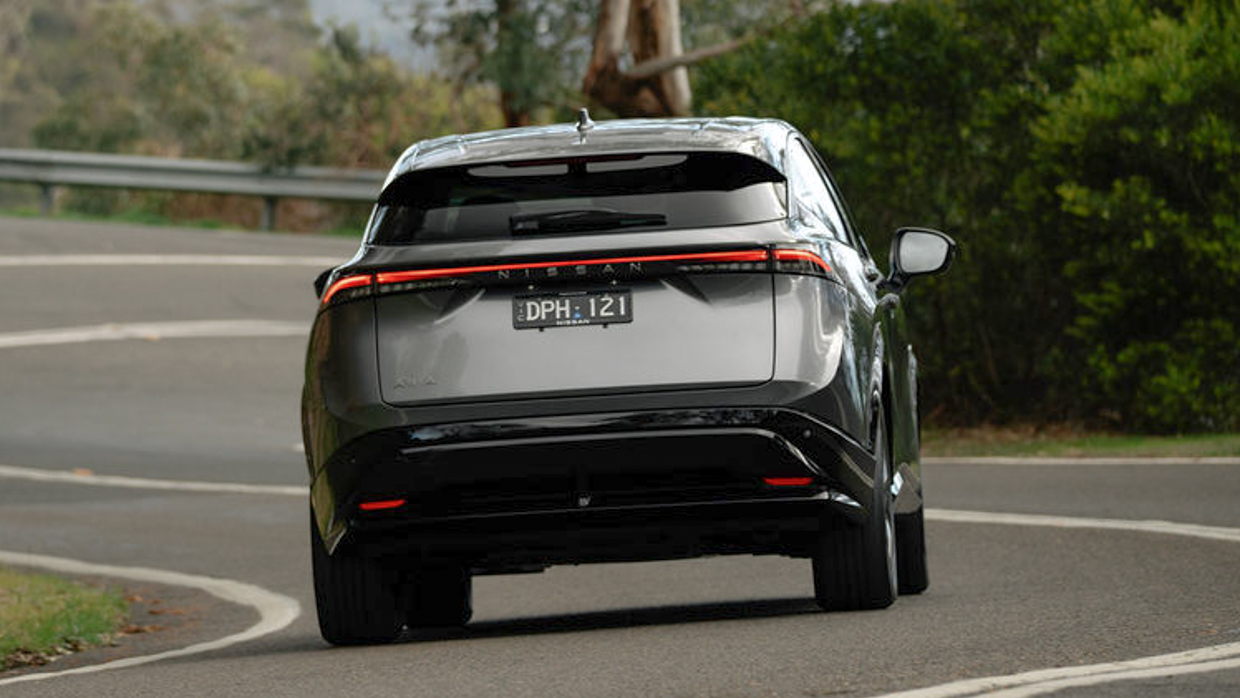
As far as on-the-ground testing goes, those numbers appear to indicate the conservatism of Nissan’s electric range figures.
What won’t change beyond the brochure specs is the relative tardiness of the Ariya’s 10-80 percent charging times – 35mins for the 63kWh and 40mins for the 87kWh, each with a modest maximum DC charging rate of 130kW. Perhaps more than anywhere else, it’s here where the Ariya seems to betray its vintage.
Riding on a dedicated EV platform – originally dubbed CMF-EV but now referred to as AmpR Medium as its debut under the third-generation Leaf approaches – the Ariya’s suspension follows modern best practice with a multi-link independent rear suspension design, though it doesn’t feature adaptive damping.
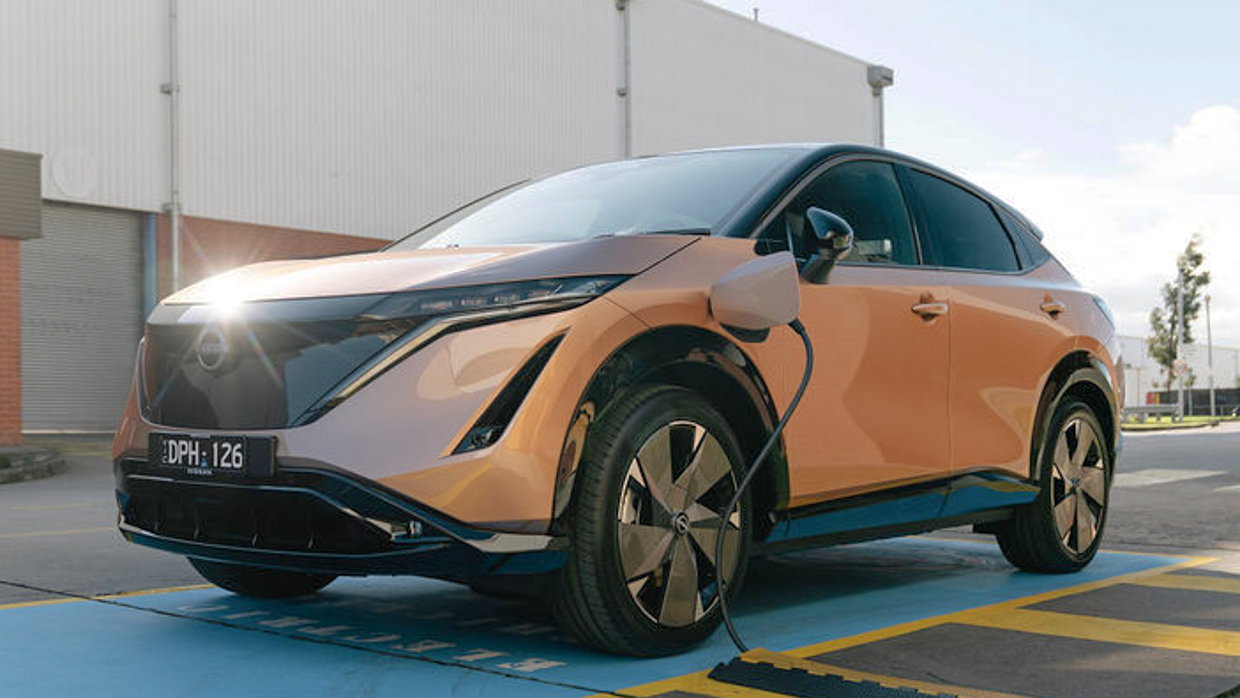
Nissan says the weight distribution of the dual-motor Evolve is 50/50 whereas the single-motor, front-drivers are 52/48, though all variants feel nicely balanced in corners and have a consistency to their steering weighting and response that contrasts starkly with the artificial remoteness and vagueness of many Chinese EVs.
In that area alone, the Ariya feels like a better-developed, more finessed vehicle, combined with a seamlessness when it comes to standing-start acceleration that makes the Ariya much easier to drive smoothly than many of its competitors.
That said, the 178kW/300Nm front-drive Advance+ can feel quite lethargic when planting your right foot at the lights – often ceding acceleration honours to many smaller, less powerful cars.
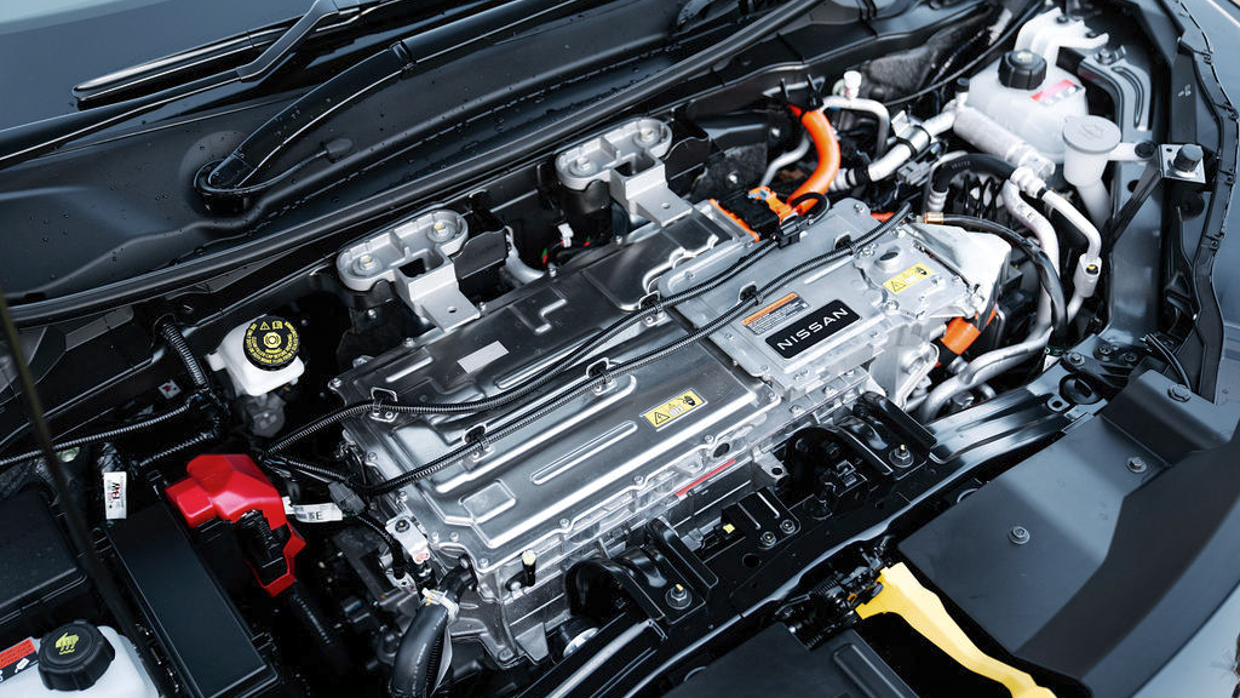
But once up and running, there’s strong response and decent grunt – especially the 290kW/600Nm dual-motor Evolve version which quickly gathers pace and build in an exponential lunge, proving it has plenty of punch up its sleeve.
Where every Ariya variant seems to suffer somewhat is in the area of ride quality. The Ariya is far from alone when it comes to this aspect among EVs but it does detract from its otherwise mostly likeable driving manners.
There’s an abruptness to the way it reacts to bumps, sometimes instigating a bucking motion that it shares with so many other EVs.

You wouldn’t call it comfortable, yet it isn’t uncomfortable either, and the Ariya’s suspension does manage to resist crash-through on larger hits. It’s just that it doesn’t breathe with the road like, say, a Kia EV3. An admittedly smaller but capacious SUV.
The Ariya variants wearing 19-inch wheels (Engage, Advance, Advance+) are marginally less affected than the sportier Evolve on 20s, yet ride quality remains the one area where the Ariya really isn’t great.
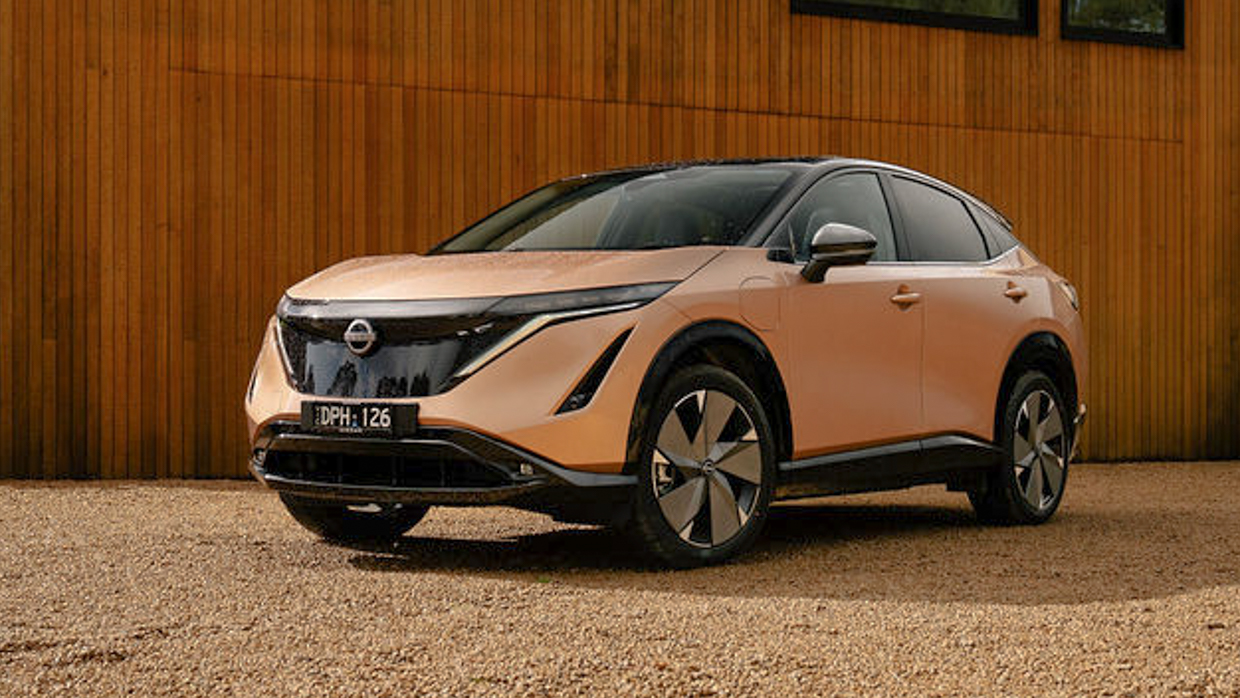
Some may say the same about the styling – slightly bloated, with a side window shape mimicking Stuey’s head from Family Guy, and a rather tall bottom, though Ariya looks better in some colours than others, and offers a standard Aurora Green hue, as well as a rich Blue Pearl, some cool greys (Gun Metallic and Ceramic Grey) and Akatsuki Copper, some with a contrasting black roof section and some without.
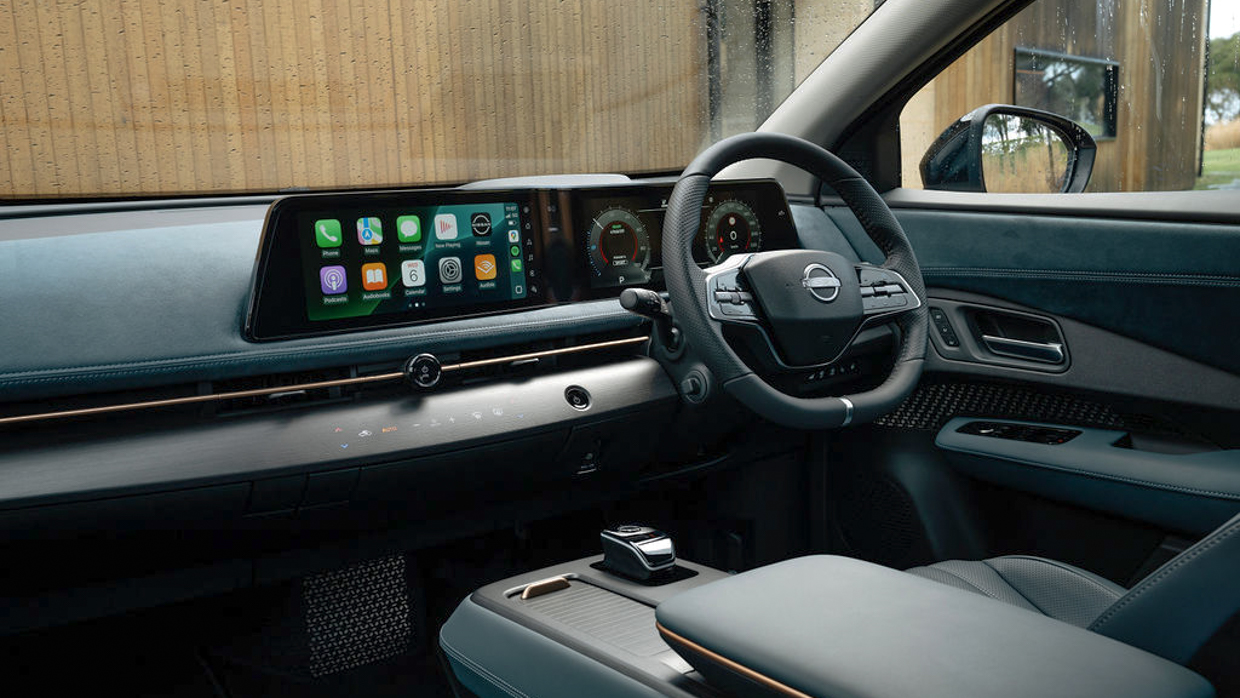
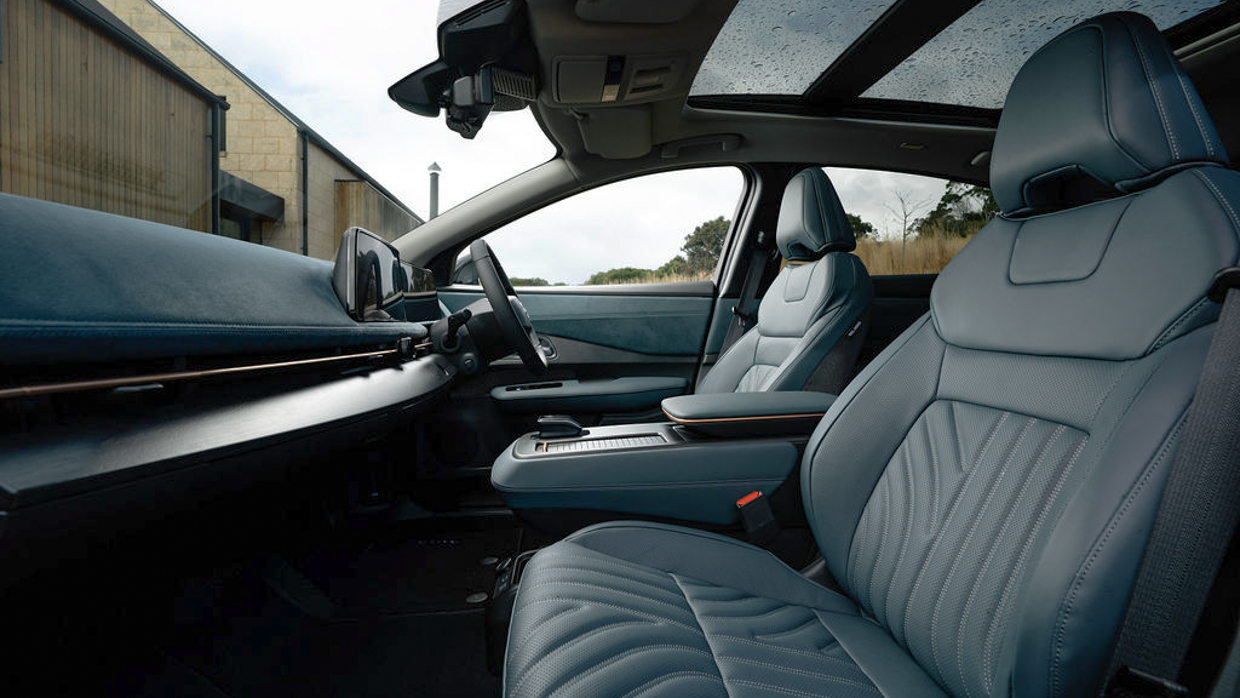
Pictured: the Ariya Evolve
Inside is where the Ariya’s comparative age perhaps works in its favour. There’s a simplicity to its interior design that feels very refreshing after the convoluted, over-designed graphic arrangements perpetrated as ‘technology’ in many EVs.
All active-safety aids are grouped together in the instrument pack and are easily disabled should their effect become intrusive – including steering/lane assist for Nissan’s ‘Pro Pilot’ adaptive cruise.
Both the Ariya Advance+ and Evolve e-4orce feature gutsy 10-speaker Bose stereos, fully electric front buckets with proper under-thigh tilt for both passengers, electrically sliding centre consoles and large opening panoramic glass sunroofs with electric blind as standard.
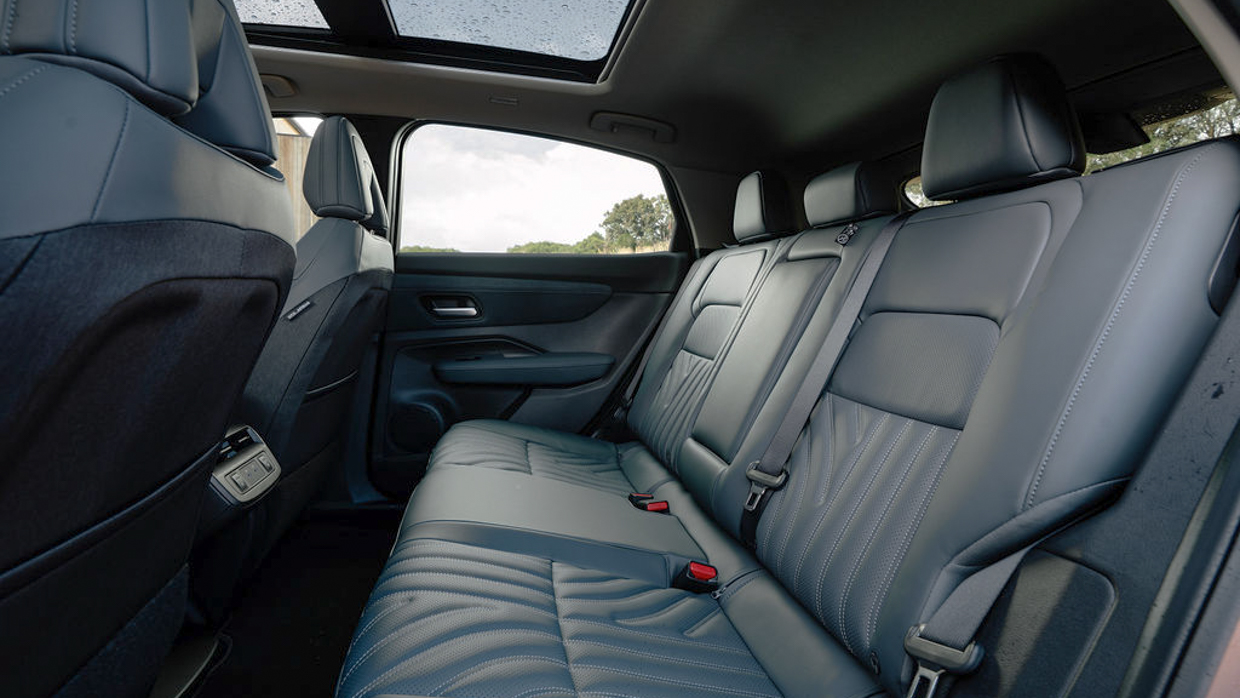
The sunroof limits rear headroom for anyone taller than around 180cm whereas the sliding console alleviates kneeroom for the centre rear passenger, who enjoys uncharacteristic seat comfort.
Rear legroom is decent, bolstered by a fully flat floor like up front, but the rear floor is quite high, meaning a fairly splayed seating position.
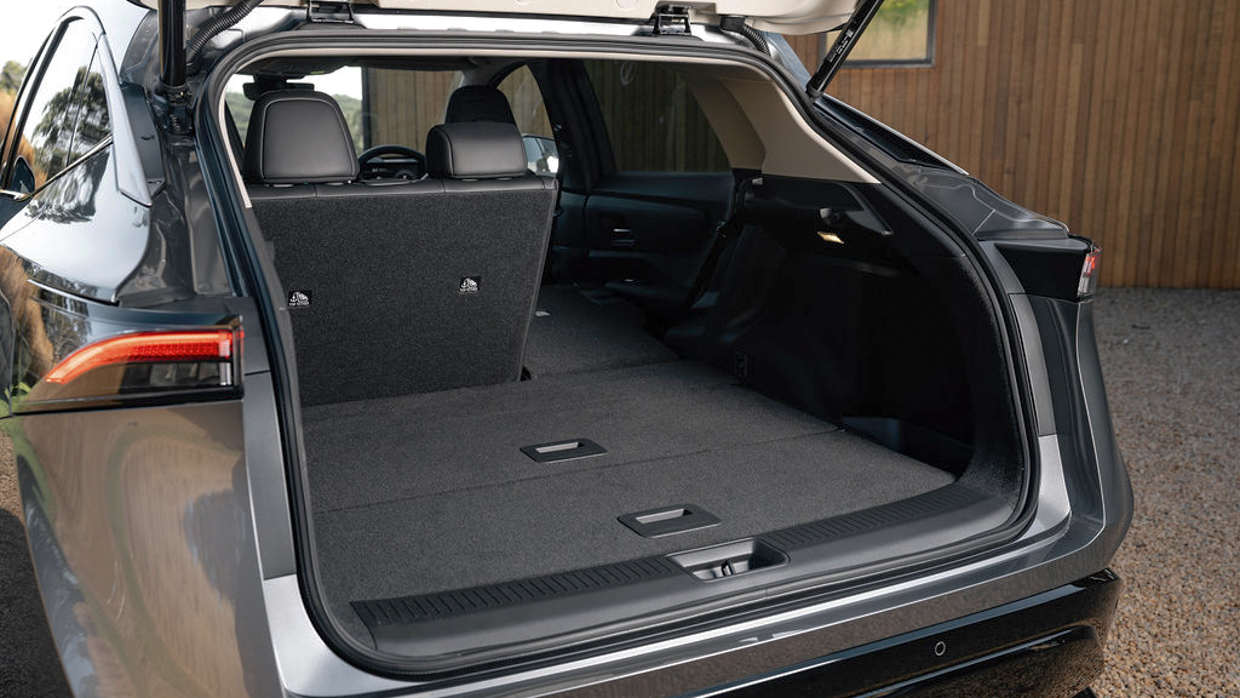
Further back, the boot measures a respectable 466-litres in the front-driven 63kWh and 87kWh models, with the storage area trimmed down to 408-litre in the top-spec AWD model. In another sign of this model’s age, no frunk is available on any Ariya grade.
Best of all, the Ariya Evolve features lovely petrol-blue Nappa leather with stitched patterning, plus swathes of blue suede upholstery spread across its dash and seamlessly through the doors and B-pillar trim.
Combined with electric steering-column adjustment and embedded heating in the windscreen, it gives this range-topper a level of tangible quality and texture.
You can tell the Ariya doesn’t have double-glazed side windows, however, as there’s quite a bit of wind rush at three-figure speeds compared to several newer, more expensive EVs.
So in many ways, the Ariya seems to have aged a bit better than we were expecting. Nissan knows this isn’t a cutting-edge EV in late-2025 but at the same time, it felt the need to flesh out its line-up given the residual good will towards Nissan’s historical association with electric vehicles.
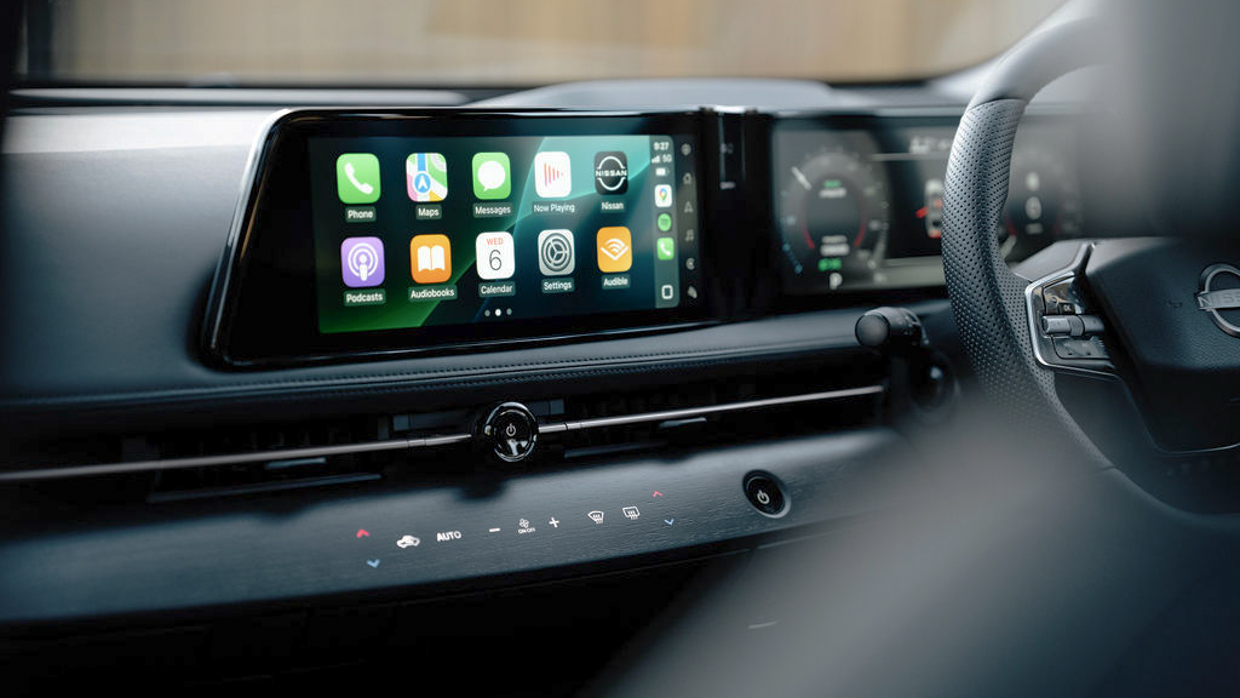
Standard equipment is quite respectable at base Engage level ($55,840), offering 19s with 235/55R19 Bridgestone tyres, cloth trim (with cloth/carpet backings on the height-adjustable front seats), dual 12.3-inch screens, dual-zone climate control, rain-sensing wipers, power-folding heated mirrors, one-touch power windows, sat-nav, digital radio, wireless Apple CarPlay/Android Auto and a full active-safety suite including auto high-beam.
For another $4K, the Advance adds heated cloth/vinyl front seats, heated steering wheel, 360-degree view monitor, hands-free power tailgate, 10-speaker Bose audio, front fogs and privacy glass. Another $4K brings the Advance+ with a bigger battery, Ultrasuede seat inserts, a head-up display, panoramic sunroof, sliding centre console and heated rear seats.
The flagship Evolve ($71,840 before on-road costs) gains all the previously mentioned features plus adaptive driving beam headlights, sequential indicators, intelligent rear-view mirror and an intelligent key with driving-position memory.
Nissan is pushing hard with the coverage it offers Ariya buyers who service within its considerable dealer network, offering a 10-year/300,000km warranty plus 10 years’ roadside assistance.
There’s also servicing capped at $299 a pop for the 12-month/20,000km intervals, meaning a competitive five-year servicing price of $1495.
It’s this level of backing, plus the tangibly useful equipment offered in the Ariya (rather than an over-abundance of tinsel and gadgets) that underscores this competent, likeable, nicely built EV.
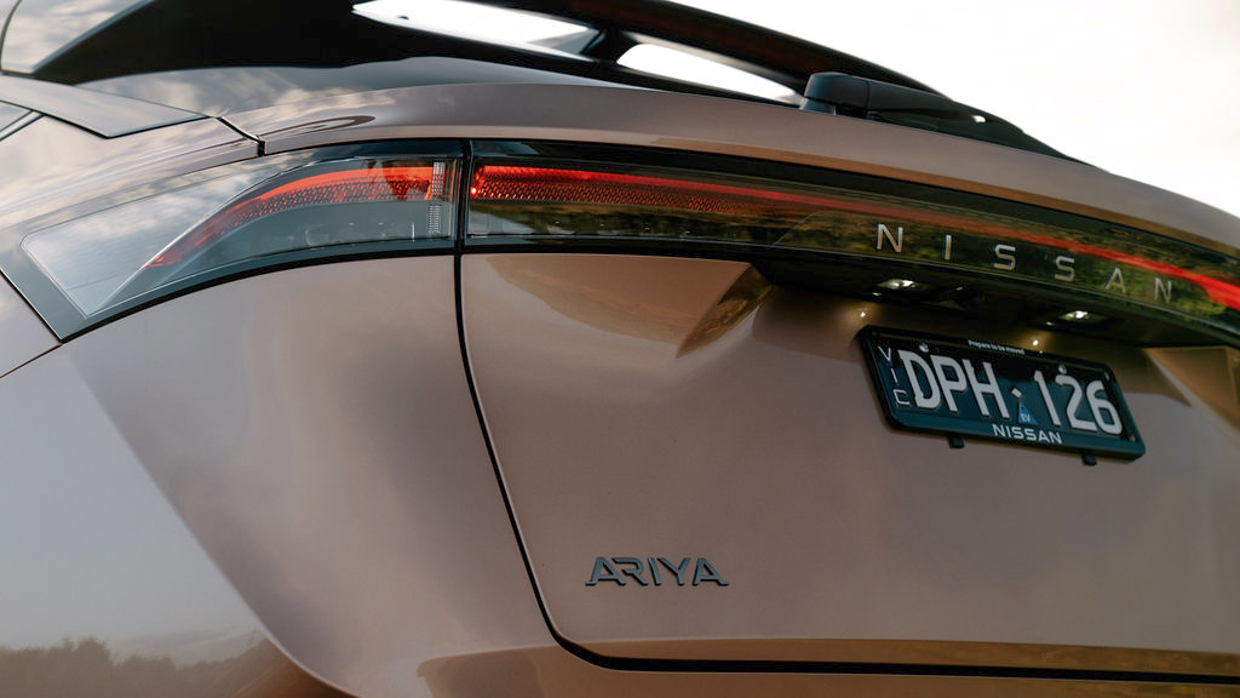
While its on-paper technology stats imply a very middle-of-the-road experience, the reality is somewhat better than that – apart from fairly leisurely charging times.
The thing is, the Nissan Ariya is an inoffensively capable vehicle that does nothing poorly, but also nothing with genuine distinction.
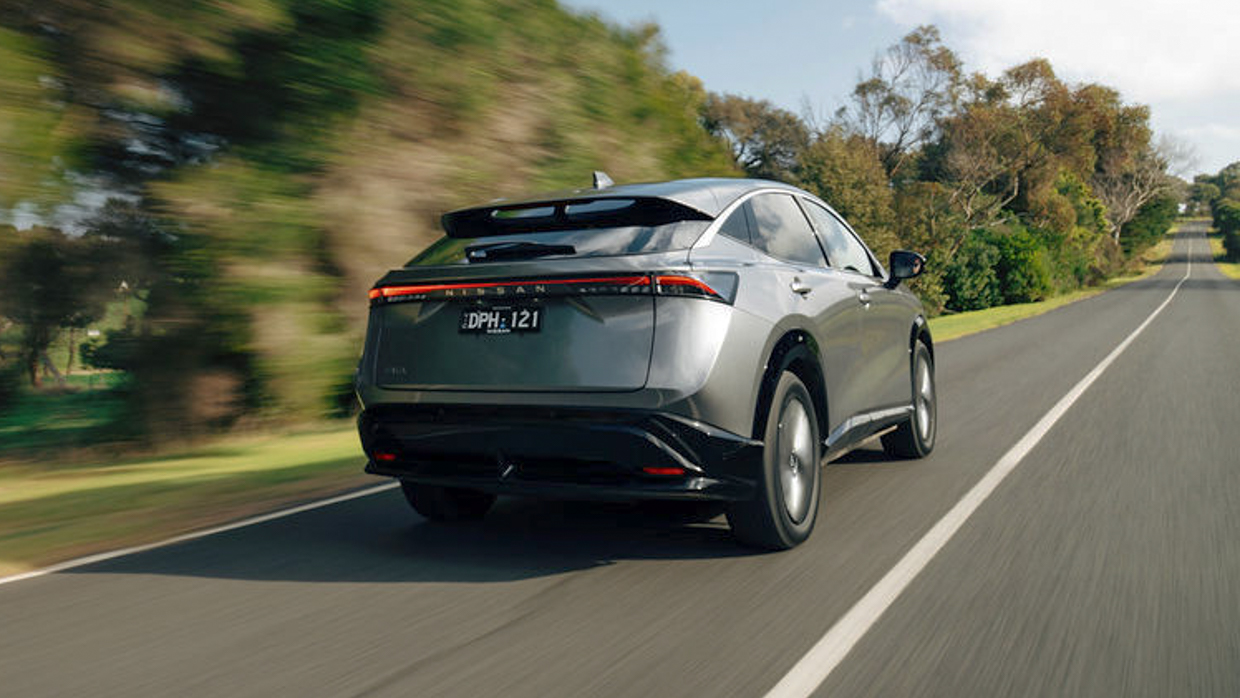
Nissan is expecting to sell several thousand Ariyas in Australia, but even that might be a bit optimistic given medium SUV competition such as the new Zeekr 7X, which is a strikingly handsome, high-tech EV occupying the same price points.
If buyers are persuaded by Nissan’s reassurance of on-going service support and dealer coverage, great.
But it will be these aspects, rather than the excellence of the product, that will push Aussie EV buyers into considering a Nissan Ariya over the swathes of competition.