


The McLaren Senna Is A True Racecar For The Road
The keys to this McLaren Senna, an early factory-owned pre-production unit, came with warnings attached. The sternest came from Bruno Senna, yup, that Senna, who called it the noisiest, rattliest example he’d ever driven. Alongside the carmaker’s generous PR team, he insisted that its build quality wasn’t representative of the 500 customer cars produced. It hasn’t had an easy life either. Having racked up just under 10,000 of the harshest miles a car can cover, including starring in various destructive magazine tests, this Senna needed a complete restoration of its suspension before its sixth birthday.
As the warnings poured in, this car’s allure only grew. Drive opportunities in hypercars are rare enough, but a chance to sample a properly thrashed, high-mile, pre-production unit? That just doesn’t happen.
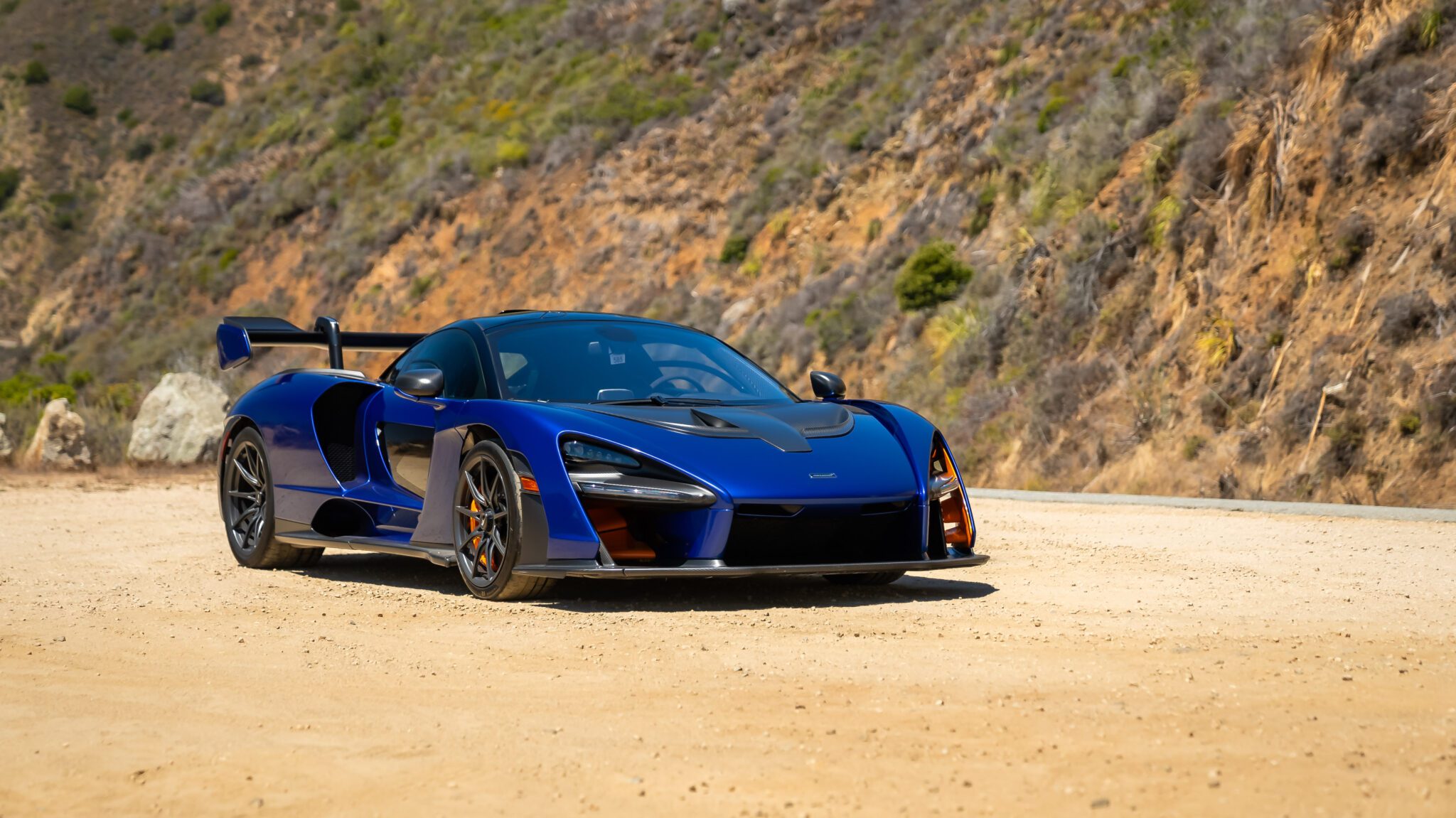
Powered by anticipation, excitement, and a dash of anxiety, I walked into the garage of the Portola Hotel in Monterey Bay, where the MSO Kyanos Blue Senna sat. It was the peak of Car Week, and a dozen young car spotters wielding supercar-hungry cameras swarmed the awaiting McLaren. This easy-to-sneak-into multi-level structure is famous for the metal it houses during this famed week in August. And alongside its low cost of entry, it’s one of few places you’ll find a Lamborghini Countach flanked by a Bugatti Veyron and a Mercedes-Benz 300 SL.
Cameras rolling, I fired up the McLaren’s 4.0-liter twin-turbo V8, engaged the front lift, and exited the crowded garage. Special attention was paid to save its nose. Accidentally creating a well-documented viral moment would make for an embarrassing start, but that’s the reality of driving a Senna during Car Week. From the moment I turned onto the streets of Monterey in search of the Pacific Coast Highway, I can’t recall an instance when I wasn’t being filmed or photographed. Car spotters would crowd crosswalks to get the perfect shot, capturing what I’m sure are flattering shots of me fiddling with this car’s antiquated but still usable navigation system. Too bad Apple Carplay wasn’t widely adopted back in 2018.
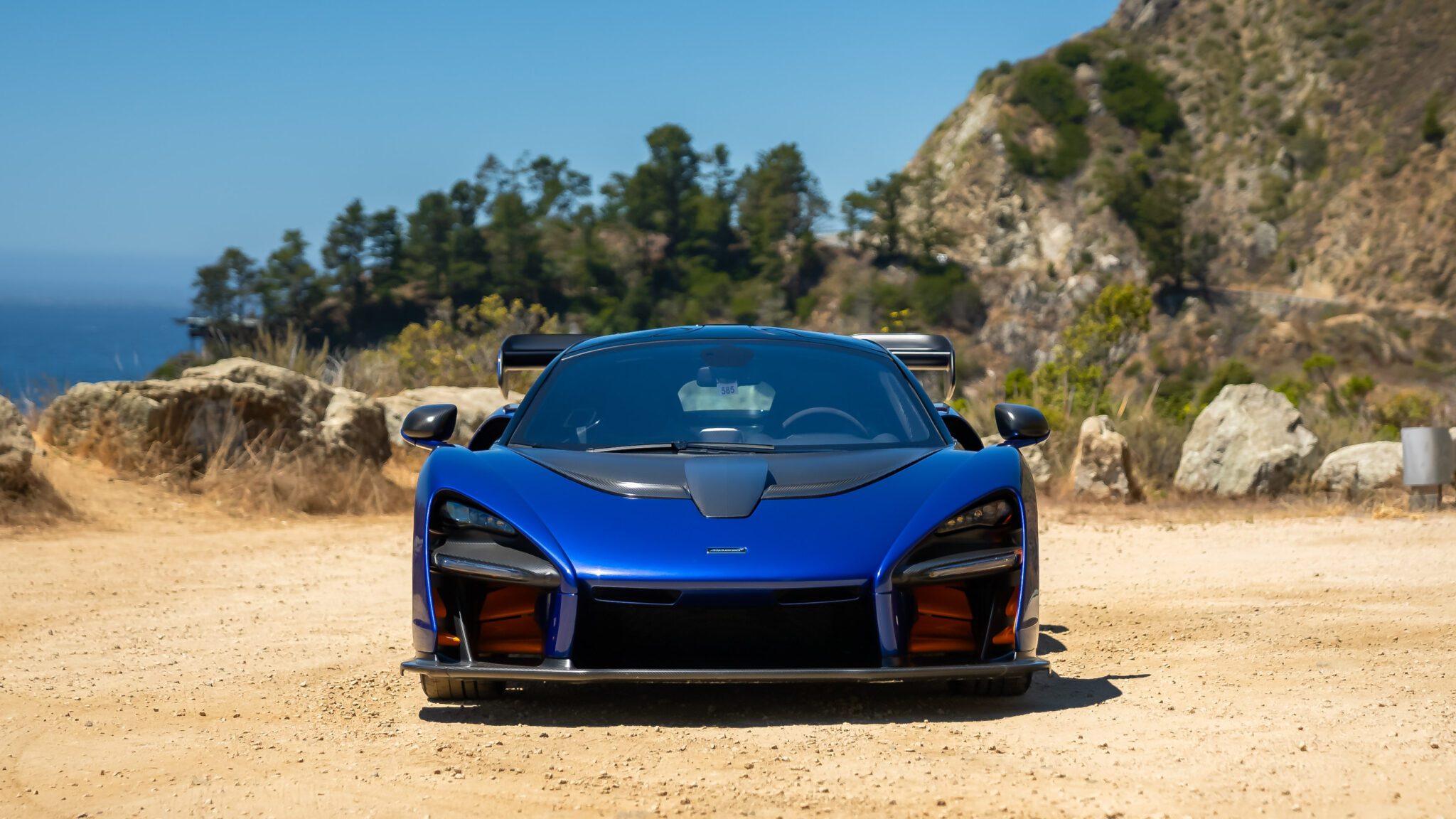
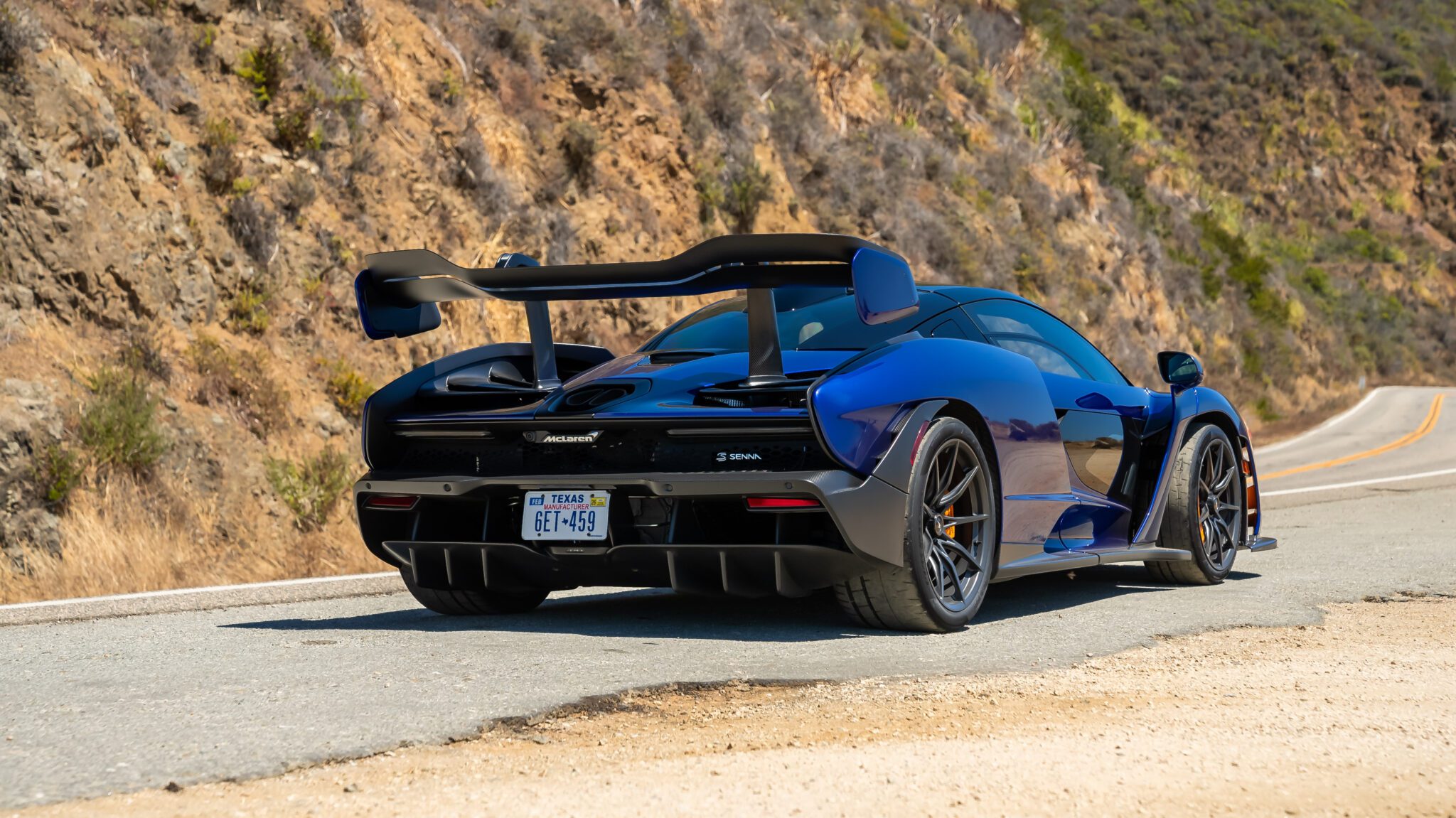
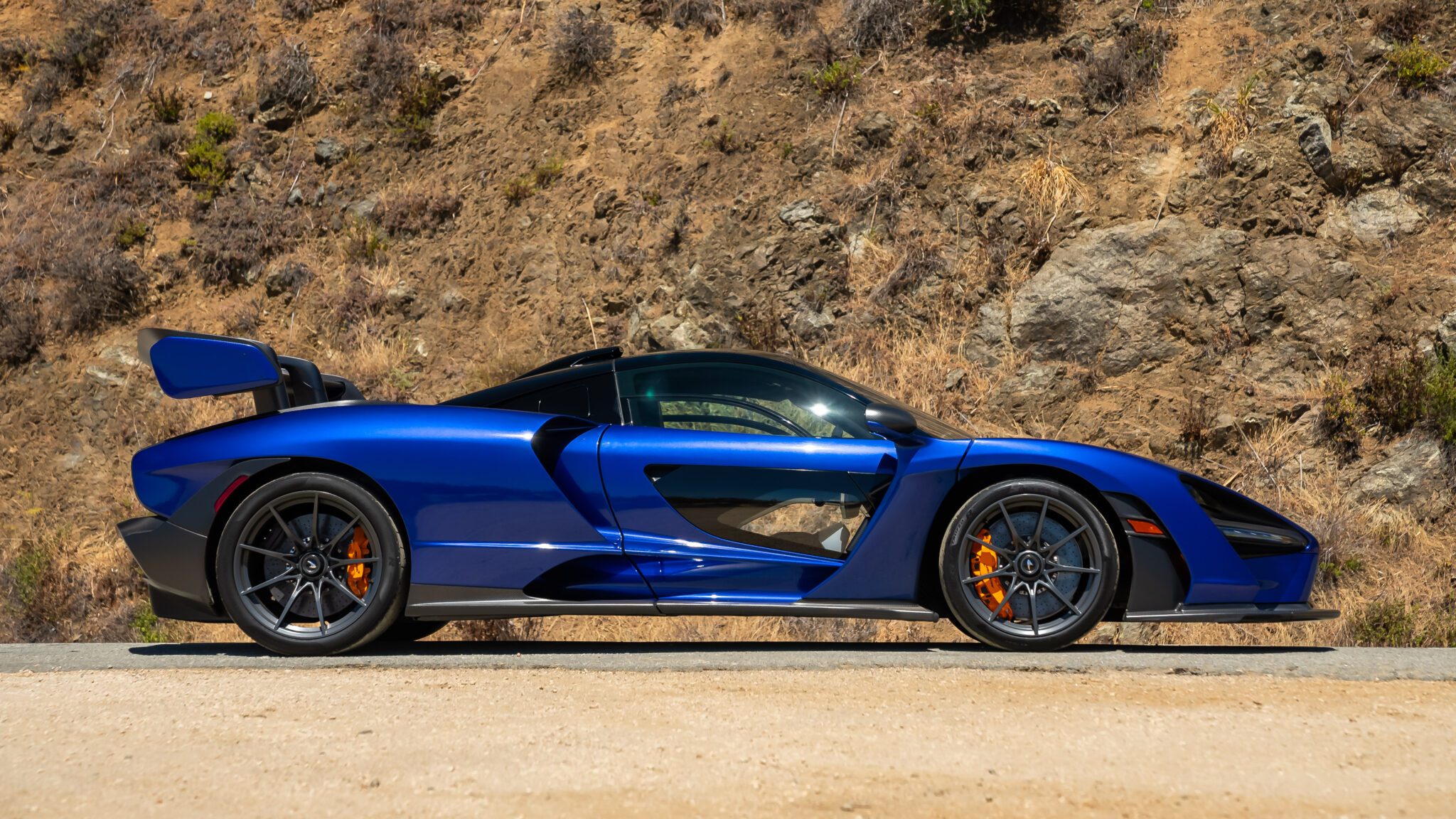
Despite the outpouring of attention, the Senna doesn’t stop traffic because it looks good. It is the clearest example of a car that prioritizes function over form, with its purposeful design generating a feeling of shock and awe. It’s a car you gaze upon with disbelief that it even exists. Yet, that McLaren successfully federalized it for sale in the US remains a tremendous feat. While cars like the Aston Martin Valkyrie and the Mercedes-AMG One arguably outdo it in terms of motorsport theatrics, they’ll have to cross the Atlantic under the “Show or Display” exemption. Years after the Senna’s 2017 debut, no fully US-legal road car is as dedicated to extremes.
Turning onto the Pacific Coast Highway, adorned by endlessly winding pavement, towering cliffs, and stunning ocean views, is usually a terrible idea during Car Week. A strong police presence, confused tourists piloting overpriced rentals, and easily annoyed locals make finding a road clear enough to exercise a car like the McLaren Senna a true challenge. Luckily, or technically unluckily, intense storms damaged sections of Highway 1, triggering its closure about 40 miles south of Carmel. With high hopes that a road to nowhere would provide enough open space, I pointed the Senna’s nose towards the coast.
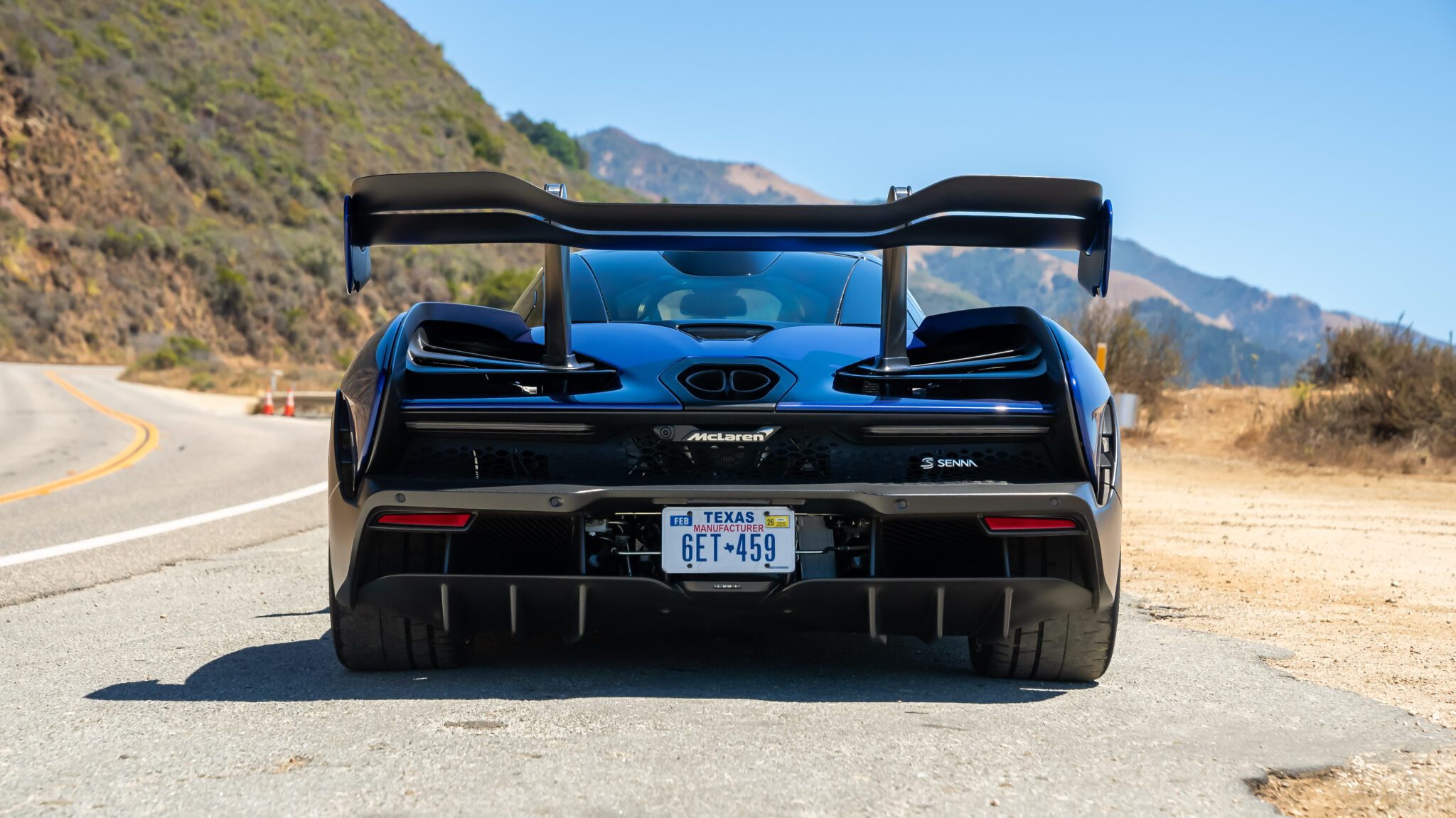
Immediately, I hit traffic, with my average speed dropping to what felt like a crawl. Unexpectedly, however, the McLaren Senna was unaffected by the slowed pace. Riding on a modified version of the carbon monocoque that underpins the 720S, the Senna also incorporates updated versions of its seven-speed dual-clutch automatic and its twin-turbocharged 4.0-liter V8, just boosted to 789 horsepower and 590 pound-feet of torque. As such, it doesn’t struggle in slow-moving traffic, shifting seamlessly in automatic mode with its dampers remaining relatively compliant in their softest setting.
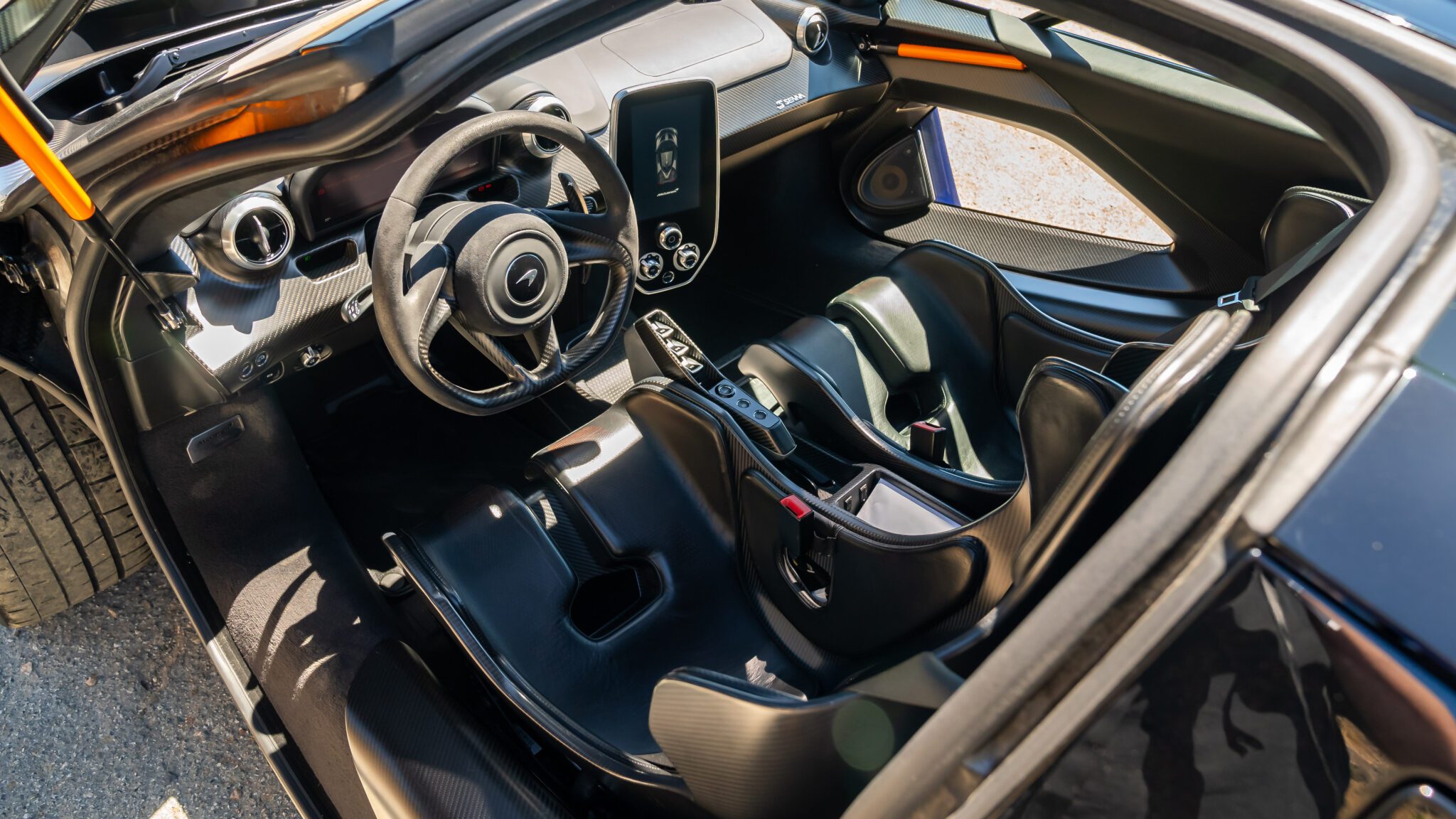
In the Senna, it’s easy to settle into what seems like an entirely normal driving experience until it’s suddenly not. Try to lower a window, and you’ll encounter an opening large enough to fit a postcard. Oh, and the switch that operates it is now on the roof, as is the start button and the door release.
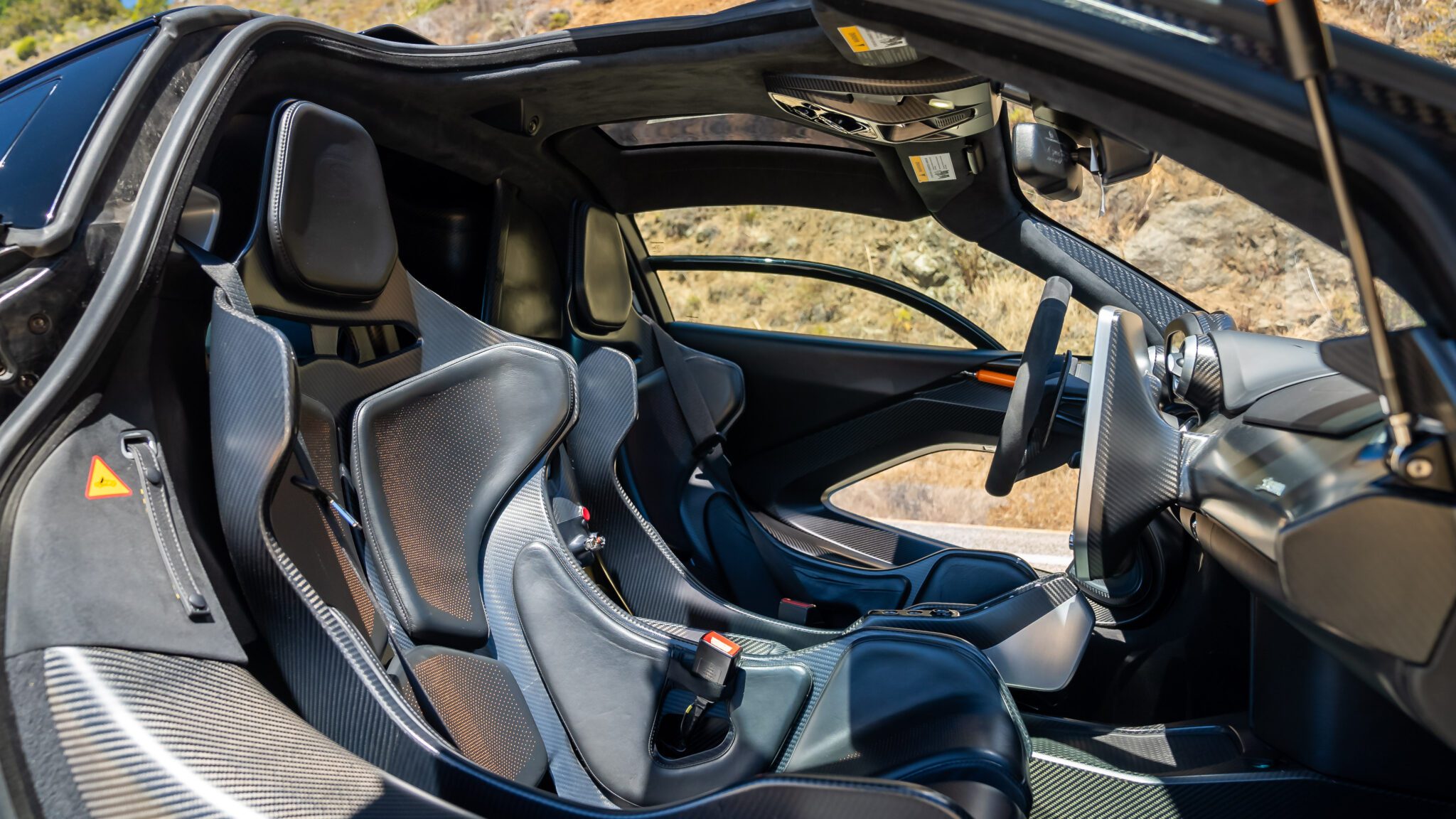
Glance out the side view mirror, and you’ll see its enormous rear wing making adjustments on the fly. Looking out the rear window feels akin to peering through a peephole, although you get yet another clear view of the massive spoiler. Even admiring the Pacific becomes an unusual experience as you can catch glimpses through the traditional side-view windows up top and the extra piece of glass in its door below.
There are constant reminders that you’re piloting something special. Be it the cabin, the stares of passers-by, or that split second when you catch a glimpse of its extreme design reflected off another car. Click down through a few gears, however, and the experience takes yet another turn. Passing what felt like, and what Waze indicated, was the last CHP officer on the route, I switched its powertrain and suspension settings into Sport.
This McLaren Senna, which had up until this point, played the role of grand tourer, suddenly awoke in anger. The graphics of its digital instrument cluster morphed to display a large tachometer and a prominent gear indicator while its dampers stiffened considerably. I could instantly feel more road vibrations permeating through the cabin and, crucially, my fixed-back seat.
No longer confined to lower revs, the Senna’s exhaust note doubled in volume almost instantly, with a high-pitched buzz absent in all other McLarens. Of all the advice Bruno Senna gave me ahead of this afternoon, wearing earplugs was one I mistakenly ignored. He mentioned that the production cars were far quieter. Still, I hadn’t anticipated how loud this pre-production unit would be. Thankfully, the song emanating from its large twin pipes wasn’t just louder; it retained an exciting, raspy tone, which made punishing my eardrums worthwhile.
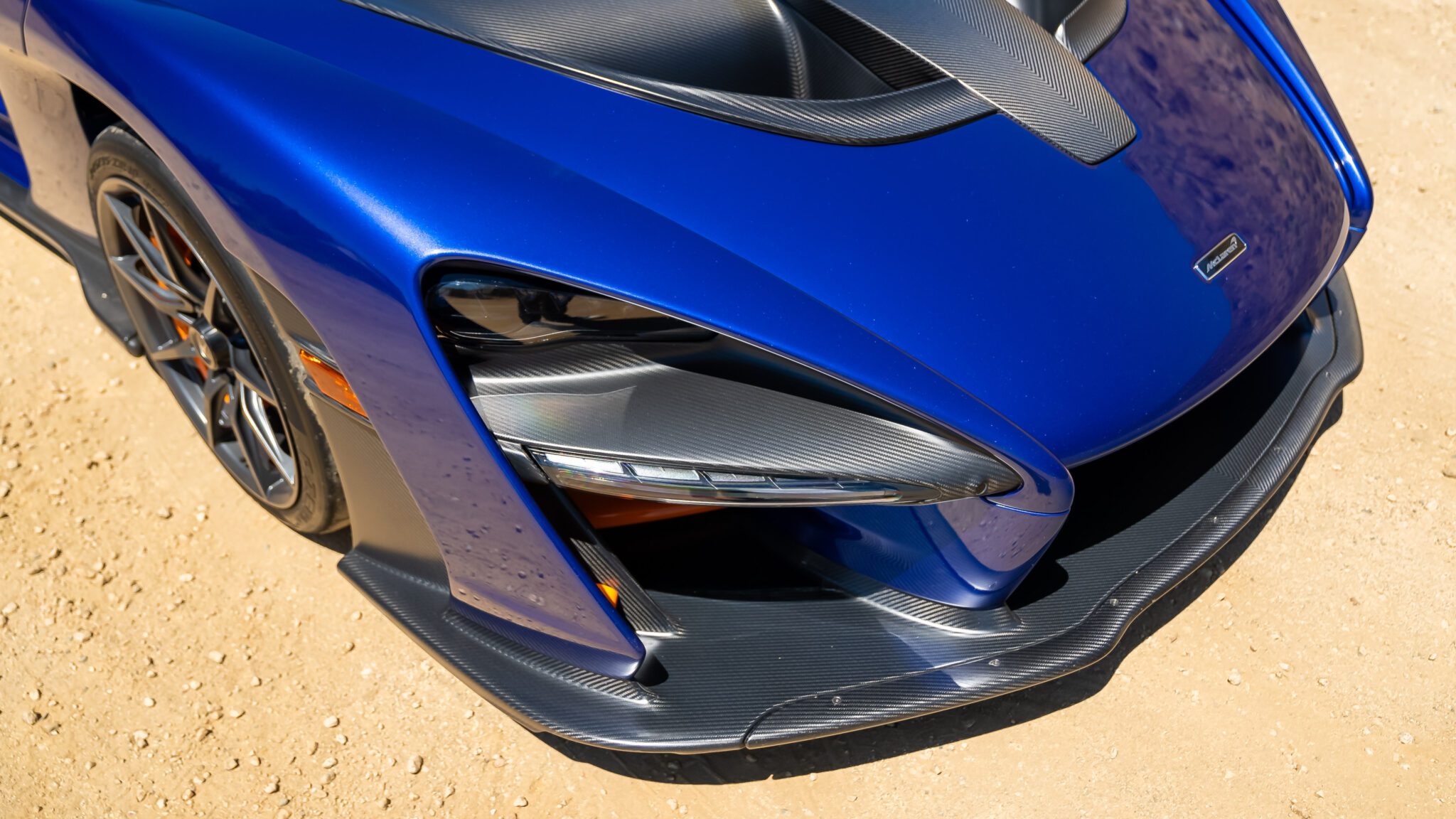
On paper, I can understand how the McLaren Senna might come across as a re-bodied 720S given all the parts sharing, but diving into the first bend at speed revealed it’s anything but. There’s an immediacy to the response you get from its front end that I’ve never felt before. It changes direction instantly without hesitation, its steering feeling almost telepathically quick. Its electro-hydraulic setup transmits every last road feature with near-constant feedback, even while resting on center.
Chaining some switchbacks reveals a feeling of masslessness you can’t fake with wider tires and firm suspension, a gift of this car’s 2,641-pound curb weight. It pays further dividends when you lean into the throttle between corners and it just picks up speed instantly as long as you avoid the turbo lag present at lower revs. Cresting a small hill provided a clear view of the road ahead. My impromptu road trip south had finally paid off, and I couldn’t see another car ahead for what must have been a mile. Assuming such an opening wouldn’t repeat itself, I dialed to track mode and went for it.
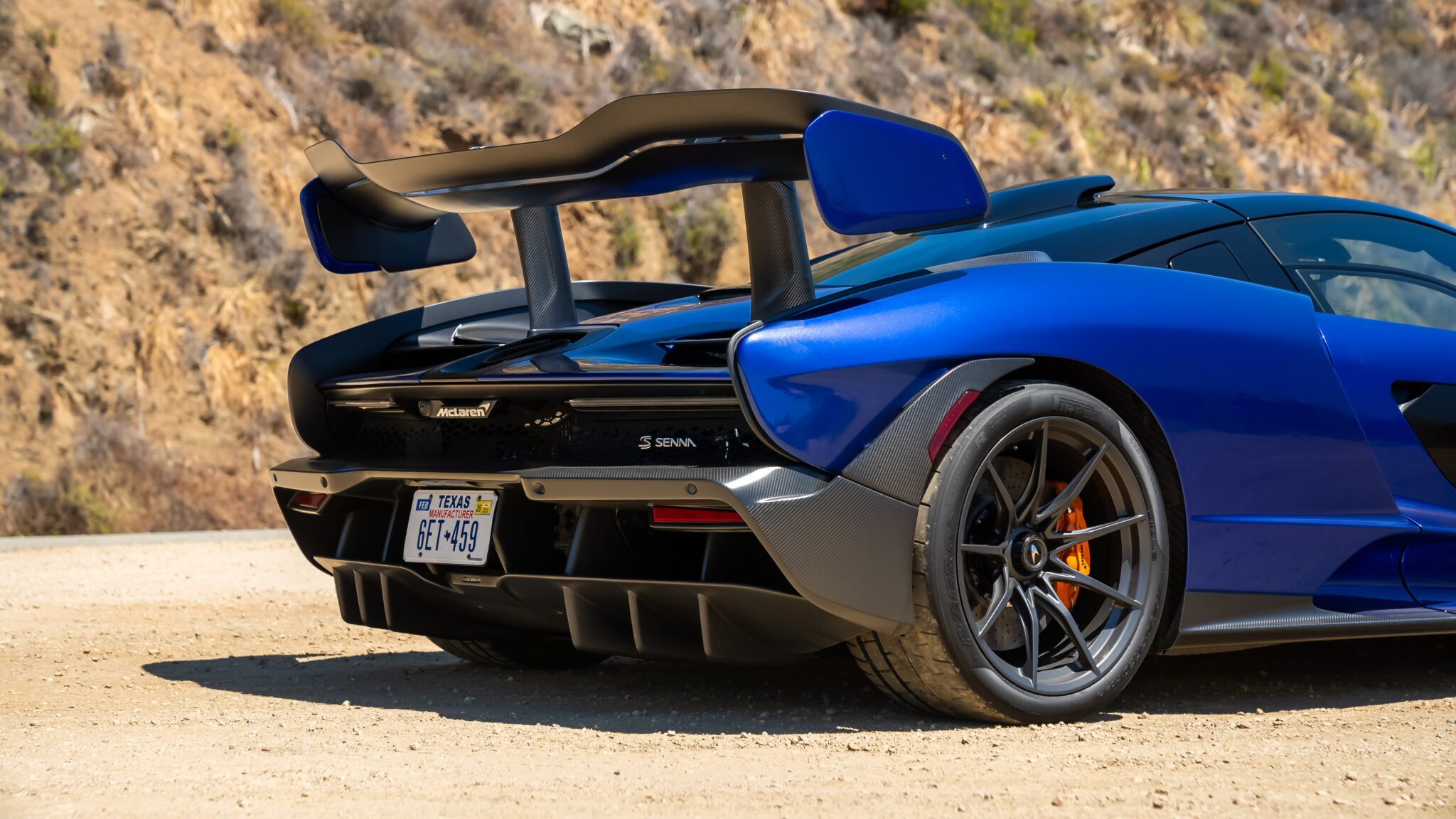
As in the 720S, the Senna’s digital cluster swiveled, revealing a small slit-like display showing the selected gear, engine revs, and current speed. The grip levels were unlike anything else I’ve experienced before. It’s undramatic in how confidently it sticks to the road with no added noise from its tires, just lateral forces embedding your torso into the leather seat pads. With each passing bend, its powerful carbon ceramics, quick front end, and grippy rubbers invited me to brake and turn later. Yet, as I did, the Senna never lost its composure, just picking up quicker corner speeds.
I’d love to tell you that the jump from Sport to Track was transformational, but even on one of the greatest roads in the country, accessing that highest level of speed simply isn’t possible outsie of a proper circuit. As enjoyable and confidence-inspiring as the McLaren Senna is to hustle up an empty mountain road, there’s an unshakable sense that you’ll reach your limits far before it does. Knowing when to back off, I found a turnout just ahead of the closure and pointed the Senna’s nose back to Monterey.
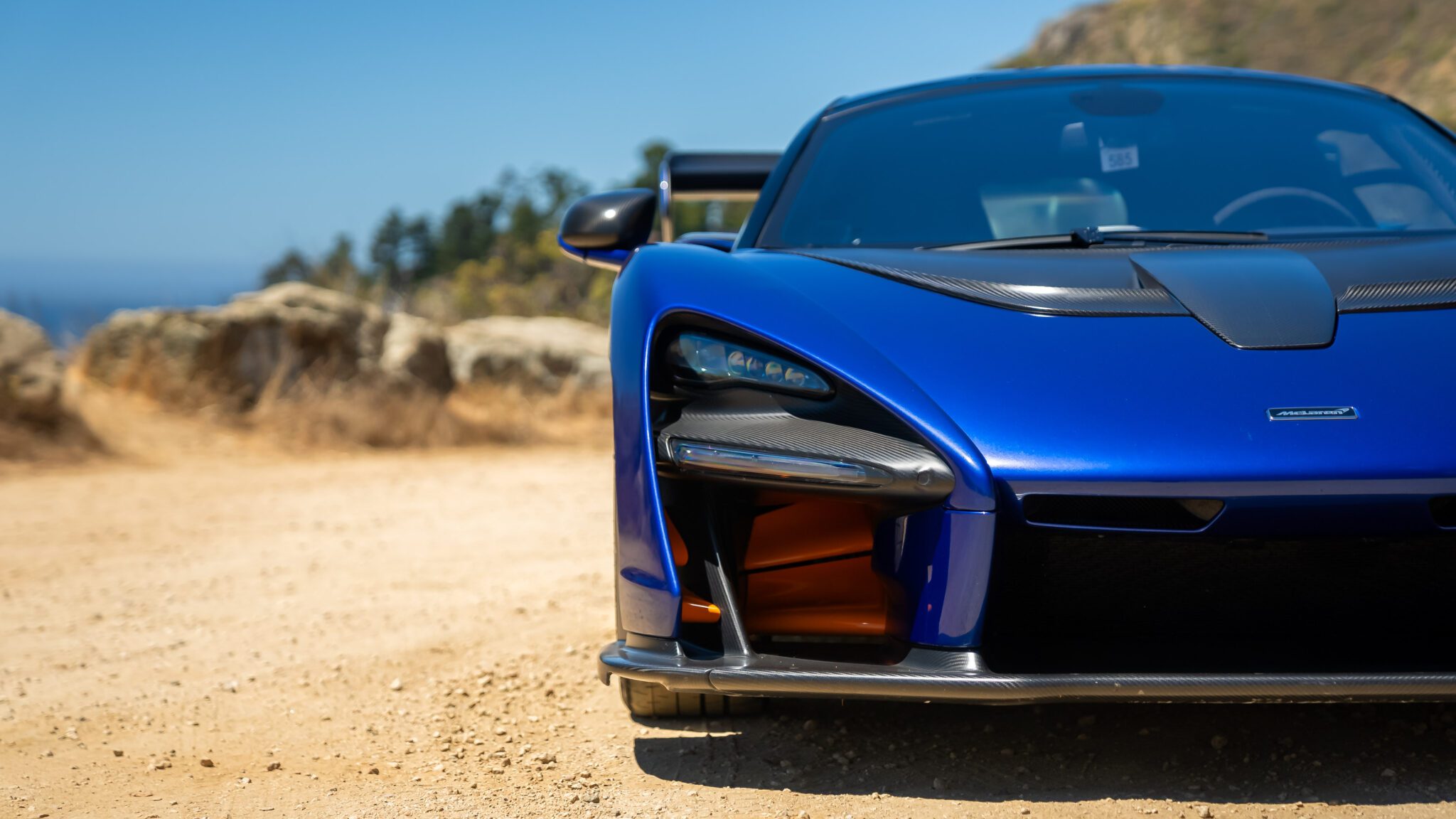
As part of McLaren’s Ultimate Series, this car carried a $958,966 base price when new, making it a seven-figure proposition once options were factored in. And despite not producing a million horsepower, this plants it firmly within the illusive hypercar category. A space dedicated to the cars that aren’t just quickest, although the Senna’s 2.8-second run to 60 mph and 211 mph top speed are nothing to scoff at, but those that deliver an experience most supercars can’t.
In this context, the McLaren Senna represents not just the best the carmaker could do in 2017 but a pivotal moment for its segment. This year’s Monterey Car Week saw multiple automakers that commonly reside in the seven-figure space, including new entrants, focus on more than just outright speed. With the arrival of electric super and hypercars in the interim making on-paper stats practically superfluous, there’s a renewed focus on the driving experience. The people who can have anything have spoken, and they want memorable drives.
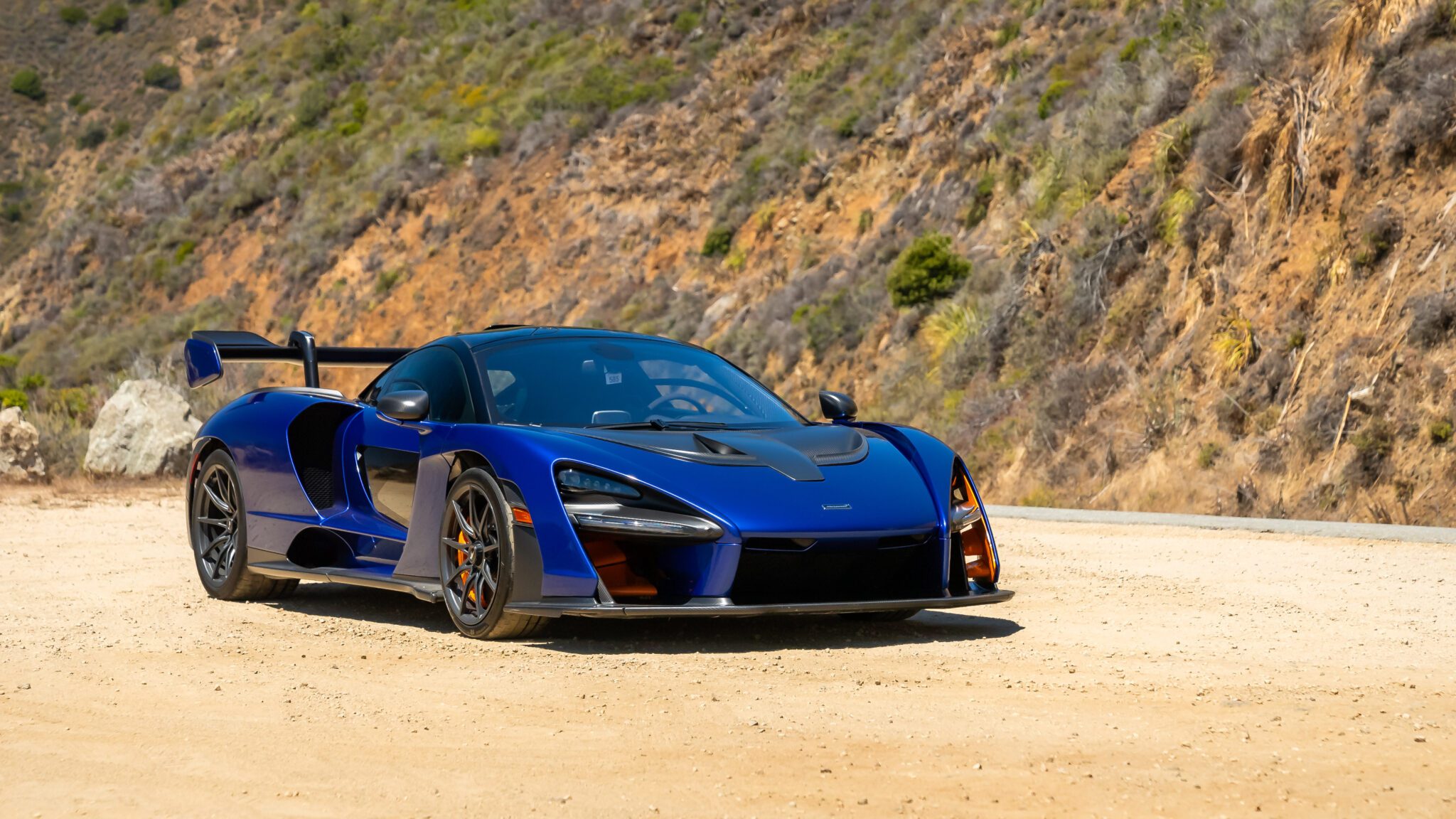
Viewed through this lens, the Senna was, in retrospect, ahead of its time. Even when new, it didn’t have the most horsepower or the quickest in a straight line. Instead, it takes the concept of the racecar for the road and focuses it to offer a memorable experience. From the moment its massive door opens, or its enormous wing adjusts into position, the Senna fills any space it inhabits with theater. What makes it unique, however, is that you don’t have to necessarily drive it to experience what makes it so special.
The spotters I first encountered, the kids that diligently stalked the Portola’s parking lot, had it right all along. Despite sitting in rarified air, the Senna stands as undeniably unique. It’s the kind of car you’re forced to admire, even if you’re not doing so for its looks. Years on, nothing on the road looks like it, and as it turns out, its strength remains that few cars can match the thrills it provides.
Tags: Featured
Review: The 2024 Cadillac CT4-V Blackwing
Agile handling, a svelte footprint, and a manual transmission add some much-needed tactility to the current sporty sedan formula.
by Gabriel Vega
in Reviews
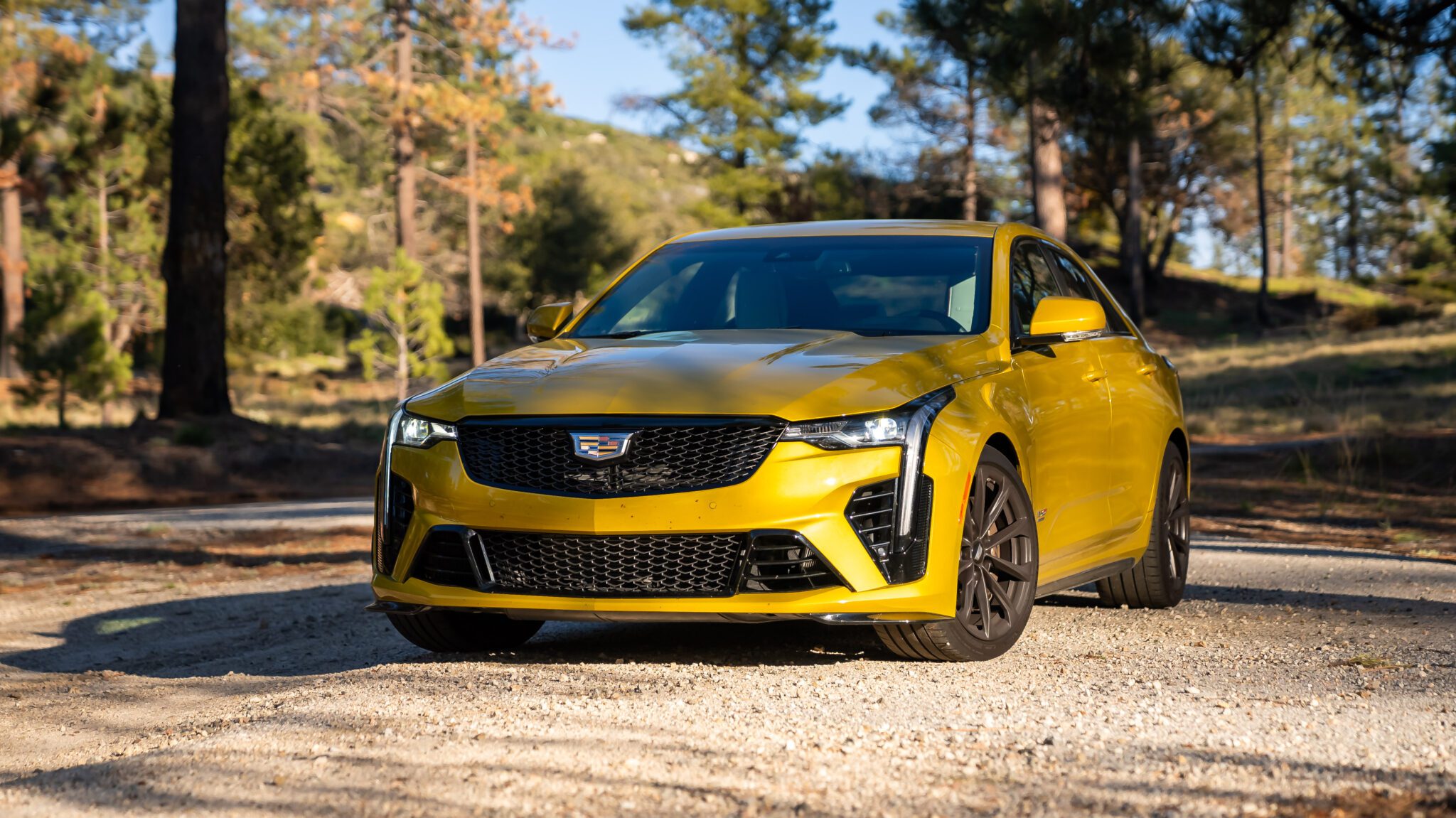
The early 2000s just about cemented BMW as the top dog in the modern luxury sporty sedan niche. Rivals like the all-wheel-drive Audi RS4 or the hilariously brutish Mercedes-AMG C63 offered differing takes on what a sports sedan could be, but neither could quite dance like Bavaria’s best on a back road. It all comes down to BMW’s ironclad formula, blending a potent engine, a manual transmission, power flowing through the rear wheels, and, crucially, sports car-like handling.
It’s a recipe that has netted BMW not just industry-beating sales numbers but coveted real estate in the minds of enthusiasts. How are other automakers to compete? Cars like the 2024 Cadillac CT4-V Blackwing offer a compelling counterpoint. Its familiar recipe incorporates a 474-horsepower twin-turbo V6 with a manual transmission sending power to the back wheels. However, it does so while sporting a smaller footprint, more traditionally elegant styling, and a much lower starting price. Is the Blackwing appealing enough to lure a few diehards away from the reigning champ?
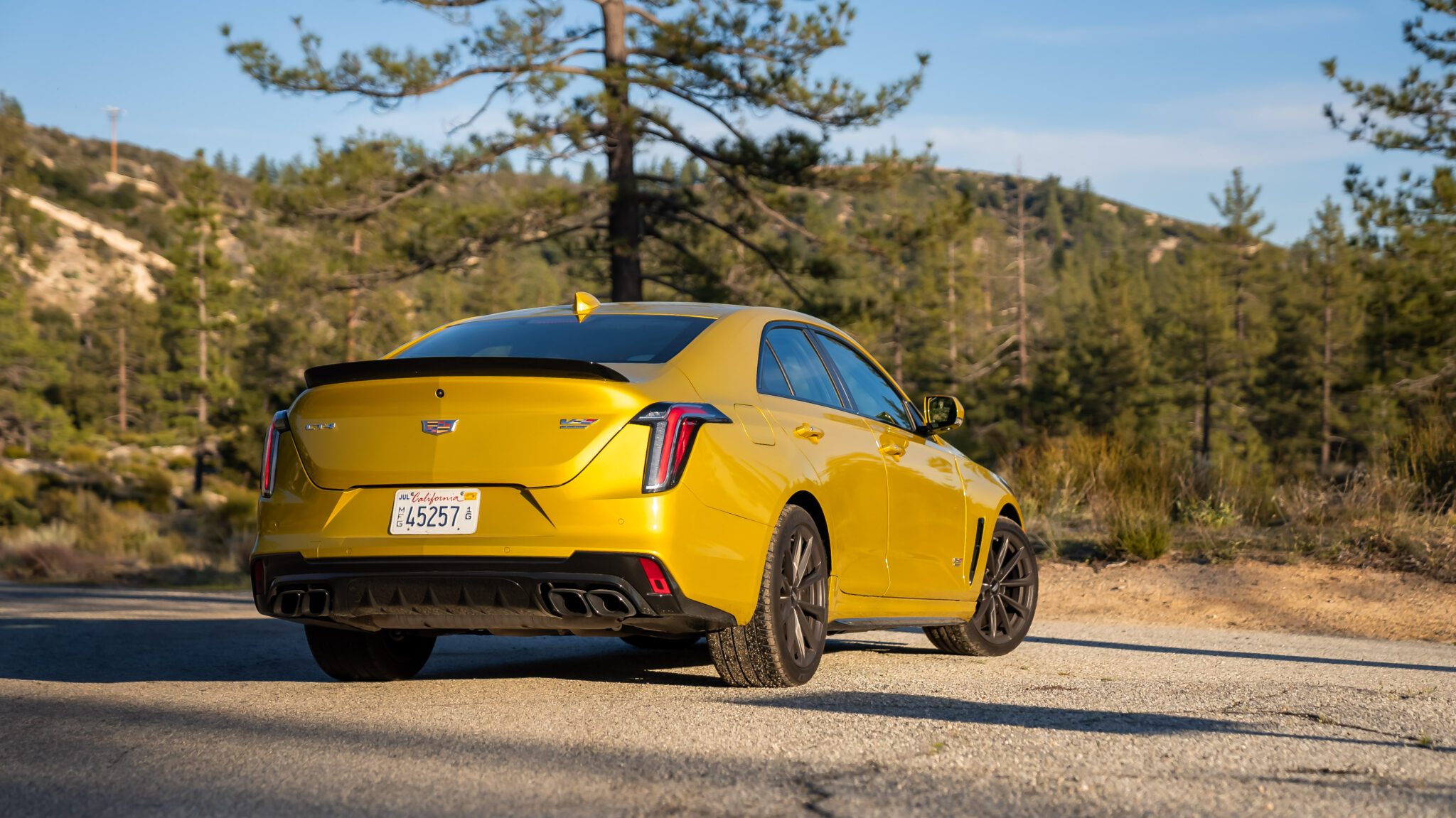
It’s worth taking a moment to clarify which version of the CT4 we’re talking about. The key word here is “Blackwing.” That’s how you know you’re looking at the sportiest variant of Cadillac’s 3-Series fighter, as the existence of a mid-tier CT4-V adds a bit of confusion. Within the carmaker’s lineup, the CT4-V Blackwing sits just below the CT5-V Blackwing, its 5-Series rival, allowing the American brand to go toe to toe with the German rival it seeks to dethrone.
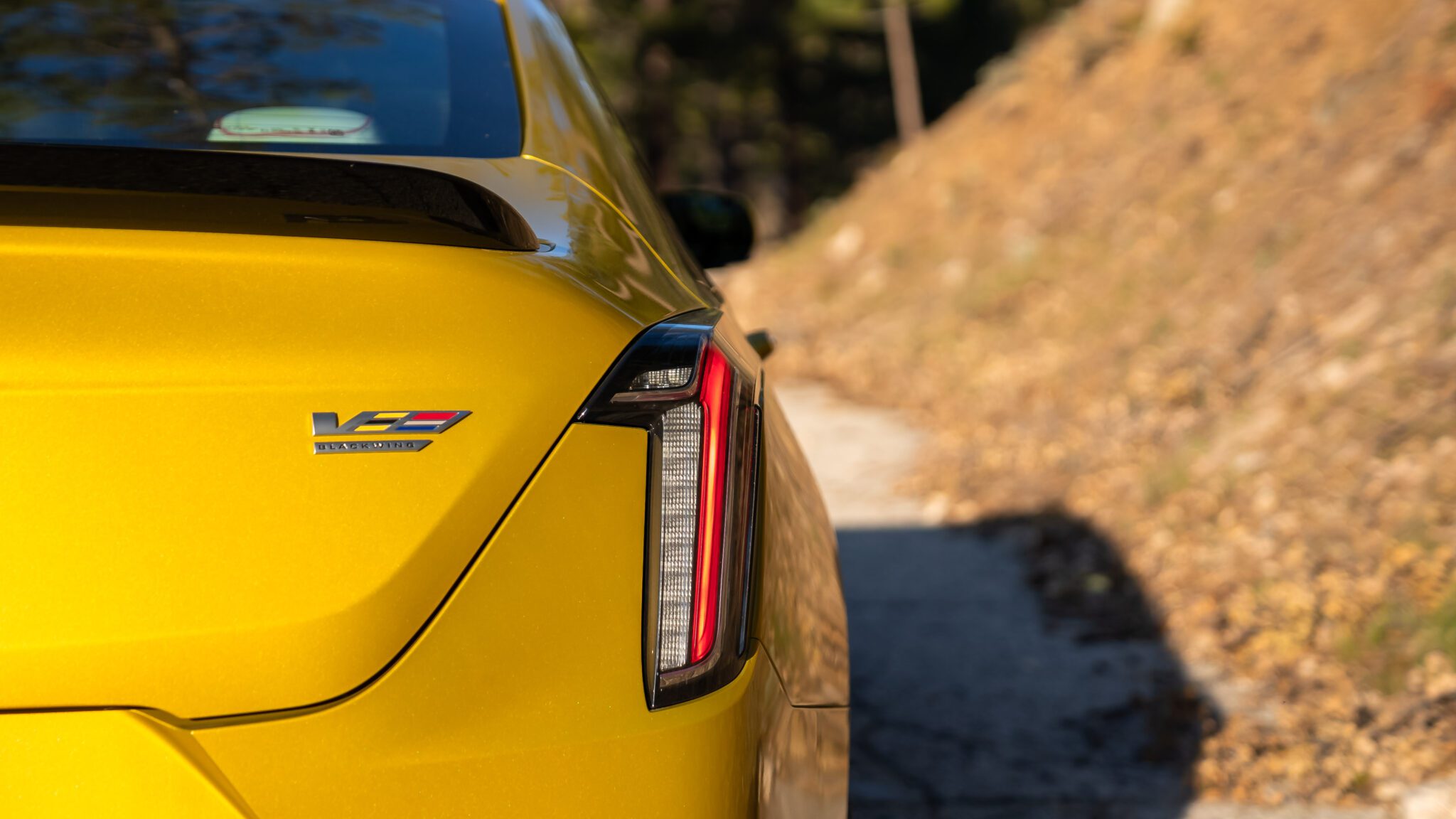
Ignore my tester’s Cyber Yellow Metallic paint for a moment, and you’ll spot more than a few goodies that separate this Blackwing from its pedestrian siblings. Up front, it sports an extended front splitter, a restyled bumper, and gloss black trim throughout. These follow a set of extended side skirts that lead onto a widened rear diffuser housing a set of quad exhaust tips. An extended lid spoiler rounds out the list of changes.
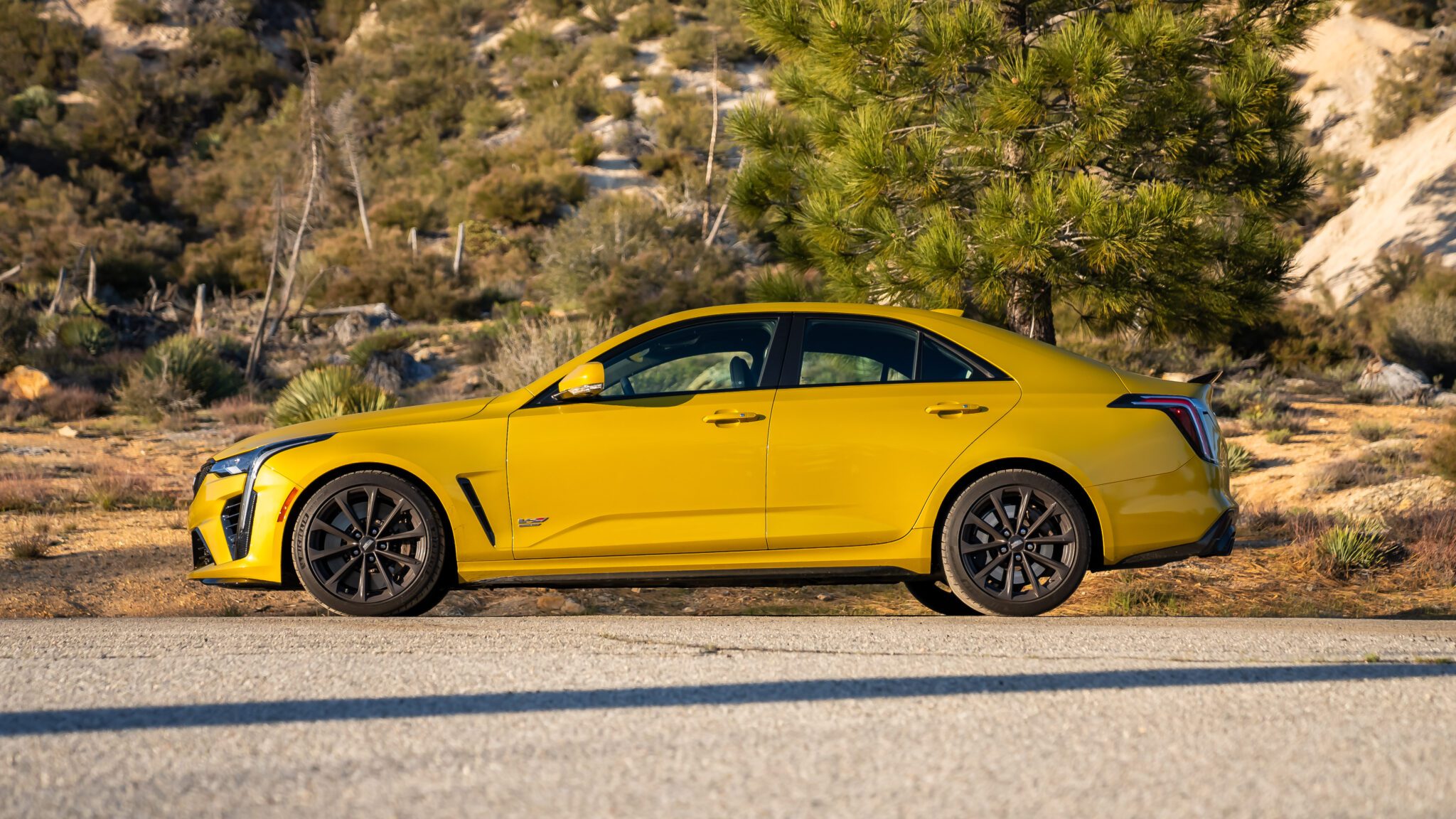
Compared to its German rival, however, what stands out most is how much smaller the Cadillac CT4-V Blackwing is. While it weighs about as much as the M3 (around 3,800 pounds), the Caddy shrinks two inches in length, three in width, and one in height. A few inches may not sound like much, but they contribute significantly to the Blackwing coming across as a considerably smaller machine, visually and from behind the wheel. Considering how swollen the reigning champ has become, this is a major plus.
Point its nose towards a twisty back road and the CT4-V will continue to make its case. As you pick up your pace, the Blackwing comes alive with plenty of feedback through its chassis and steering, which, along with a very knotchy shifter, immediately immerse you in the experience. The twin-turbocharged 3.6-liter V6 that powers it, despite producing a healthy 472 hp and 445 pound-feet of torque output, is somewhat muted and often fades to the background. Even with the V’s exhaust flaps open, we get a relatively conventional high-pitched note you’d expect from a 90-degree V6, but nothing exceptional.
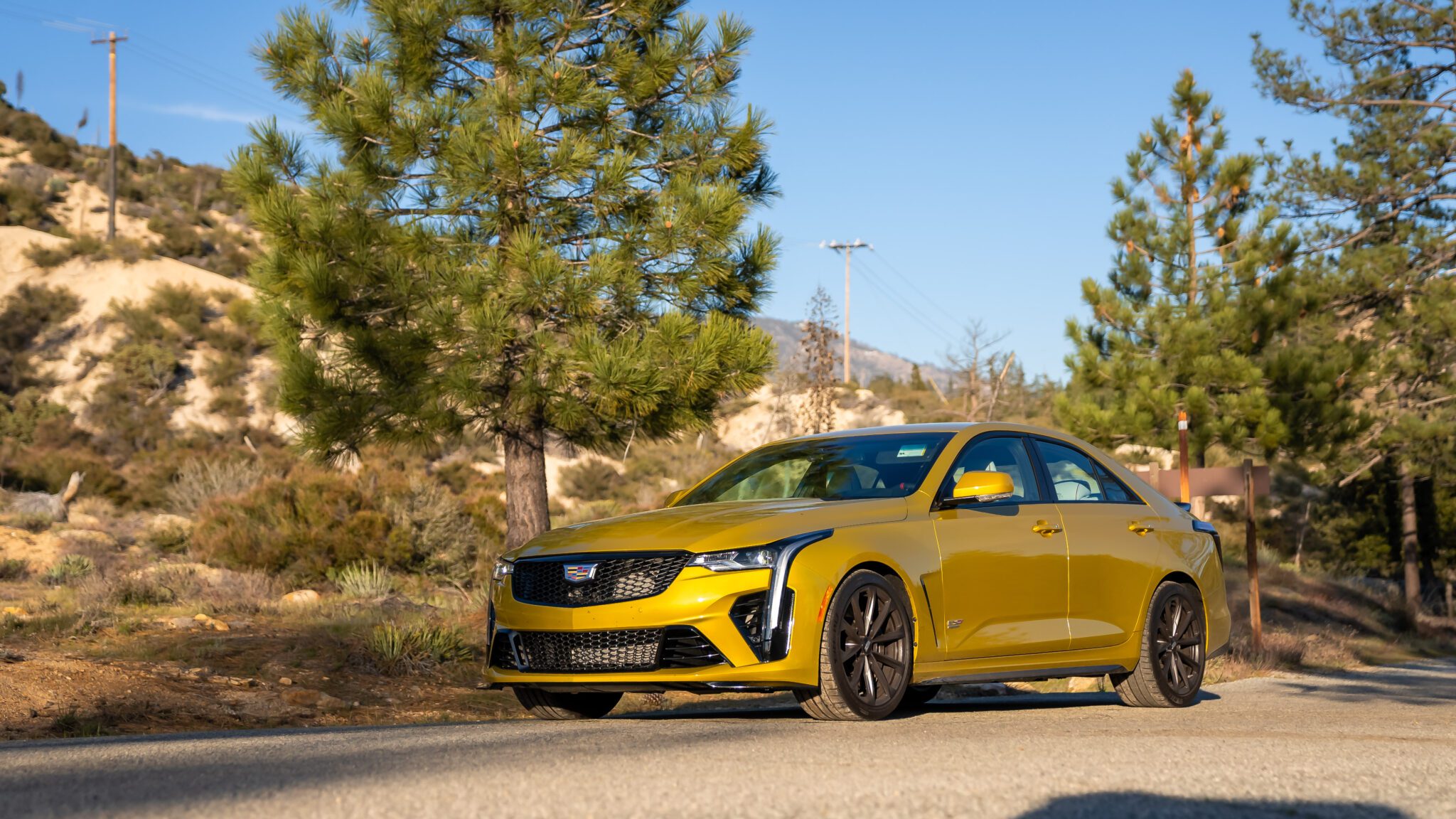
What is noteworthy, however, is just how sporty the Cadillac CT4-V Blackwing feels despite its attempts to double as a luxury car. We have its adaptive suspension with magnetic ride control to thank for this. Soft enough for long highway cruises but firm and stable enough on a back road, the Blackwing is a versatility and suspension tuning masterclass. Add a quick front end and you end up with an agile and lively back-road machine.
Its 18-inch wheels, although small by modern standards, are significantly lighter than, say, a set of 20s that have become so ubiquitous. By keeping its unsprung mass as low as possible, the CT4-V does an excellent job hiding its hefty curb weight and changing direction effortlessly. Its electronic limited-slip differential allows controllable slides out of corners on demand, while its quick and precise steering allows you to quickly catch and correct them.
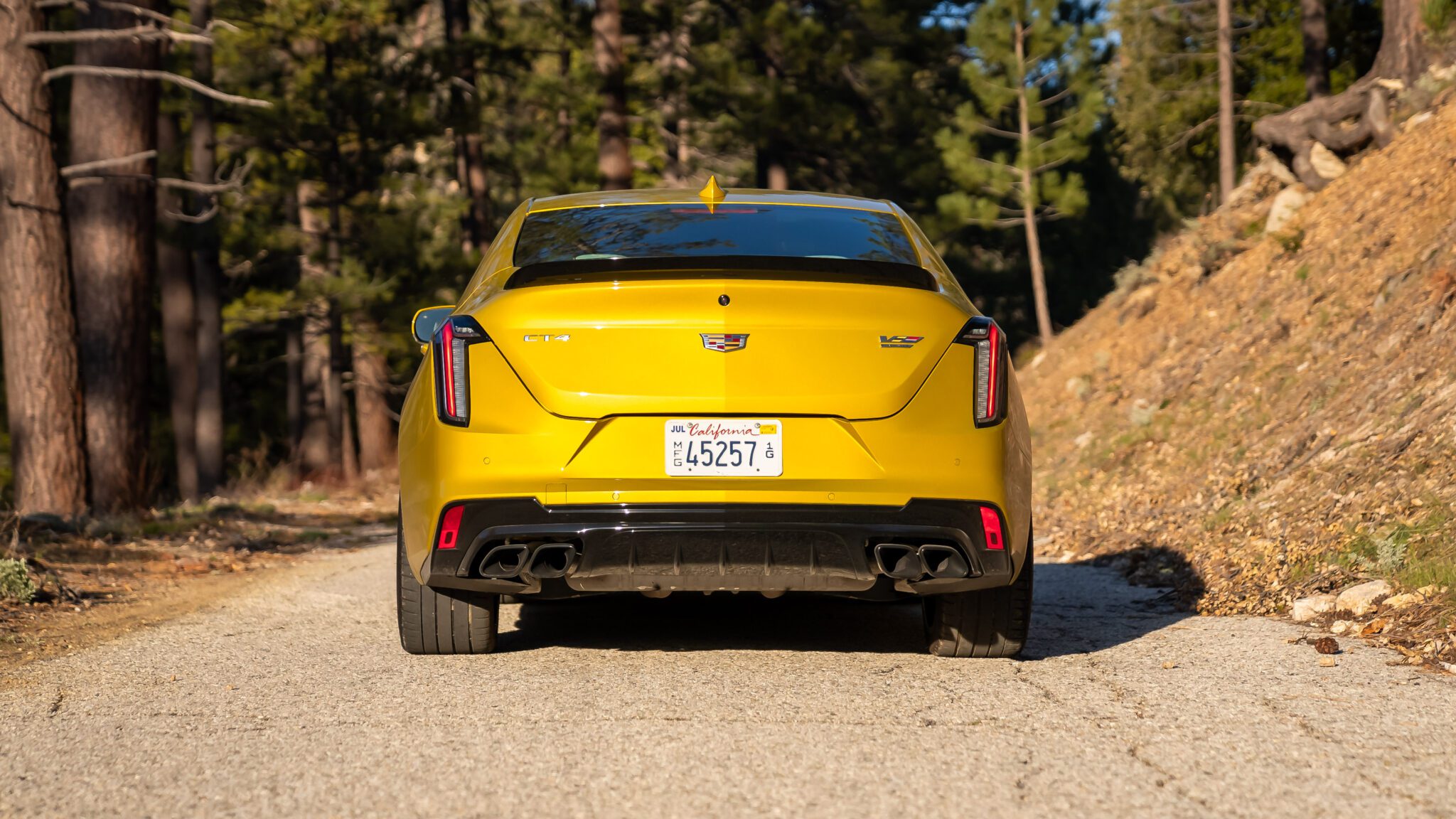
Flat out, the Cadillac CT4-V Blackwing delivers respectable performance, a 4.1-second sprint to 60 for the manual-equipped car or 3.9 for the auto, and an 189 mph top speed. While on paper, at least, the Caddy hits 60 in precisely the same time as a non-Competition rear-drive M3, their real-world experience is drastically different on the count of the BMW punching way above its weight. In contrast, the CT4-V is quick enough with decent midrange torque, but it falls off towards the redline and doesn’t deliver the gut-busting punch its Bavarian rival does.
That said, the Cadillac CT4-V Blackwing is far cheaper than its competitor from across the pond. This 2024 tester costs $62,890, including a $1,395 destination fee. However, it adds $9,645 in optional extras, mainly attributed to over $4,900 in interior upgrades we’ll cover shortly. As such, it costs $72,535 once all is set and done, which is still considerably under the $76,000 or so a base M3 commands.
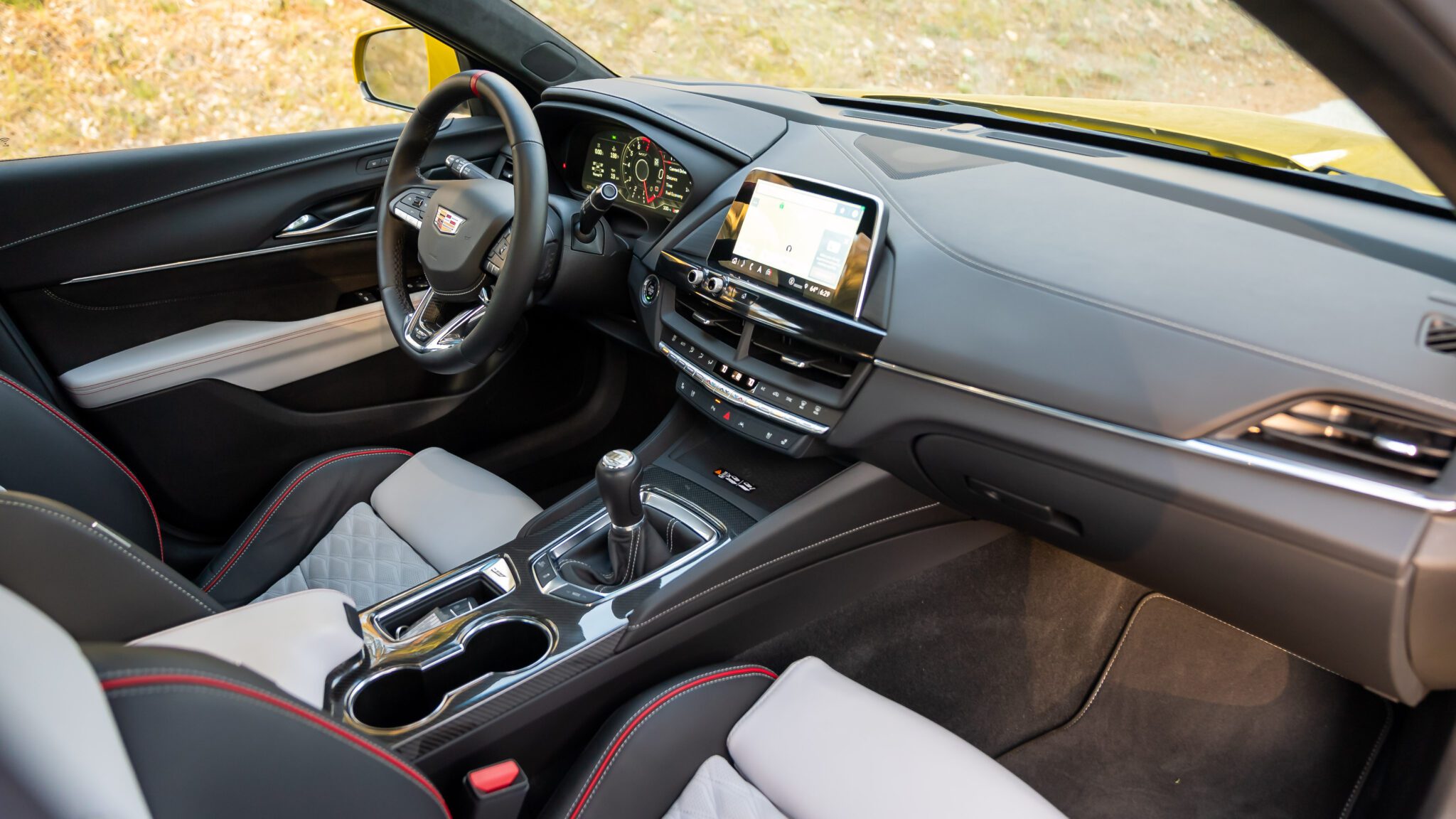
The Cadillac’s cost-cutting isn’t exactly well hidden, either. Step inside, and you’ll immediately see and feel trim and finishing that isn’t quite as polished as what you’d get from pricier competitors. While its digital instrument cluster pops with bright colors and excellent graphics, you count on delicate plastic buttons on the wheel to interact with it. The eight-inch touchscreen housed within its dashboard does offer all the smartphone connectivity you’d want, but it’s comparatively small and not quite as shark as the display used for the instrument cluster.
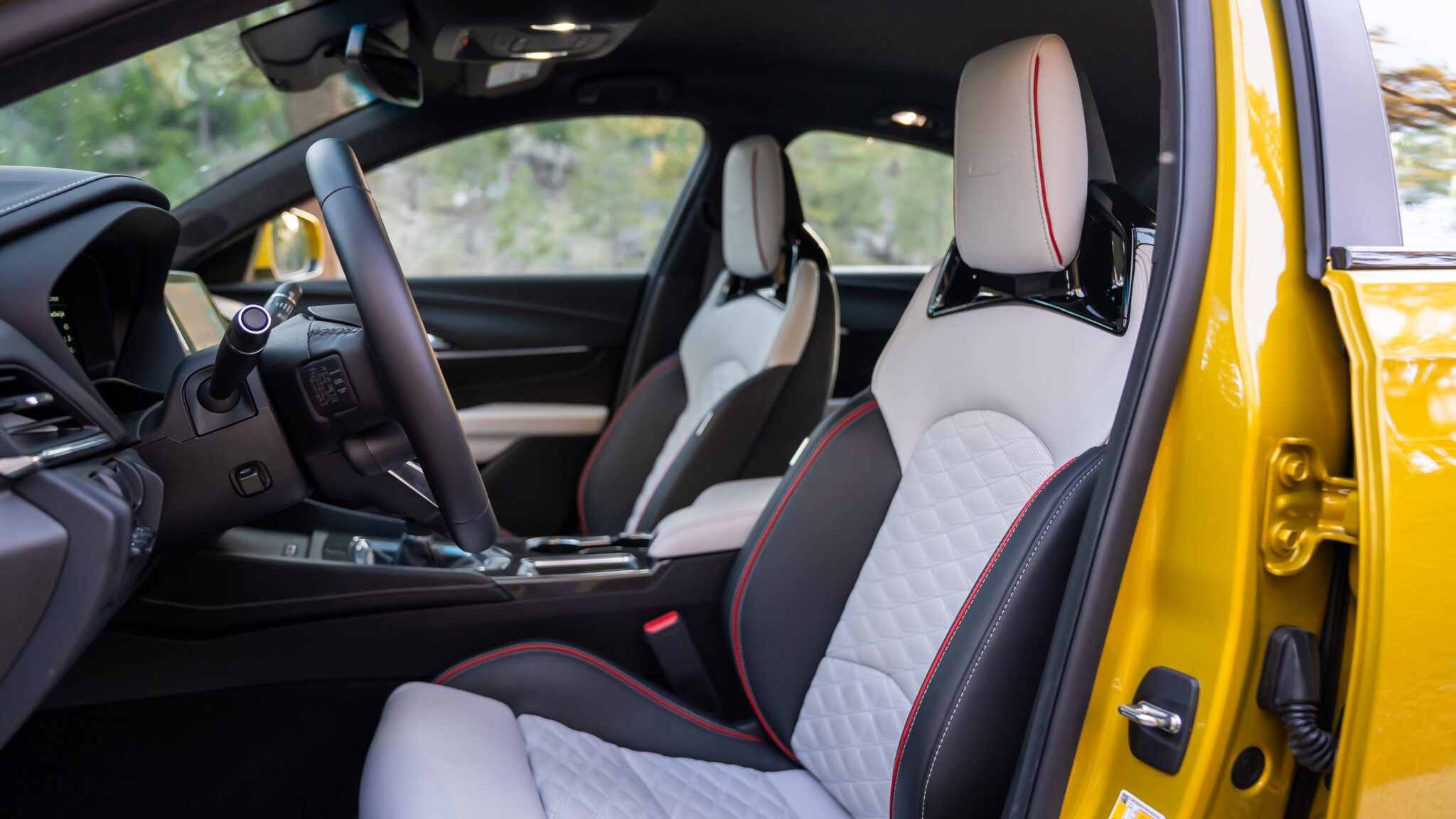
That aforementioned $4,900 interior upgrade goes a long way to making the Blackwing’s interior feel premium. It incorporates two-tone bucket-style seats with perforated diamond-stitched leather and red contrast piping. This duo-tone theme continues onto the door cars and the second row, matching nicely with this tester’s carbon fiber extras.
More importantly, do any of this Cadillac’s drawbacks truly matter? There’s certainly a case to be made that they don’t. It all depends on what you want out of a sporty sedan. If top-notch materials, the latest highest-definition displays, and a feeling that you’re piloting something expensive are essential, the Cadillac CT4-V Blackwing likely won’t be for you.
However, if we look back at those early 2000s BMW that took the segment by storm, they weren’t mainly known for these things. The M3 doubling as a luxury limousine is a recent development. Instead, what mattered most then was the driving experience.
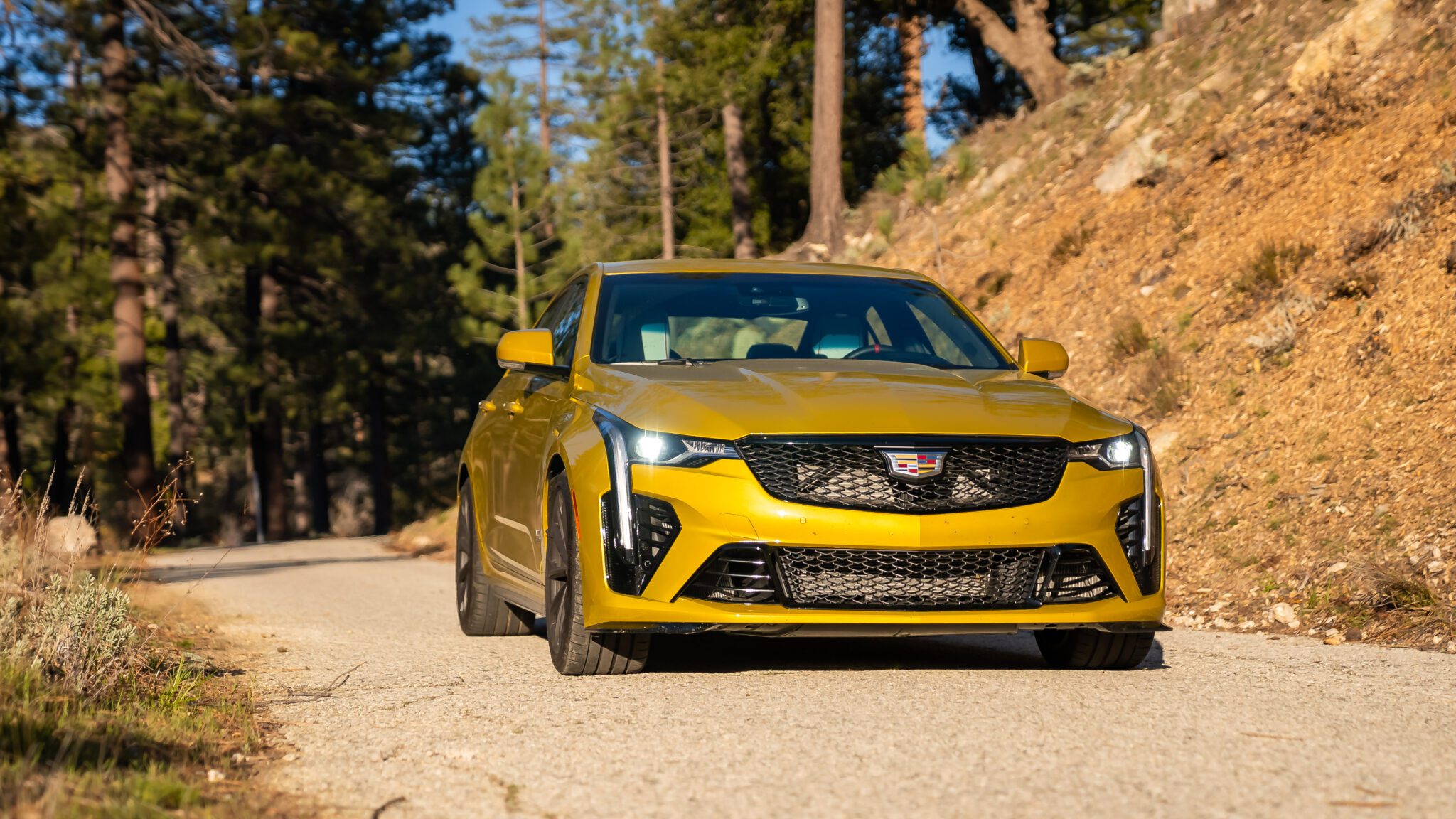
The Blackwing is not perfect, but given the choice, it’d be the one to have if what you’re after is a driving thrill. It feels agile and relatively small while delivering plenty of feedback. Driving it is an immersive experience, and in a segment that often prioritizes outright speed over enjoyment, the Blackwing is a refreshing return to form that reminds us of what exactly made those sporty sedans of the past so memorable, to begin with.
Tags: Featured
Broad Arrow Auction At Monterey: 2006 Bugatti Veyron 16.4
in *Sponsored, Auctions, For Sale
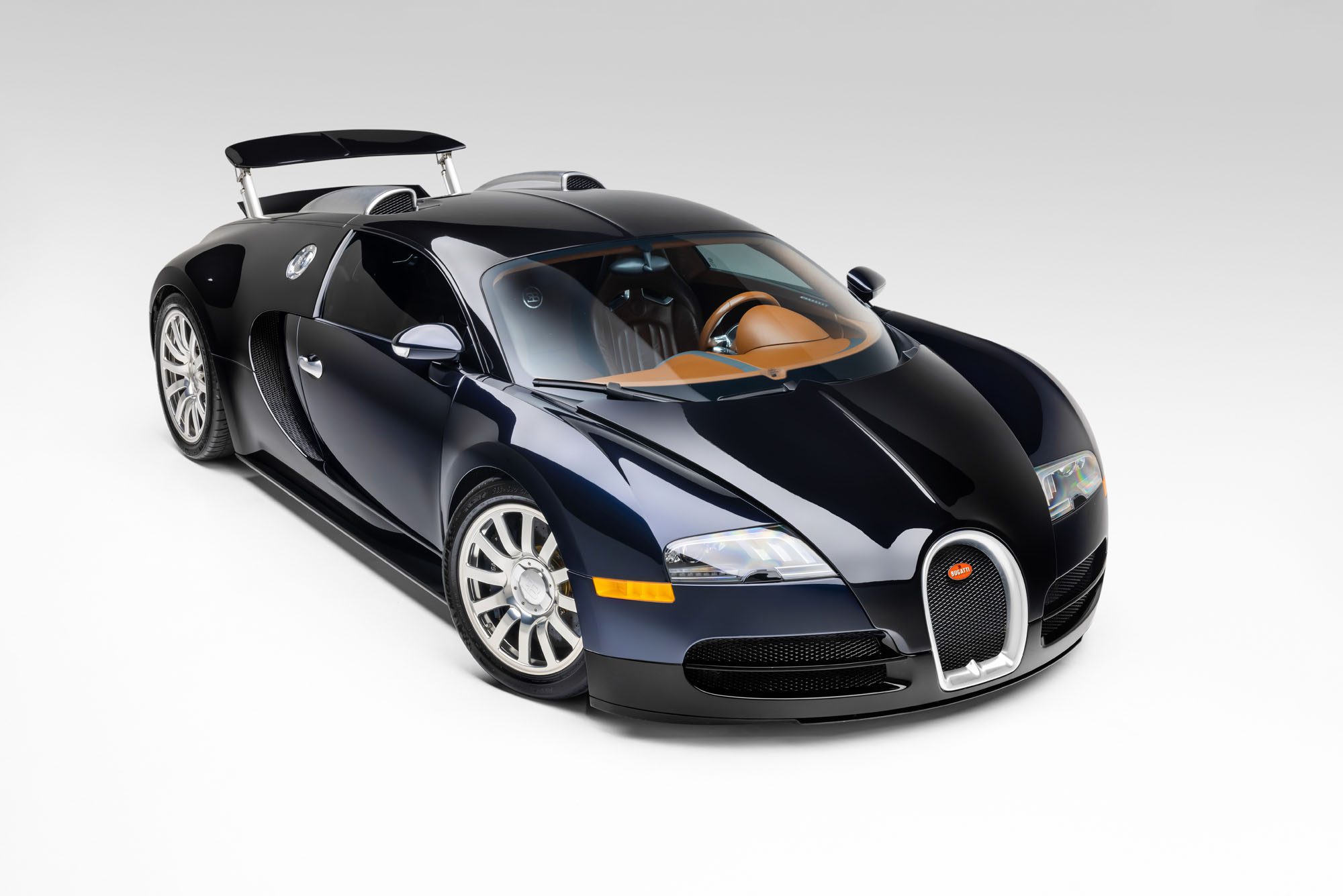
Broad Arrow Auctions, a Hagerty (NYSE: HGTY) company, is thrilled to offer an exciting group of over 155 collectible cars at its Monterey Auction this 14-15 August at the Monterey Jet Center. Highlights include this 2006 Bugatti Veyron 16.4 estimated at $1,200,000 – $1,500,000.
An engineer by trade, Ferdinand Piëch’s ethos toward automotive development is perhaps best summarized by the three-word slogan of the company he helped to elevate into a premiere luxury brand: “Vorsprung durch Technik.” Meaning “Progress through Technology,” the Audi motto would not only transform the brand with such audacious designs as the four-wheel drive Quattro and the economical 100, but set the stage for Piëch’s broader progress-driven assault on the automotive industry during his time as head of the Volkswagen Group.
Ascending to the position in 1993, Piëch orchestrated a series of bold acquisitions that would reshape the automotive landscape at the turn of the millennium. These included such hallowed marques as Bentley, Lamborghini, and in 1998, Bugatti – reestablishing the fabled French sports car maker as Bugatti Automobiles S.A.S. Piëch’s vision for the modern Bugatti was ambitious and uncompromising, and involved the construction of a sprawling, state-of-the-art factory in the Bugatti’s ancestral home of Molsheim, France. This factory, directly across the street from Château St. Jean where Ettore Bugatti once entertained clients for his beautiful creations, would produce Piëch’s crowning achievement – the fastest, most powerful, and most expensive production car in the world.
Volkswagen tried a series of different concepts in the late 1990s before officially introducing the Bugatti Veyron 16.4 at the 2005 Tokyo Motor Show. The performance statistics were as extraordinary as they were groundbreaking: 987 horsepower, 922 pound-feet of torque, a top speed of 253 miles per hour, and a zero to 60 time of just 2.47 seconds (or 119 feet). At the heart of this automotive marvel was a titanic 8.0-liter W16 engine – essentially two narrow-angle V8s joined together and driving a common crankshaft – equipped with four turbochargers and ten radiators. This unit alone, assembled by a select group of eight specialists, required a week to complete.
To harness this immense performance, Bugatti fitted the Veyron with a permanent Haldex four-wheel drive system and a seven-speed dual-clutch transmission. Equally immense braking power came from 15.7 inch, eight-piston front, and 15-inch, six-piston rear carbon-ceramic disc brakes supported by an additional 0.7 G of braking force from the rear air brake – capable of bringing the Veyron from 60 miles per hour to a standstill in 2.2 seconds. All told, the Veyron was the most ostentatious and rapid production road car money could buy at the time of its release, with a staggering list price of $1,250,000.
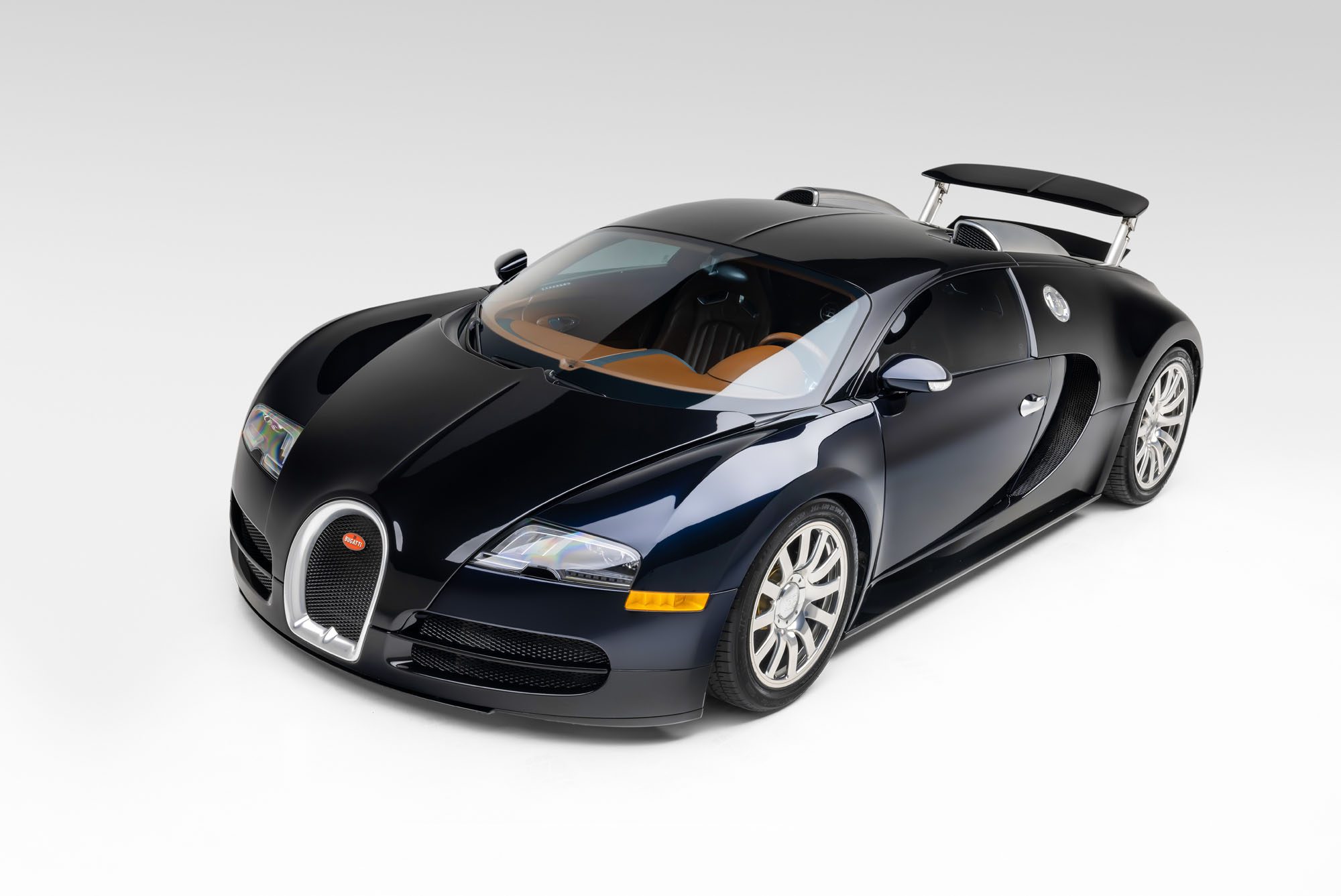
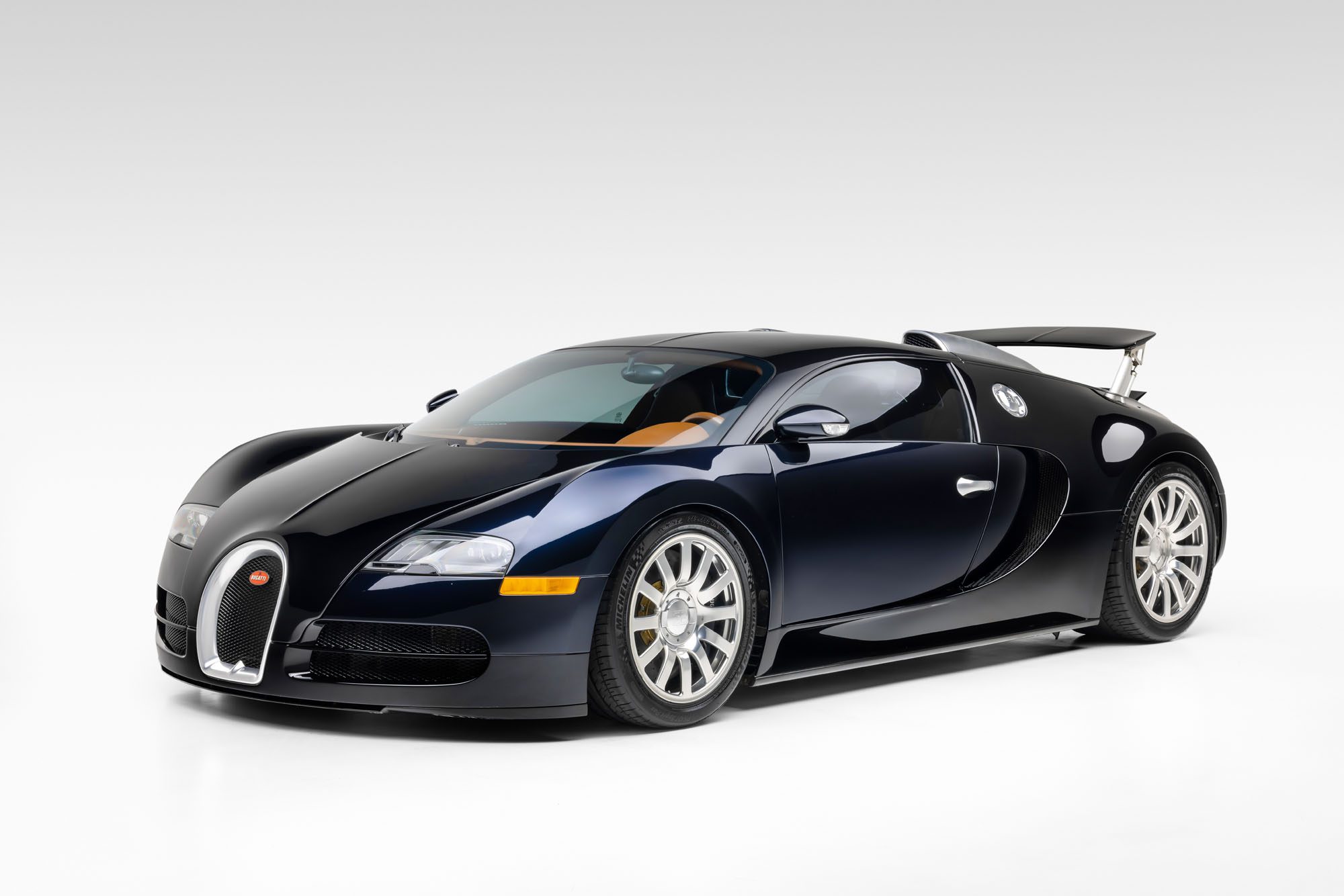
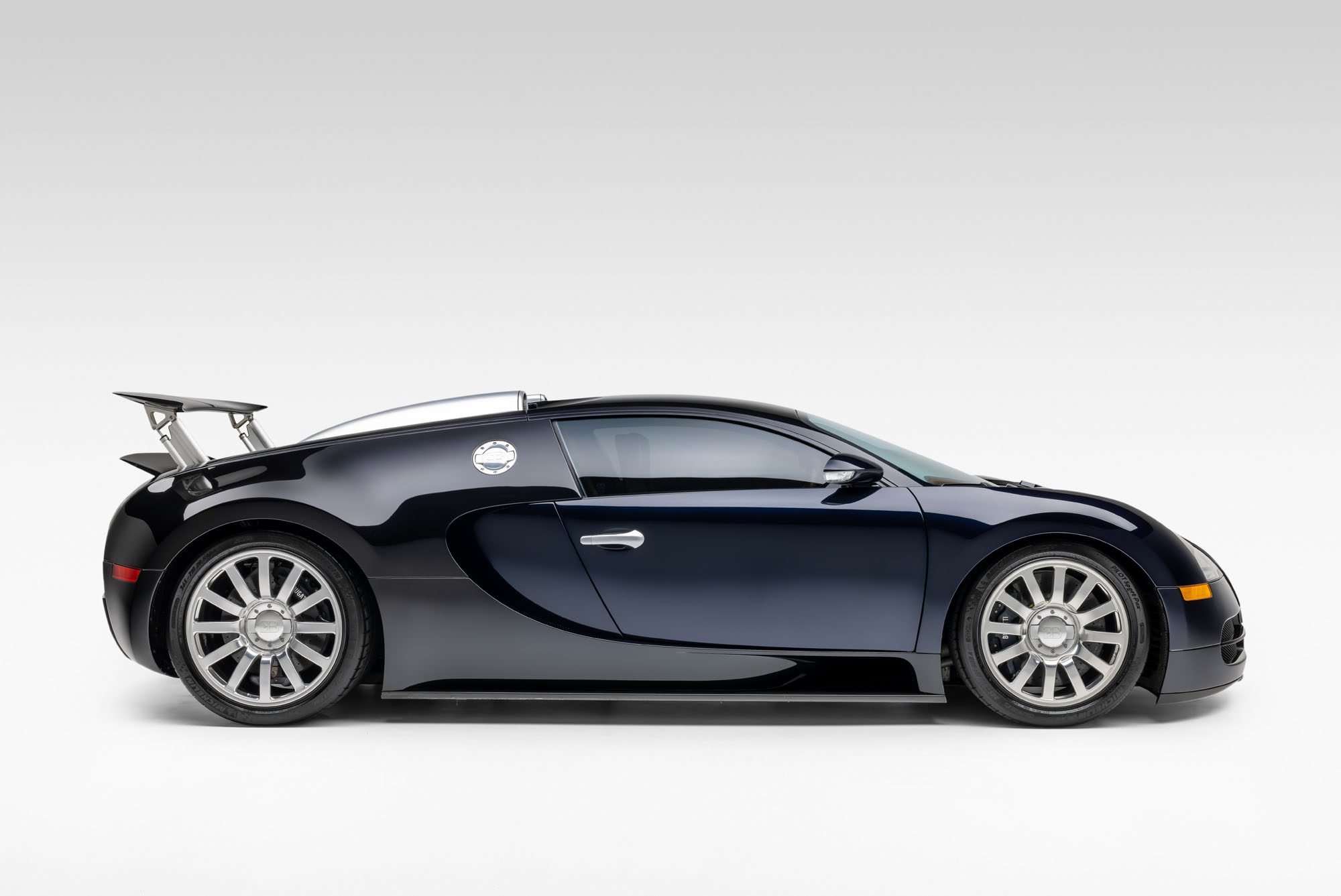
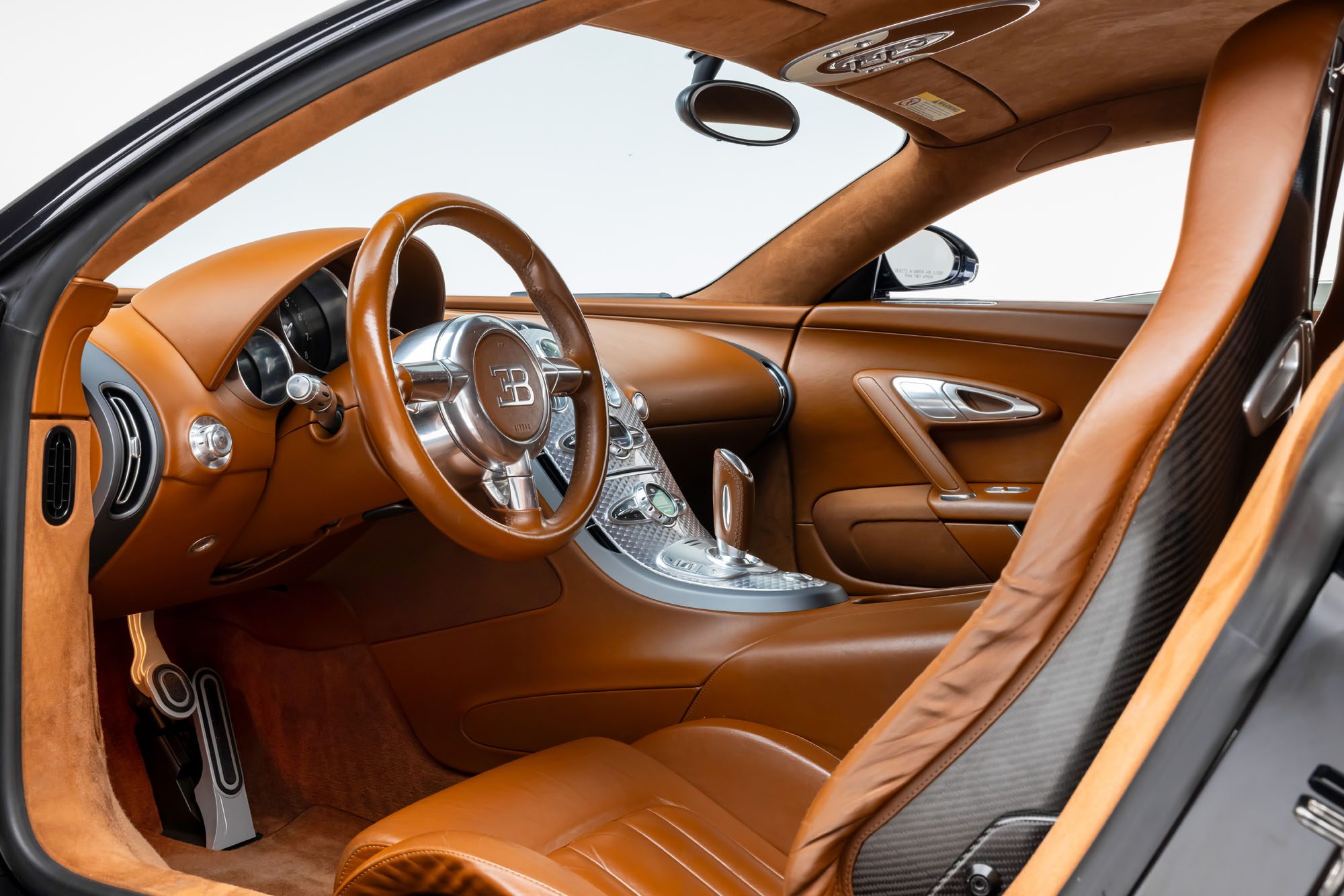
This outstanding example of the Veyron is one of only 252 16.4 coupes produced, with just 76 completed in United States-market specification. The example offered here is chassis number 017, finished in two-tone Black Blue Metallic and Blue Metallic paintwork, wonderfully offsetting each other in the trademark “C-line” running along the side of the car. The exquisitely crafted interior was trimmed in fine Cognac leather and Alcantara upholstery, with an optional engine-turned aluminum center console acting as a centerpiece and evoking the jewel-like instrument panels of historic Bugattis. Its accompanying CARFAX Vehicle History Report places the Bugatti in South Florida in the late 2000s, with subsequent registration history indicating that it had moved to Texas by 2010. The car remained in Texas until 2018, when it sold into new ownership with approximately 17,200 miles. Over the next several years, the car was registered in Florida, New York, Montana, and Illinois.
Chassis number 017 has received the level of meticulous care by authorized Bugatti service centers befitting of a modern hypercar, with receipts on file documenting comprehensive service in recent years. A major service in August 2017 at 16,934 miles included replacement all four tires and various other items. In May 2023, at 21,828 miles, another significant annual service was performed, followed by the most recent major service in February 2024 at 23,028 miles. With a current mileage of just over 23,000, this Veyron has received numerous documented services in the past seven years, demonstrating the unwavering dedication of its loyal caretakers in maintaining this extraordinary hypercar to the highest standards.
Given its lifetime of careful enjoyment and its up-to-date maintenance, this elegant example of Bugatti’s revolutionary supercar can be enjoyed guilt-free as Piëch and Volkswagen intended for its record-breaking performance. The Bugatti has traveled less than 300 miles since its last service and is accompanied by its Bugatti scanner tool, owner’s manuals, first aid kit, three keys including its Speed Key, fitted car cover, and service records, presenting a rare opportunity to own and drive the car that forever transformed the supercar landscape as we know it today.
To view more thrilling cars on offer at Broad Arrows Monterey Jet Center Auction, please visit their website at broadarrowauctions.com and be sure to register to bid for this exciting event.