


Final Fantasy Lotus Exige V6S Review
As production of the Exige comes to an end and the firm embarks on it’s new journey, Wayne Goodman takes his supercharged V6 to the Yorkshire Dales for a long goodbye. Photography by Andrew Ambrose.
The Exige attracts a lot of questions. It’s an enigma, because as a device it is so hard to classify. With its unique design, is it a sportscar or a junior supercar? Well I have to say both, except I think to truly understand the Exige, you have to be thinking not in the present, but in the past. This is when everything starts to stack up. If you said to somebody in the 70s or 80s that you own a Fibreglass, mid-engined two seater car with around 300bhp, contortionist-like entry and exit, poor outward rear visibility and arse-on-the-floor driving position, you’d instantly be thinking of something like a Ferrari 308, a BMW M1 or perhaps even a Ford RS200.
_edited.jpg)
Now take one of the above cars, add in some relatively decent running costs, modern reliability and a price lower than most current GT cars, and you’re starting to understand why the Exige is so coveted by those who own them.
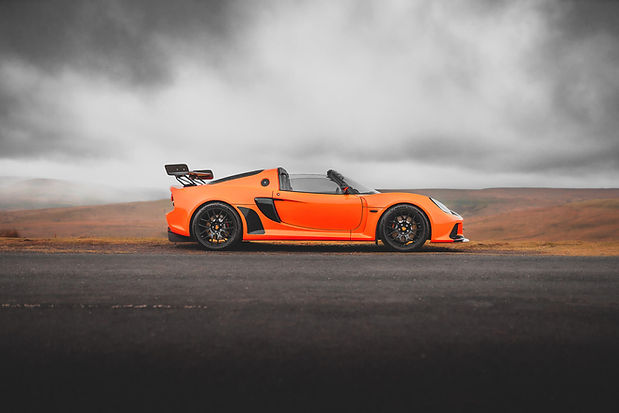
I adore the Exige. Mine is a 2016 Exige S V6 in Signature Orange, featuring a “Premium” Pack (cruise control and carpet – I know!) and a “Race” pack (one above Sport mode and more than just a gimmick, as it actually opens up another 200RPM to play with at the top end, plus it includes a unique Bosch Traction Control System which learns the surface’s grip level and adjusts slip accordingly).

As I type, it’s currently sitting at around 41,000 miles on the clock, which means since I purchased it in late December 2018, I’ve covered over 34,000 miles in three years! That’s more than most people cover in their shopping trolleys! This wasn’t a part of the plan to be honest, but it’s been so reliable and fun to own, I can’t help but constantly go out for a drive!
I have other cars, but why would I take anything else if I can take the Exige? It’s a cheap car to run, and it isn’t affected by mileage as much as a “Supercar”, so if I want to use it, I don’t feel guilty. If I want to drive to the South of Spain, I can, and I don’t need to worry about transporting the car on a truck, plus where’s the fun in that anyway. Better still, when you make such a trip, the seats are also surprisingly comfortable, so you don’t climb out searching for a chiropractor.
I’ve not-so-subtly modified my car, in case you haven’t noticed as well. Again, this wasn’t the plan, and I’m sure at first sight, to some, it could look a little OTT. I don’t think Frank Stephenson will be calling me up for advice on design that’s for sure. However, growing up in a household that wasn’t the wealthiest to say the least, I dreamed as a kid of being a racing driver.
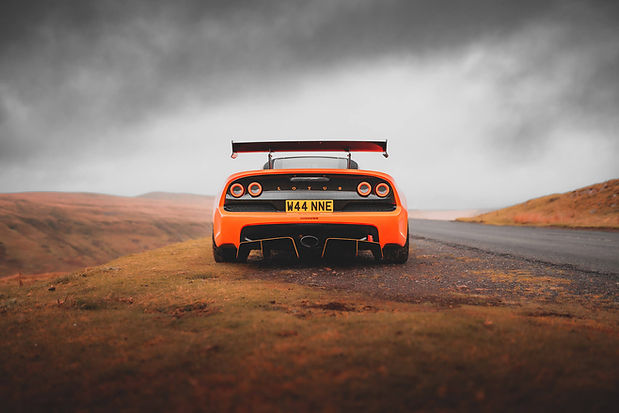
I never quite got there, but I’ve always admired race cars. Their crazy wings, large front splitters, weight-saving carbon fibre and their overall eye-catching looks whether they’re at 2 or 200mph. So when a company advertised some Carbon parts for sale, I looked at my bank account, realised I had no money, but still went to haggle a deal on them anyhow. It then cost me half the cost again, to bring these used parts up to scratch as they were looking a little worse for wear!

The second thing that raises eyebrows to the Roger Moore stratosphere is my choice of gearbox. Hear me out as I know, any Lotus die-hards will want to print this article out and burn it in disgust once I say this; it’s an Automatic with Paddle Shift. Lord forgive me, for I have… well no actually as I’m being completely honest when I say it’s the best decision I feel I could have made. I think the main issue people will have is the perception Lotus offers the purest driving experience out there, and anything other than three pedals is hearsay.
Even resident statto Craig quizzed me on this, assuming it must be some form of automatic single clutch transmission. On top of that, it’s not even the best automatic box ever to be created. To both of these responses though, I’d have to disagree; within reason of course. I’m not delusional but I do have various reasons why I say this.
Firstly, my main argument for the two pedal salute (not that I’m bothered by what anybody else thinks, but the internet does love a good debate) is the fact that I’m part of a number of Supercar groups, as well as having friends dotted all over the country. Therefore the main part of a journey for me to meet up with groups/friends will be in towns and on motorways etc.
These are boring places to drive, and they demand a lot of concentration in a car that’s an inch off the floor and doesn’t have the largest windows. It’s so much more relaxing to drive the car in automatic mode, and it’s more frugal on the wallet as well. In fact the Auto model produces an official 219g/km of emissions which means it’s £340 to tax annually; the best part of £200 less than the manual variant. If I owned a manual, I honestly don’t think I would have covered anything like the mileage I have.


Secondly, I don’t mean any disrespect to owners of the manual variant, but honestly, I found the manual box itself to be one of the less exciting ones I’ve experienced. For a manual box to be good, it needs short, snickety changes when you slot in to gear, giving the driver confidence and a feeling of quality. The MX-5 got this bang on, and even a Ford Focus I used to own was pretty good in this regard too. However this wasn’t my personal feeling from experience of the Lotus Manual box. In the early V6’s I’ve driven, I found the lever would slot in but was void of any satisfaction. 1st and 2nd were also too far over to the driver side for me and it aggravated a shoulder injury I have after a while.
It’s clear I’m not alone in this assessment either, because not long after my car was produced, the V6S was discontinued and the 350/380 took up the mantle. This had an upgraded gear selector and visually, it’s a stunning setup – Pagani for the people. However, in my opinion the operation didn’t improve enough to make it desirable to me – it was a case of style over substance.
Long story short, I personally don’t rate the manual box, but I’m sure others will beg to differ. It’s each to their own, but I expect a lot of naysayers have never actually experienced an Auto. My car was one of only eight automatics produced that year, so it’s a very rare option, but I encourage you to seek out one of these cars if you can and see for yourself.
So what about the supposed mediocre automatic box? Well, before buying the Exige I purchased a Porsche Boxster 981S PDK. In 2018 I’d test driven an Exige at Oakmere in Cheshire (in fact I think half the country had test driven the yellow car they had, as it was in stock for months due to not featuring air con), but sadly, at the time I just couldn’t find an Exige that suited me well in terms of pricing and spec. My gaze diverted to a Boxster S, with its two year warranty and features such as the Sport Chrono pack, which included active engine mounts and more. It was, at the time, the ultimate specification. A few days into owning it though, I knew I’d made a big mistake. As a result, that car lasted just seven weeks before I sold it at a huge loss and went back on the hunt for an Exige, yet again.
Enjoying the content? RUSH is an independently published print magazine.
Please support us by buying a copy.
The Porsche was just too perfect. Too accomplished. Plus on exiting the garage after buying it, a Macan Turbo raced me and kept up! I wanted something fun and edgy. Something that would want to kill me but could still easily outrun the grim reaper if he appeared. The Porsche was just too polished, too smooth for such antics.
The PDK box was also one of its downfalls to me, believe it or not. It was so smooth, you didn’t know it had changed gear. It almost felt like an EV in its power delivery. In Sport+ mode things were better as it ignition-cut during gear changes which threw you forward a bit at each change, but it was too aggressive if you weren’t fully on it, and then it wasn’t aggressive enough if you were. It was trying to be too many things that it wasn’t using software and algorithms. It did sound pretty decent though.
The Exige was much more focused in every way, and I knew it was the car I truly wanted. I’d even considered a McLaren but as much as I’ve always wanted a McLaren F1, the 570 I tried was again, maybe too perfect. Stories of reliability are a little off-putting as well considering the nearest dealer is an hour from me.
Then I came across an Exige for sale in one of the Lotus Magazines. A few days later, I travelled 5 hours to test drive it, and I wasn’t entirely convinced at first. In ‘regular’ automatic mode, the gearbox was very slushy and nothing too special. In fact it was as bad as I expected from reading reviews. However as soon as I switched to sport mode, the car came alive. It was like I’d jumped into another Exige! The paddles, although not “clicky” in their feedback, allowed full manual control, to the point where you could bounce it off the limiter all day in any gear if you wanted. They’re also attached to the steering column, not the wheel which is my preference as I always know where they are, and they’re long enough to catch with your pinky finger if need be.

The gearing seemed absolutely perfect as well. A shorter first gear and long-ish second. Third is just starting to get you into trouble and there’s six gears in all. The software doesn’t do what some supercars do and auto-upshift for you, and it blips the throttle on downshifts. Of course, I’m not healing-and-toeing like Senna to achieve the blip, but that V6 spins up as quick as you’d like, and the rev-matching sounds like all those toy car noises you ever made as a kid, as does lifting off the throttle from high revs.
The car also has shift-lights on the dash to help with the timing of the changes, enhancing the race car vibe. However, there’s a fractional delay between pulling the paddle and the shift, which is something you have to adjust to. You quickly learn to pre-empt the paddle shift though, and of course the software of the box stops the risk of over-revving the engine. So no, it’s by no means a “perfect” gearbox, but to me at least, that’s a great thing.
The pedals are well spaced, although left-foot braking would be a little uncomfortable after a while as the brake pedal is quite centrally-mounted. However, leaving the car in automatic mode and choosing either “Sport” or “Race” on the DPM switch means that the car will shift for you at the absolute limit. If you were to ever drag race at the traffic lights, which of course I’d never do, ever, honestly, then the car does that bit for you; leaving you to concentrate on the important bits, like not binning it and becoming insta-famous for all the wrong reasons.

So for me, the box is the best of everything. Drive in slushy auto mode to a group meet, then choose Sport or Race mode (Race mode offers a little more slip and the extra revs mentioned above using a unique Bosch traction system) and manually paddle shift to your heart’s content at the red line. It’s not as smooth as a PDK, but it’s nothing like your dad’s old Rover either. It just adds to the character which the car already has by the bucket-load anyhow.
Another virtue of the car is of course the steering. I know people go on about Lotus steering like it’s a contractual obligation in any article, but once you’ve driven a Lotus, you tend to compare it to everything from your mate’s hyper-car to the hire car you’ve just picked up at Malaga airport. You’ve been educated on what good steering is. You now understand what turn-in is, and how steering ratios are as important as any other part of the car, if not more so. The tiny steering wheel reminds you of the go-karts you drove on holiday as a kid with your mates, and the comical tooting horn can diffuse any potential road rage incident.
The driving position, for myself at 5ft 10” is perfect. I worried when I found out there’s no seat height adjustment, but I don’t mind sitting on the floor when I drive, so I’m fine with it. The dials are slightly masked by the rim of the tiny steering wheel, but that’s fine as they’re useless anyway. The speedo is 5mph out at 70mph compared to GPS, but bang on at 40mph; it has a complete mind of its own so I’ve bought an EBD digital speedo off Amazon to allow for more accuracy when going through camera zones etc. The fuel gauge is also a game of petrol station roulette but it hasn’t caught me out so far.
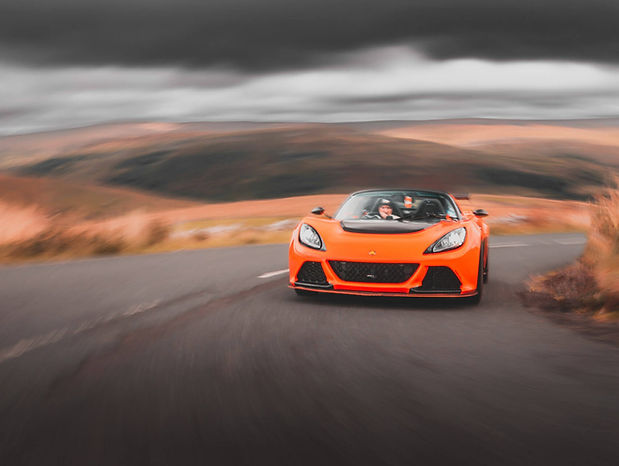
On my car, I’ve also fitted the soft top roof. Another reason for the purists to sharpen their pitchforks, as it does allow the car to flex a little more. I won’t lie, you can detect an extra degree of flex vs the hard top, so on track, I’d say the hard roof will be much better. Yet when you’re going out for a sunset drive on the mountain roads surrounding Marbella, and you can hear that glorious V6 exhaust-note bouncing off the cliffside walls, I assure you, you won’t be bothered about a bit of flex. I can honestly say it’s never bothered me, and the fact it keeps up with most things on the road means that I don’t think it would bother anybody else either. There is quite a lot of wind swirling around in the car with the roof off at higher speeds, but at 140 mph on the Isle of Man Mountain a couple of years ago, I can’t say it was doing anything but adding to the experience.
The engine is always a talking point. I guarantee, the guy that runs over to you at the fuel station to tell you they owned a Lotus in 1974 will ask you, “is it a 1.8?”. They always seem to think it’s powered by that infamous K-Series engine from the Elise. So when I reply with “no, it’s a 3.5 Supercharged V6”, they look at me in disbelief. “A what?!”. Then my Toyota-Tourette’s comes out and every time I go, “yes it’s a 3.5 V6 out of a Toyota Camry…”. Yeah, I’m that boring.

It’s true though. This engine is featured in a Camry in the USA, as is the automatic gearbox, the Air Conditioning Compressor is from a USA RAV4 and I’m sure there’s many more parts shared. However when you turn the car on, you would never know it. The engine is soulful. It’s so under-stressed in this 1200KG body that I’m sure it behaves very differently. Low-down torque has always been enough for me, it revs very quickly and the power has always felt incredibly linear.
The only disappointment I had with the engine was the lack of supercharger noise. I’m a sucker for a big American V8 Charger whine, or the noises an R53 JCW Mini makes, but the Exige has such a disastrous airbox design, it removes any of this. Thankfully, the likes of Alias23 and Komo-Tec offer Induction kits that bring this noise into the cabin and it’s much more pronounced with the roof on.
With the roof off, you don’t hear the supercharger so much, but you now start to hear the exhaust note much more prominently. With the standard exhaust, it always sounded great, but it felt like more could be achieved, so early on I fitted a Larini Backbox and it made this car loud. Very loud. It was something a lot of people would mention; even those driving Ferraris in a group with me would ask about my exhaust. This went on for 2.5 years until recently my mechanic found a crack on one of the mounting points, so I switched to a Komo-Tec. This sounds better higher up the rev range, but not as good low down compared to the Larini.
Ideally, I’d like to find a system that offers a sound that’s somewhere in-between at some point, but for now, the Komotec backbox is more than fruity enough.
One thing I don’t see mentioned a lot is the practicality side of Lotus cars. Often you’ll hear how impractical they are, but what if you’re reading this because you’re genuinely considering an Exige? What if you’re wondering how it would work out on a weekend trip, if it’ll carry a couple of race helmets for a track-day or how it might handle a food shop? Well, yes two lids do fit in the boot – just don’t carry any frozen food in there as it gets toasty, but overall it’s surprisingly accommodating.
I’ve driven all over the place with this car, and I’ve never really struggled as long as I’ve planned what I’m carrying. If you’re bringing someone along, tell them to pack light of course; it’s not going to fit a suitcase. A couple of soft holdalls and some camera equipment though is fine. In comparison, I once had an Evora 410 for the day as a courtesy car and in terms of boot space, I don’t think there’s much, if anything in it. The Evora has some extra space behind the seats and can be had as a 2+2, but it’s hardly the world’s best GT car itself. I feel the Exige is much more of an all-rounder and I didn’t expect that. In fact I’ve driven to the South of Spain with this car for 3.5 weeks and it managed it without issue. I ended up using the passenger seat but there’s some space behind the seats and if you’re good at Tetris, you’ll be able to pack the car well.
So could you choose the Exige over an Evora? It depends what you want. The main difference really is the ingress and egress. Climbing over that thick sill is what separates the car from most others on the planet, and falling in/climbing out isn’t for everyone. It’s great for a hilarious candid photo of your parents attempting the challenge, and it does form part of the Aluminium tub/crash structure, but it’s the key decision versus any other car in my opinion. If you can live with it, it genuinely feels like you own a race car though.

So what are the bad points of the Exige V6? Well there’s a few. None of them have been deal-breakers for me, but it’s down to your expectations at the end of the day. The car features a cabin that’s based off the Elise… a 25 or so year old car at this point. It’s no McLaren or Ferrari with plush materials; think more rugged and robust with borrowed parts as Lotus didn’t have the same funds that supercar manufacturers have for development. It’s a company that produced around 1500 cars per year in total, worldwide. This is pittance compared to most other brands out there.
The brakes, as standard, were never confidence-inspiring for me originally. I replaced them last year with lighter-weight aftermarket brakes as well as more aggressive road-biased pads, and these made a huge difference. Its shaved metres off the total stopping distance and made a real difference to the pedal feel, and in turn my confidence when pressing on.
The standard geometry setup on the S model definitely leaned more towards heavy understeer. I actually don’t mind a bit of this as it allows you to probe the limits safely, but after learning the car, I took it down to Dave at Seriously Lotus, and his alignment is the best I could ever hope for in standard form. The car is much more predictable now, and they make the most of the Komo-Tec/Braid Forged alloys I’ve fitted to the car, as the wider Cup 2 tyres are able to really bite into the road. The car used to feel lazy; you’d turn in to a corner, and then what felt like hours later, the rear would finally follow the rest of the car. It was like there was a delay. Now though, the car flows through bends all in one move. It’s hard to explain as I’m not a mechanic, but it’s like a snake vs a bendy bus.

The standard suspension isn’t particularly advanced. It’s a non-adjustable Bilstein setup which is over-sprung in my opinion. The damper rate also isn’t ideal in standard form on anything but smooth surfaces. The thing is though, I didn’t really notice this until I took the car to Spain, so for most people, it’s going to be more than suitable on the road. However for me, because I’ve taken the car to the Continent, and I’ve seen how impressive it is on the roads over there, I now see how it doesn’t cope all that well with our bumpy country roads. It skips along undulations and more than once I’ve hit the bump stops. As a result of this I’m considering upgrading the springs and shocks to a three-way system. It’s not necessary for most people out there, but it’ll allow me to adapt the car to my own driving style and British roads even further.
The headlights are like candles in fog. In fact the standard dipped beam is so lacking in lux, that when you turn them on, the DRL LEDs dim, and the headlights aren’t actually as bright as the DRLs were! Full beam is thankfully very powerful, but to overcome the dipped beam issues, I’ve fitted a set of aftermarket LED bulbs. They aren’t an ideal solution as there are dark spots in the beam pattern, but they’re 1000 times better than the standard bulbs. I’ve had them in a few months and they’ve performed well so far.

Overall though, this is just nit-picking. It’s a hardcore sports car, so it’s always going to be compromised, or at least I think it needs to be to have some character. Perfect things are boring to me as you can probably tell after reading this. It’s powerful enough on the road, meaning you can hustle supposedly faster cars, but the real thrill is in taking it to the red line rather than short-shifting to save your license.
In fact, my biggest issue with the Exige is the question of “what to replace it with”. I adore the car, but there’s times when I think I’d like a change for the sake of it. However there’s no similarly-priced direct rivals. There’s the Cayman GT4 but that seems more of a side-step than an upgrade. An older Aston Vantage but it’s similar only by price, and with all these ULEZ/CAZ zones etc coming into play, it’s a risky move right now. Audi R8 mk1, nice but less reliable as they pile the years on and aren’t as fun to drive. So then you start looking at serious alternatives and you’re at several times the value of the Exige. It truly is an underrated and very reasonably-priced toy that will be as fun at high speed as it will in stationary traffic.

Of course you’re thinking “he’s not mentioned the Emira”. Well it’s a lovely car, and I wish Lotus/Geely the very best with it, but the fact of the matter is, it’s a car designed to attract buyers away from other brands, and I just can’t imagine it offering the same level of excitement as the Exige, if the Evora is anything to go by. I’d have bought an Evora if I wanted a true GT car and don’t get me wrong, I’m sure the Emira will be fast, but the visceral experience of the Exige is what got me hooked, and I’m not the only person I know that’s had that experience. The Emira is a fantastic final swan-song for combustion Lotus cars, but it’s a Cayman GTS/F-Type/Zupra rival and at this point in time, that’s not what I’m looking for.
So back to that original question about taking it on track. Well, I’m sure I’ll get into that more in time, but for now, whilst we can still have at least a bit of fun on the roads, I’m content. When there’s (even) more cameras, electrification has fully taken over and the track is the only way to let the proverbial hair down, I’ll be the guy in the high mileage Exige with a massive grin on his face no doubt.
Sonic Boom – Subaru Impreza P1 Review

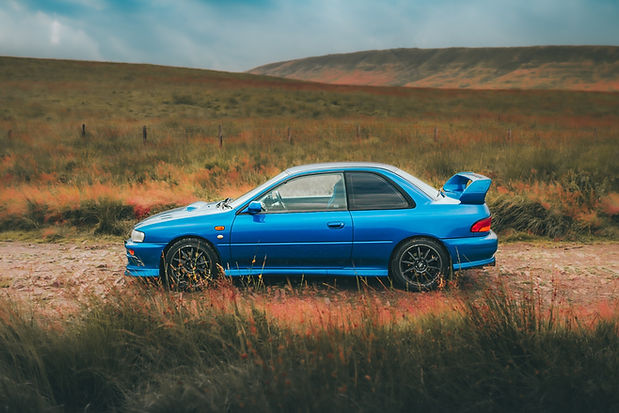
Battling against a tsunami of grey imports, Subaru UK decided it wanted to build the best drivers’ Impreza ever, enlisting the help of WRC maestro’s Prodrive. Chris Tsoi takes a P1 to the West Pennine Moors to find out if they succeeded.
Remember the days when the colour of a car used to grab your attention? You’d only need a fleeting glimpse but it would be enough for the internal database to run a quick search and immediately download the answer: a Scarlet Rossa Corsa Ferrari; a British Racing Green Jaguar; a Championship White Honda Type-R; a Guards Red 911; a Purple TVR; a Papaya Orange McLaren. Each shade has meaning. It stirs a range of emotions and pulls at the heartstrings of anyone with octane in their veins.
Now the motoring landscape is a sea of silver and greys, or silver-grey. Even a modern Ferrari looks best in dark Tour de France Blue. Where has the imagination gone? Lost in a tidal wave of PCP resale fear? It’s a sad time indeed when the torchbearer for a creative palette is the Fiat 500 city-car-slash-motoring handbag. Sure, the odd Lamborghini slips through the net, but little else.
Making my way across the West Pennine Moors towards today’s photoshoot location, it only takes a split-second flash of Sonic Blue before the database nearly crashes with the weight of expectation. It’s a famous Subaru metallic – so charged with energy that it positively leaps out against the backdrop of dark green and browns, like I’ve just donned some 3-D glasses in an IMAX cinema. Hairs stand up on my arms and I can feel myself getting giddy.

Suddenly, I’m transported back to a different time. A time when ‘race on Sunday, sell on Monday’ still had credence. One of Colin McRae, Richard Burns and Tommy Makkinen that led to a perfect storm of four-wheel drifts and grey imports. One of street fights with Mitsubishi Evo’s and savaging anything this side of a 911 Turbo from point A to point B.
It was a no-holds-barred, bare-knuckle dust-up with no quarter given or asked for. Mitsubishi spat out another Evolution; Subaru responded with a new wing and some intercooler spray. The fact that both were limited by the gentleman’s agreement between Japanese manufacturers restricting maximum power to 276bhp meant all the effort went into the chassis – and how we reaped the rewards.
The standard 214bhp Impreza Turbo had already established itself as a legend in its own lifetime in the UK and special editions, like the Terzo, Catalunya and later RB5, added 237bhp stardust with the performance pack. But, over in the land of the rising sun, was a treasure chest of high-boost, big-wing specials with tightened gear ratios and strengthened, two-door bodyshells. People always want what they can’t have – and the specialist importers were only too happy to oblige.

Subaru UK dangled a carrot in the form of the 22B, but only brought a meagre 16 to Blighty – although the consensus suggested it was too stiff for our roads anyway. Eyeing up a bigger slice of the pie, Subaru drafted in Prodrive – the Banbury-based concern behind Subaru’s multiple WRC championships and the RB5 – and tasked them with producing the ultimate homegrown Impreza with a JDM matching output.
The resulting P1 might lack the finishing iconic touch of gold alloy wheels, but it still rocks every square inch of its WRC pedigree. Pulling into the designated car park meeting spot, pleasantries are in order but my mind is distracted, absorbing the endless motorsport details. There’s a brutalist appeal to the P1 – bollocks to the form, all praise the function. Peter Stevens of McLaren F1 fame may have been drafted in to style the P1 but he ultimately spent his time minutely refining the aerodynamics – the P1 requires three fewer horsepower to hit 100mph.
You wonder how he did it with such a comical rear wing – jutting out from the boot lid like the Blackpool tower against the distant Lancashire skyline. It doesn’t even look like it should belong on a car of this size – yet somehow the deeper chin spoiler and fat arches manage to balance it out – visually lowering the car, despite the rally car ride height.

Up front, the eyes are drawn to the giant signature air scoop, whose sole purpose is to feed the top mount intercooler with refreshing air. Either side sit a pair of bonnet louvres, which allow the 2.0 turbocharged engine to dissipate its vast heat. The highlights keep coming – from the branded mud flaps to the obligatory aftermarket drainpipe exhaust.
The mind fog is interrupted by owner Paul passing me his keys. I swing open the tinny door and dive straight into the Recaro – which feels modelled for the typical 68kg Japanese driver usually quoted as a ballast in the official kerb weight. I get the nod to start it up. Damn – I’m excited.
No sign of a stop-start button; instead we have an old-school immobiliser fob and the most basic of keys which could have easily been used in the 70s. No need to depress the clutch; no silly driving modes to activate; no driver aids to deactivate. Twist the key and the boxer four springs to life with a cough and a splutter, finally settling into that famous laconic burble as it warms. You’d swear you can almost hear each cylinder labour to rotate, compress and fire, but the reality is of course the result of an unequal-length exhaust manifold.
Being kind, the interior is a time capsule of late ‘90’s Japanese functionality. It has aged with all the subtlety of Mickey Rourke and has just as much plastic in its fascia. There’s a sheen to every surface that would cause an Audi engineer sleepless nights.


To many, that’s all part of the charm – but, when ambitious speculators are pushing prices for a respectable P1 to the expensive side of £50,000, it becomes a harder pill to swallow. You also sit closer to the windscreen than expected, with a steering wheel lacking rake and carrying a fraction too much diameter.
Easing my way out of the car park, I’m fighting the urge of the clutch to bunny-hop us down the road. There are patches of standing water loitering and even some mist descending to give me the Full Network Q fantasy. I’m feeling my way in, but it’s still a shock to the system how nothing happens until I hit 3.5k rpm and the turbo springs to life, launching us down the road with real punch. It’s strong all the way to the 8,000rpm red line and the exhaust takes on a deeper and smoother tone as the revs rise.
In my younger years, I’d have probably been frustrated with those levels of turbo lag, but now it’s an enjoyable counter to instant gratification turbochargers – challenging you to keep it spooled up and in the sweet spot.

The gearbox has a good weight to it. It’s a little mechanical and notchy in feel, but the shifts are short and it slots into each gear with precision allowing you to make quick changes and keep the revs up. The pedals are nicely spaced for those that like to heel-and-toe as you’d expect, but the brakes feel pretty wooden. In fairness, this is likely down to the fact the cars’ not seen many miles this past year having only been to the MOT station and body shop for a paint touch up.
Even so, the one aspect of performance cars that cannot escape Father Time is braking ability – and the Scooby is no different. The Impreza doesn’t do too bad of a job shedding speed, even if this one’s wearing the standard stoppers. You can still modulate the brakes, but you’re reacting to it, rather than feeling it through the pedal.
Prodrive also chose to ditch the DCCD centre differential controller of the JDM cars as it came at the cost of ABS brakes – a ‘must’ in any British winter. Subaru did offer an optional Alcon brake upgrade, alongside 18” alloys of the same OZ Racing design. They even – shock, horror – offered to trim the Recaro in leather and fit electric adjustment in exchange for money. Even the boot was re-trimmed in a thicker carpet in a futile attempt to increase sophistication. It was minor details like this that resulted in a 30kg weight penalty over the STI – with the P1 clocking 1,295kg.


Time to step it up a notch, the car feeling so alive and ultra-planted. That natural confidence and encouragement that flows from any classic Impreza to its driver is still very much alive and kicking. The conditions are improving too, so I have no concerns finding its limits. I change up from second to third with a thud and I let the turbo do its work, exploiting the longer gearing fitted to the P1 courtesy of a revised 4.444 final drive. The steering has excellent natural weight to it and you can really feel what the front end is doing with every input. Controversially, Prodrive chose to stick with the slower steering rack from the regular Impreza Turbo – but, with hindsight, it’s proven to be a wise decision.
Doubling back towards a particular uphill hairpin that’s proving to be a favourite of mine and the P1’s, braking with the aid of gravity means it’s easier to modulate my entry speed and I tip it in, the nose pointy and faithful to my inputs. The rear just seems to follow wherever the front wants to go – it feels lively, yet planted, and gives no signs it’s going to let go. Mid-corner, you can really feel the car pivoting – it’s an act only the best of cars can match. The way it rotates around the driver’s seat with the front and rear in harmony is something to behold. There’s no hint of under or oversteer and, as soon as the nose is in, you can start applying the throttle – allowing the diffs to do their work and sling shot you out of the bend.
The 205 section tyres are barely warmed over supermini spec these days, but the level of adhesion generated is still bang up to date. It’s a recurring theme with the P1 – it just maximises every single component at its disposal. The dampers and springs feel perfectly matched, with any dip or camber dusted off as if it’s nothing.

This is where the experts at Prodrive really earned their money. Believing the front suspension of the STI was set up too firm, whilst the rear was too soft for European roads, the P1 received a custom set up. The result is the P1 performs witchcraft by filtering out all the harshness you don’t need, yet still possessing a magical ability to deliver all the essential feedback you require to push on.
For example, you’ll have no doubt gathered by the pictures that the car likes to get its knee down during hard cornering but, from behind the wheel, this doesn’t translate into sloppy body control. Everything happens with a wonderful progression, signalling the outer limits of the P1’s ability, encouraging you to nibble up to it – or back off when you’ve bitten off more than you can chew. The high degree of roll is intentional – Prodrive found the STI spec roll bars too aggressive for UK tarmac and thus decided once again to stick with the standard UK Turbo items.
Then there is the view out. The car feels narrow but the vista is in glorious widescreen thanks to the slim A pillars. The aforementioned position of the steering wheel means you sit slightly further over it than conventional cars and your hands are quite wide at a 3 and 9 position where your palms rest. It means your weight is over the wheel and your face is closer to the windscreen than you’re used to.
Yet it works. Placing the P1 becomes a doddle and suddenly you’re exploiting roads that have you thinking twice in bloated, modern metal. No wonder McRae and co were so fast down those narrow rally stages. Even the grey cloth of the roof lining that contrasts so sharply with the blue accented seats serves to add to the airy aura. It’s also mildly perplexing that the mighty rear wing doesn’t even obstruct the two fingered salute of the person you’ve just overtaken.
In period, the P1 cleaned up. EVO magazine welcomed it with a fifteen car mega test against anything and everything available secondhand for its £31,500 list price. The P1 was crowned the champion, then pitted against a five times more expensive Ferrari 550 in a David v Goliath clash.
Today, viewed as a pure weekend toy, the reception towards the P1 can vary depending upon who you ask. Hardcore devotee’s of the Subaru Technica International will soapbox about the rawer nature of a JDM spec car and the premium attached to the P1; whilst supporters of the homegrown model prefer its more polished nature. It’s a battle within the wider war.
Ultimately, that gentleman’s agreement that resulted in such chassis magic also proved to be the Impreza’s downfall. The European power wars, advancements in tyre technology and slick dual clutch gearboxes saw hot hatchbacks supersede the Subaru as the fastest four wheeler down a backroad. Throw in badges that got the Jones’ curtains twitching and soft-touch plastics with 20,000-mile service intervals and it was checkmate against the Impreza. Add a change of WRC regulations that favoured Citroen shopping trolleys, and even Prodrive couldn’t keep the party alive.
But what counts is the P1 still offers one of the richest, most colourful driving experiences ever manufactured, and we applaud Subaru and Prodrive for giving us this machine to cherish.