



Ferrari 430 Scuderia Review
The Ferrari 430 Scuderia has always lived in the shadow of its 360 Challenge Stradale and 458 Speciale stablemates. But, as Craig Toone explains, that needs to change.
D
uring Pulp Fiction, the extended-cut, Mia Wallace informs Vincent Vega that: “There are only two kinds of people in the world: Beatles people and Elvis people. Now, Beatles people can like Elvis and Elvis people can like The Beatles, but nobody likes them both equally. Somewhere you have to make a choice.” The implication being that whoever you choose defines who you are and your personality.
You can apply Quentin Tarentino’s logic to the world of cars: you’re either a Ferrari acolyte or an advocate of Porsche. I’ve always considered myself a Beatles guy (insert your own appropriate quip about the 911’s origins here). The more subtle, under the radar qualities of the products of Stuttgart have always held greater appeal than those of flamboyant Maranello. A Porsche just gets on with business. It doesn’t need to shout about it. It doesn’t need a theme park.
I was mulling over the rich history of these two fierce rivals on the eve of popping my Ferrari cherry, yet I remained steadfastly dug in in my Zuffenhausen trench. That was until the next morning, when Maranello struck with such force that I felt like slicking back my hair and growing sideburns in tribute to The King. There I was, on the edge of Kielder Forest, aiding snapper Ben in his preparations for the day ahead and surveying the peaceful glen below, when suddenly I heard the sound.
It starts off faintly – the ears straining to capture dulcet tones dancing on the wind – before fading back to silence and tranquillity. Then: Whaaaaarrrp! Without warning, the sound returns. Inexplicably closer, louder and more feral – and utterly hypnotic and seductive. It wails and climaxes to a crescendo, pausing for breath before angrily reaching for the high note once again.
The glen morphs into a living entity, amplifying each scream of the onrushing V8. A flash of red is glimpsed between the pines: nature’s warning of a hunter closing in. The sound comes at us from all directions now, reverberating around the valley. The topography is a willing accomplice – playing tricks on the senses and disorientating the vulnerable prey.
Then, out of the treeline, the beast appears, pursuing a path towards us at breakneck speed. It dances around a series of corners with breathtaking agility. In the final approach, the sonic assault climaxes once more, before the beast is brought to a sudden and dramatic stop inches before us. Its beating heart slayed.
Our meeting point above the Caddroun burn provides a uniquely-acoustic setting, suited to this dramatic display. Long, deep and narrow, cushioned by a pine forest on the opposite side, you’d christen it nature’s own amphitheatre… If it wasn’t for the tell-tale efficient rows of the original saplings and the uniform ambition of their reach into the sky. The perch I’m standing upon is man-made too – a shale pedestal protruding outwards, jolie-laide in design. It should be an ugly blight, yet somehow it works: man and nature melding together.
Mark – the owner of this particular Prancing Horse and disturber of the peace – emerges from the car, donned in shades and sliders. There is just enough time for a hearty “what a fucking road” greeting before we hear the sound once more – this time refracted off the valley head miles away – and we all fall to silent contemplation. I thought the speed of sound was supposed to be faster than any mere production car. Clearly it plays second fiddle to the 430 Scuderia.
AUTHOR

Rush Founder
Photography by;
Ben Midlane
Published on:
18/8/2024
OUR PRINT MAGAZINE

CATEGORIES

D
I’m sure everybody has a fantasy about driving their first Ferrari but I must admit I was more than a little intimidated to drive the Scuderia – a hyper-focused, stripped-out version of the F430 Berlinetta with the wick dialled up to over 500bhp. This wasn’t due to a lack of faith in my ability but simply my respect for somebody else’s property – a mental block created by the £200,000 value of the car. Up until this point, the fastest mid-engined motor I’d driven was a Porsche Boxster S of the 986 vintage. Doubling the horsepower and increasing the value twentyfold is quite the step up.
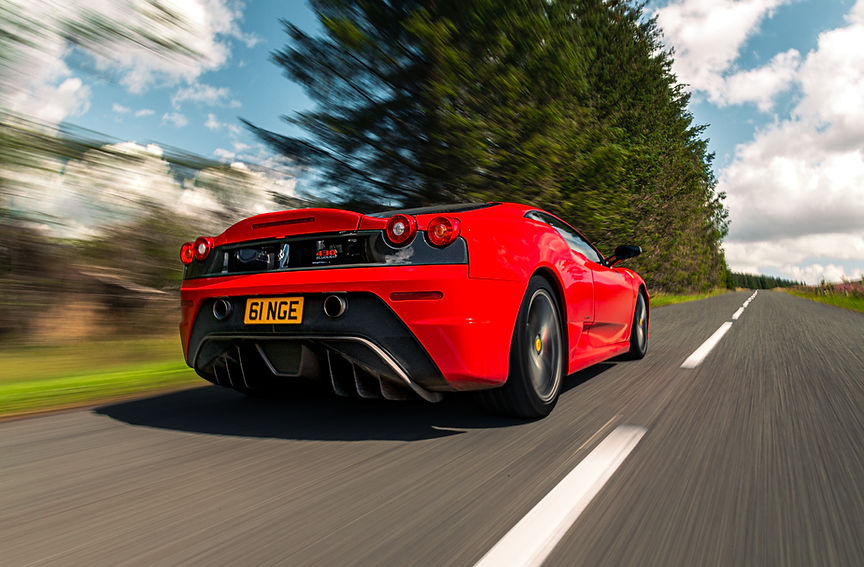
Even parked up, it’s clear the Scuderia means business. The engine sheds excess heat through cover vents like a sleeping dragon ready to breathe fire. I’ve never been the biggest fan of the regular F430 Berlinettas styling, feeling that it lacks the cohesion of Pininfarina’s finest, but there is a purpose to the Scuderia that’s alluring. There’s art in the engineering of this car: from the hunkered down stance, to the reformed aerodynamics and cooling, to the obsessive use of deeply glossy carbon fibre at every opportunity. The gorgeous, lightweight forged alloys are bolted over the top of enlarged carbon ceramic brakes (up ¾” to 398 mm) and the calliper clearance features the sort of tolerance only used by NASA. Speaking of bolts, those on the wheels are fashioned from titanium – as is the majority of the suspension componentry. Super strong, super lightweight – it’s a theme that runs through the entirety of this car.
The hardcore aesthetic continues to gain momentum when you swing open the driver’s door and lay eyes on even more carbon. The weave is used for the door cards, seat shells and as a housing for the shift lights in the steering wheel. The dashboard is clad in alcantara instead of leather and the glovebox has been replaced by a net. Still, what is by far the most evocative element is the bare aluminium floor and the exposed welds in the footwell. The welds aren’t even particularly well-finished, but jettisoning the carpets not only saves weight – it harks right back to the F40 and speaks directly to my inner child. The one pressing his nose up against the window of Stratstone Ferrari Manchester. In total, 100kg has been cut from the regular F430 – resulting in a kerb weight of 1,349kg.
What you can’t see through that bare floor pan is the extensive revisions to the car’s underbody. Ferrari claims downforce is up to 300kg at the Scuderia’s top speed of 198mph, yet the drag coefficient of the standard F430 is maintained. At the back, the new rear diffuser has gone full-blown alien invasion sci-fi and the rear grill, again fashioned from carbon fibre, takes heavy inspiration from the Challenge racers.
The Scuderia benefits from a power-to-weight ratio increase of 42bhp/ton over the regular F430 Berlinetta
D
It’s all so easy that it almost robs you of the cerebral moment of contemplation before you turn the key and thumb the starter button, giving life to all eight cylinders and 48 valves. I can imagine the Ferrari powertrain engineers smiling wryly as they calibrated the slightly-too-long starter motor sequence, that seemingly eternal inhale you take before the ignition fires and the exhaust blares and settles into an impatient idle.
The gearbox is a doddle to operate. There is no BMW SMG nonsense, with 42,000 settings to grapple with, and the car creeps forwards obediently with a brush of the throttle. Yet the Ferrari is already egging me on – and it all stems from the ridiculous tractability of a mesmerising naturally-aspirated motor. Honestly, as cliche as it sounds, the throttle pedal behaves as if connected directly to the synapses in your spinal cord – so instantaneous is the response, so telepathically judged is the thrust received, and so sweet is the vocal approval from the 90 degree V8. Outright traction is also indomitable. As long as you’re not a complete gorilla on the throttle, introducing the pedal to the bulkhead with a smooth arc, full-bore acceleration and maximum attack upshifts are possible from first gear all the way into fourth without a hint of complaint from the rear tyres.
You might wish for a Ferrari to emit a creamy symphony, one that evolves with every single revolution. But honestly, the V8 spins so fast, there isn’t the time – the tone simply changes in stages. First, the exhaust valves come over all antisocial at 3,000 rpm, then the note hardens again as the needle rockets past 6k – at which point the shift lights start giving you epilepsy and you’re closing in on the 8,640 rpm redline faster than an avalanche freefalling down the side of Mont Blanc. It’s like VTEC on acid.


D
Obviously, it comes as no surprise to find more horses in the V8’s stable – pun intended. We’ve gained 20 of them but, more importantly, the powertrain team has also played with the torque curve – widening the reach of the 347lb-ft peak. Liberating the extra power from the 4.3 litre engine is a revised intake plenum, a Challenge-derived exhaust system – new pistons with a higher compression ratio (11.88:1) and a tweaked ECU. The specific output is now up to 117bhp/litre.
The “F1 Superfast 2” gearbox also fights hard for your attention. It maybe even eclipses that manic engine – it’s that exciting. Banish any thoughts about a lurching 360 Challenge Stradale or E60 M5, this gearbox is in another dimension – changes happen as fast as you can pull a paddle. The headline 60 milliseconds shift time is only accessed above 50% throttle or north of 5,000rpm. For perspective, the regular F430 shifts in 150 milliseconds – almost three times as long. Even the FXX clocks in at 80ms. F1 cars of the time were banging home 40ms shifts.
This gives the gearbox the speed of a dual clutch; however, it still maintains the heavy metal, mechanical fury of a single clutch change. Despite such aggressive shift times, swapping cogs at such a rate never upsets the back axle, and you don’t receive a heavy dose of whiplash or motion sickness with every full bore upshift. From where I’m sitting a dual-clutch transmission seems redundant. This gearbox is so sublime, so addictive, you’ll catch yourself shifting gears just for the hell of it, like you would in a manual. It is central to the entire experience of the car.
I always dreamed my first Ferrari experience would centre around stirring one of those iconic, open gate H-pattern manuals, but I’m going to commit it to paper: fitting a manual gearbox to the Scuderia would ruin it. Want a metaphor? I’m sorry, only an expletive will do: changing gear in the Scuderia is fucking life affirming. Days afterwards, I would find myself clawing at an imaginary paddle as I bumbled along my commute. Sadly, Ferrari perfected the F1 transmission right as it went out of fashion.
.jpg)
“The overwhelming feeling is of a car with a sublime balance and practically zero inertia – from the way the V8 spins to 8,000+ rpm, to the ability of the carbon ceramics to shed big numbers with a typically Italian shrug of the shoulders…”
D
Once you have become accustomed to the head rush of the powertrain, you can concentrate on the rest of the car. The turn-in is another high point. The steering is very light, super direct and oh-so-perfectly geared. Some may assume this lightness might be a little disconcerting in a mid-engined car, especially if big speeds are introduced, but honestly – at road pace – the car is so planted. If you need it, the nose will dart for an apex with complete commitment, or change direction as quickly as the fast twitch muscles in your forearms can react. And it’ll stay completely flat whilst doing so, for the Scuderia simply refuses any form of body roll.
The overwhelming feeling is of a car with a sublime balance and practically zero inertia – from the way the V8 spins to 8,000+ rpm, to the rate the car can change direction with complete composure, and the ability of the carbon ceramics to shed big numbers with a typically Italian shrug of the shoulders. Mark likens it to a big Lotus Elise and I completely endorse the extrapolation.
The sensory assault is constant. Your fingertips buzz with feedback and your spine tingles to the pulse of that V8. But the key is this: it is never tiring. This is because the car is surprisingly comfortable. Save for the clinking rose joints, you’d swear the Scuderia is no more taxing than the regular F430. The Lexan rear window reduces mass – high up mass – yet it doesn’t rattle or vibrate. The seats are perfectly moulded, but you won’t need to rearrange your vertebrae to appreciate them. The fabric is grippy and they remain comfortable after hours at the wheel. You’ll even forget you’re wearing harnesses after a while.
Speaking of touring, the V8, for all its noise, is never harsh and, despite being naturally-aspirated, torque is plentiful. At one point, I was cruising along the sweeping A68, stuck behind a pack of motorbikes. Maintaining their rhythm was no hardship using the impressive mid-range urge of the V8 – I was doubly impressed when I assumed I was loping along in fourth gear, only to look down at the digital readout and see a five flashing back at me.
Famous glass rear screen showing off the mighty V8 has been switched for a Polycarbonate item saving weight.

D
And then there’s the brakes. You read online horror stories about carbon-ceramic brakes when cold but, across mixed driving, the brakes on the Scuderia were never anything more than completely faithful and powerful. In fact, so well-judged was their operation, I genuinely remember little about them. You might see that as a backhanded compliment, but it’s just that the rest of the car is so bloody raw and unhinged, some assets fade into the background.
One of the assets you’re constantly appreciative of is the damping – specifically bumpy road mode. It doesn’t suddenly mean the S in Mercedes S-Class stands for Scuderia – what it does is give the damping incredible poise, smoothing off all the rough edges and opening up even the most weathered of B-roads for play. It’s underpinned by a reassuring firmness, but is never harsh. All this despite the car riding 15 mm closer to the ground than the Berlinetta. Witchcraft.
What’s interesting is, whilst you’re enjoying yourself, there is some seriously sophisticated technology plying its trade in the background but, so seamless is its interaction with the chassis, you’d swear everything was natural. I’ve always taken the whole “F1 technology for the road” line from Ferrari with a pinch of salt, but it seems the Scuderia really can back this claim up.
There is enough electronic wizardry occurring here to baffle Alan Turing. Central is the E-diff – the first of its kind pioneered on the regular F430, but revised and sharpened up to suit the higher grip capabilities of the wider, stickier tyres and bigger brakes. Its action is integrated with the gearbox and programmed in unison with the F1-Trac stability and traction control systems. Ferrari claims the technology offers 40% more acceleration coming out of corners than a traditional mechanical set up and, given how well the Scuderia hooks up, I can believe it.


D
It’s a hardware and software unison that is enough to see the Scuderia lap Ferrari’s fabled Fiorano test track in an Enzo-humbling time. A mere four years prior, the Enzo was Maranello’s flagship hypercar, the very best it could do with money no object. The £172,500 asking price of a Scuderia made it a comparative bargain – at least in performance terms.
Much has been made of Michael Schumacher’s input into the development of the Scuderia. One specific request Herr Schuey made was the ability to operate the above traction and stability controls independent of the suspension setting. If this hadn’t been taken on board, I might’ve been writing about a very different feeling car. Everything is dialled in via the Manettino switch on the steering wheel. It could’ve been a gimmick, but it genuinely works intuitively – although in the real world, you’ll quickly default to the Race setting (loosens intervention, but still gives maximum drive forwards) combined with bumpy road mode, and pretty much leave it there the entire day. If you want to be a hero, you can have traction off with stability on, or make the cross of the Holy Spirit and turn it all off.
Flaws? Of course the Scuderia has some – every car does. The most noticeable driving glitch is some mild understeer present in low-speed corners. It wasn’t unpleasant or scary – the nose just washed a little wide of my requested line. Twice it happened to me, and both times the otherwise excellent steering failed to telegraph it.
Mark informs me the car is rather sensitive to set-up and tyres. Before a recent thorough fettle by The Supercar Tech in Edinburgh, Mark had the Scuderia up for sale because he hadn’t fully gelled with it – unable to trust “a disconnected and wandery front end when pressing on” and a driving position that felt far too high for a car of this ilk.
“At TST, the car got a new set of Continental SportContact 7’s to replace the 10-year-old P Zero Corsas, and what a difference this has made – the ride quality and grip levels are night and day improved. I chose a more road-biassed tyre because that’s where the car spends the majority of its time. Paul also replaced some worn suspension components that would account for the loose front end. Finally, we lowered the driver’s seat to its lowest position – I wasn’t even aware this was something that could be done, but the car is absolutely transformed.

D
“I can’t quite believe what these three changes collectively have done to the driving experience. It now feels like I always wanted it to: steering and suspension feels as tight as a drum, with a lovely supple ride quality and huge corner stability from entry to exit. The lowered driver’s seat means that, all of a sudden, it feels like I actually fit in the car and the driving position is now perfect. I’m actually pretty gobsmacked at the difference.”
I’ve no doubt a BMW M3 or Alfa Romeo Giulia Quadrifoglio – with their equally fat tyres and steroidal mid-ranges – could keep pace with, or even outrun, the Scuderia. I know for certain a 488 Pista would make mincemeat of this car in an airfield drag race on YouTube.
But that completely misses the point. The V8 doesn’t just turbo torque from 20-120mph in the blink of an eye, with a turbine suffocating the soundtrack. The Scuderia is still a thrillingly fast car – nought to sixty takes 3.6s and 100mph will flash by in eight – yet extended periods of full throttle can still be safely used, exploited even, on the public road.
The Scuderia is a car that transcends the physical art of driving. Where the perfect apex is forgotten about and acceleration times and peak lateral-g numbers fade away. Yet within the storm, you – the driver – are calm. The heart is pumping and the adrenaline is firing, but it’s not a fretful or nervous energy. You’re happy – revelling in the moment. You feel in control and that the car is working with you, rather than judging you.
There is so much texture to driving the Scuderia. It feels like the essence of Ferrari: capturing all of the emotive drama and distilling away any of the old-fashioned compromises. I want to drive it until the oil fields run dry and all the petrol stations across the land are derelict. And, when that happens, I’ll just close my eyes, access my hippocampus and download the memory of the sound and stick it on repeat. I’m rather fond of my new sideburns and I’m now on the look-out for a Ferrari-embroidered rhinestone jacket if you happen to know a place…
Scuderia rides 15mm lower than the regular F430. Manettino switch offers five modes; Icy, Sport, Race, CT Off (disables traction control while leaving the stability control active) and CST Off, which turns off every driver aid.
Ferrari 430 Scuderia Stats, Performance and RUSH Rating
Engine
4,308 cc 90 degree V8, 48 valves, max 8,640 rpm
Bore and Stroke 3.26 x 3.19 in (92 x 81 mm)
503 metric horsepower / 510 PS @ 8,500 rpm
347 lb-ft. @ 5,250 rpm
11.88:1 compression ratio
117 bhp/litre
CO2 – 360 g/km
Transmission
6 speed paddle shift single clutch automated manual
Electronic differential “E-Diff2 (E-Diff + F1-Trac)
Brakes
Carbon-ceramic, front 15.6 x 1.4 in (398 X 36 mm)
Rear 13.7 x 1.3 in (350 X 34 mm)
Tyres
Front 235/35 19”
Rear 285/35 19”
Chassis
Rear wheel drive, mid engine layout
43:57 front/rear distribution
Double wishbone suspension all-round
Adaptive “magna-ride” dampers
Titanium springs
Wheelbase 102.4 in (2600 mm)
Front track 65.7 in (1669 mm)
Rear track 63.6 in (1616 mm)
Weight
Kerb Weight 2975 lb (1350 kg)
Power-to-weight 373 bhp/tonne
Torque-to-weight 257 lb-ft/tonne
Performance
0-62 mph (0-100 km/h) in 3.6 s
0-124 mph (0-200 km/h) in 11.6 s
0–1000 m in 20.9 s
Maximum Speed 198 mph (320 km/h)
RUSH RADAR
Steering – feedback & responses
Drivetrain – throttle response, power delivery
Performance
Value – running costs & residuals
Chassis & Handling Balance
Ride & damping

Mazda MX-5 NC 2.0 review – Attainable Performance Part II

For the second part of our series showcasing performance cars that don’t cost a fortune, Ken Pearson tests the NC-generation MX-5 to find out why it’s the obvious choice for compact sports cars.
The Mazda MX-5 has enjoyed global success and near-universal praise in every form that it has taken. It is a common sight on British roads all year round and every current or former owner I’ve spoken to has a lot of love for the compact roadster. The MX-5 continually does well in reviews and group tests alike, is usually on the radar of anyone who’s after a sports car and is often right at the top of the shortlist for those wanting an affordable sports car. So is it worthy of being the obvious choice? There’s only one way to find out.
The “NC” is the third generation MX-5 which launched in 2005, having been previewed by the Ibuki concept of 2003. Being released in the age of the coupe-cabriolet, a folding hardtop was available alongside the classic fabric roof. This increased the weight by 43 kg over a fabric-roofed roadster, but 1,153 kg is hardly elephantine is it? Initial versions had a strong resemblance to the original NA generation, however an early facelift after just three years in production brought about a styling overhaul that made the model look like a true successor to the second generation NB model – at least in terms of its front bumper design. The oval grille and headlights were out and a larger, inverted D-shaped grille with angled side inlets and lights were in.
The metal roof was very popular in the UK with the promise of greater isolation and refinement – as was the larger of the two Ford Duratec-based engines; a 1.8 litre and 2.0 litre naturally aspirated four-cylinder were available, with the smaller option sending 126 bhp and 123 lb ft to the rear wheels through a five-speed manual transmission. The 2.0 litre option gained an extra ratio, along with an increase in power and torque to 158 bhp and 139 lb ft respectively. Ask anyone who’s never owned an MX-5 and they’ll tell you that the bigger engine is the one to have and that the 1.8 is terrible in every measurable way…probably.

My last two MX-5 experiences (NA and NB models) required the roof to be lowered for me to be comfortable and not a stressed member of the chassis. Luckily, the NC’s biggest criticism at launch – it being too large – allowed me to slip into the cabin and keep my head straight. At 6’3” my view is through the top of the windscreen, but I don’t have to arch my neck to see the road ahead, which is a good thing. The thin two-piece seats help to make the cabin hospitable for taller occupants and provide good levels of comfort and support, although the lack of adjustable head restraints means that only the base of my skull gets a place to rest when leaning back.
The thin-rimmed steering wheel doesn’t adjust for reach so my seating position ends up being a little further forward than I’d like, but it doesn’t take long to realise that I’ll be using the centre of the bonnet bulge and the visible front wheel arch blister as my yardsticks for placing the car on the road. Before heading off, I ask owner Mark two key questions: “Does it have one of those handles that you have to pull to get the roof to lower or lock?” and “Are there any mechanical quirks?” The answer to the first question is yes: one must press a button and pull a lever to unlock the roof, before pressing and holding a button on the dashboard until the car beeps at me to tell me that the mechanical ballet has been completed. With the cover rising out of the way fairly quickly, the two-piece roof falls into the recess behind the cabin faster than a semi-sealed pot of yoghurt falls out of the fridge.
In answer to the second question, Mark says “the gearbox needs to be warm before it shifts smoothly…and the air conditioning doesn’t work!” In a rare case of Japanese unreliability, a blown fuse killed the roof, stereo and traction control – a bit of fuse box roulette brought back everything but the air con.
You might also like:


With clear blue skies and not a morsel of moisture on the horizon, the non-functioning air conditioning wouldn’t be an issue and the MX-5 would be tested as Toshihiko Hirai, chief engineer of the original NA Mazda Roadster, intended: with the roof down. At this point, I reach for the centrally mounted window switches, drop the handbrake, press the clutch pedal to the carpet, grab the narrow gear stick for the first time and immediately stall the car. I start the car again, repeat the steps and try to find the biting point with a little less haste this time, before stalling it for a second time. I’ll freely admit that I am not the greatest operator of a manual gearbox, but the last time I stalled two times in a row was on an inclined slip road in the fastest car I’ve ever driven – a rented Ford Kuga.
As it happens, the saying “third time lucky” exists for a reason and the MX-5 and I finally advance towards my testing grounds, taking the indirect route all the way. Village roads give me a good first impression of the steering – it’s heavy and direct: exactly how I like it. The car is quick to change direction even at 30 mph so I use the meandering streets and parked cars to get a feel for how much lock is needed.
Within two minutes of setting off, the car is already telling me that I can trust it to tackle corners well. My intuition to use the flat bonnet with its almond-shaped indentation to position the car turns out to be spot on, and the car is easy to place as the national speed limit sign beckons. The powertrain is still warming up, but some gentle throttle application returns an instantaneous reaction, with the 2.0 litre engine having no issue swiftly doubling my speed from 30-60 in fourth gear.

I take some time to get better acquainted with the gearbox and acclimatise myself to the very short throw and narrow gate that the shifter moves around. MX-5s are known for this setup and although it seems like the distance between first and fifth is narrower than a £2 coin, I have no issues selecting the right gear each time.
I get even more practice as Sunday traffic brings out the infamous 45 mph everywhere-category of driver, who are only ever seen on the 7th day of the week or tailgating people who obey the speed limits in villages. This gives me some time to get used to the car’s brakes as 45 mph quickly becomes 14.5 mph on any bend with more curvature than a cucumber.
Impatience gets the better of me and I head for less populated routes, briskly getting up to speed and enjoying the smooth ride from the suspension and 17” 5-V-spoke wheels on each corner. With the roof down on a perfect day in a naturally aspirated manual sports car, I can’t help but wonder whether I am enjoying a false sense of security that will turn into disappointment on twisty roads? As luck would have it, the mild sense of apprehension goes completely unfounded.
Exiting another village, a long left hander heads up and over a railway bridge before immediately arriving at a 110-degree right hander. I apply full power in third, see the needles rise and feel the car lean a touch before the road straightens out and crosses the East Coast Main Line. I tap the brakes which quickly bring my speed back down, drop a ratio and let the confident front end pull me around the hairpin, before quickly getting on the power again and exploring the full range of notes on offer from the car’s rev range.
4,000 rpm is where the four-cylinder becomes tuneful, with 4,500 revs being the crossover from singing to shouting, before positively screaming at 6,500 rpm towards the red line at 7,200. Peak power feels as if it is reached around 6,750 rpm so there’s no real need to rev it past this point, but the sound on offer is reason enough to do so. The torque on offer feels plentiful from 2,000 all the way to 5,000 rpm so it is possible to briskly make progress without telling everyone in a three-mile radius that you’re getting a wiggle on. The engine note is raspy rather than boomy and it settles down when cruising, but the perfect soundstage that an open-top car provides is too inviting not to make the most of it.

With the red line reached and second gear switched for third, I check the other large round dial and see that the perception of speed from my driving position doesn’t quite match what the speedo says; it’s the opposite of the smart roadster where 35 mph seems like the speed of sound. The MX-5 has rather long gearing – much like the Nissan 350Z which will feature in a future instalment of this series – so if I want to consistently hit the red line without getting my friend’s car repossessed by the local rozzers, I’ve only got two gears to play with which is rather frustrating as the engine really does reward the driver with power and noise when sent towards the rev limiter. The low gears seem to be too long, yet the high gears seem to be too short. It should be the other way around with first through third shortened, fifth and sixth lengthened for greater cruising prowess, and fourth left as it is. The ratios are the only consistent source of frustration that the drivetrain provides, so to enjoy the rev range to the full I must head towards some slower corners.
The little Mazda continues to inspire confidence under braking. There is noticeable weight transfer as the nose dips under hard braking, before it leans on its sidewalls through corners, but not rolling excessively once. It’s much like a Renault Sport Clio 182 in that regard, as there is so little mass to move around that the changes in pitch and roll are consistent and never catch me out; the car is wonderfully composed and this composure is a guiding hand, rather than an intimidating one that is preparing to smack me if I make a sharp adjustment to the steering, throttle or brakes mid-bend.
The steering remains heavy, but quick and consistent, with only the slightest bit of correction required to undo a little too much turn-in. As a right-hander turns to a left, I notice that a relatively small amount of lock is all that’s needed to get the MX-5 to head in the opposite direction, and that my hands don’t cross over with the wheel staying within 25 degrees of centre, even in tighter turns. It all feels very natural, and as I unwind the wheel and accelerate down a straight, the engine picks up with no delay and I catch the next Sunday driver in no time at all. Still used to automatic kickdown in my C-Class, I forget to drop from fifth to third to complete an overtake but even at lower revs in higher gears, the lightweight roadster picks up speed with little effort and I once again have an unspoilt view of the road ahead.
My latest manual-prompted blunder highlights that power-to-weight is often as important as outright grunt; weighing only 1,132 kg and having 158 bhp to deploy means that the magic ratio stands at 138.6 bhp per tonne. In isolation, the car never feels like it’s underpowered and the performance on offer is more than enough for the type of driving that I’m enjoying for this test, despite being used to 50% more power and three times the torque in my C-Class.
I get the sense that the engine and the chassis could handle more output, so it’s no surprise that the aftermarket has catered to that wish with countless powertrain upgrades ranging from inlets and exhausts to superchargers and turbocharger kits. In my view though, for the sort of driving that I enjoy and if I had one of these as a second car, I’d leave the performance figures as they were when it left the factory. Daily use might see me succumbing to temptation and browsing the BBR GTi website though.
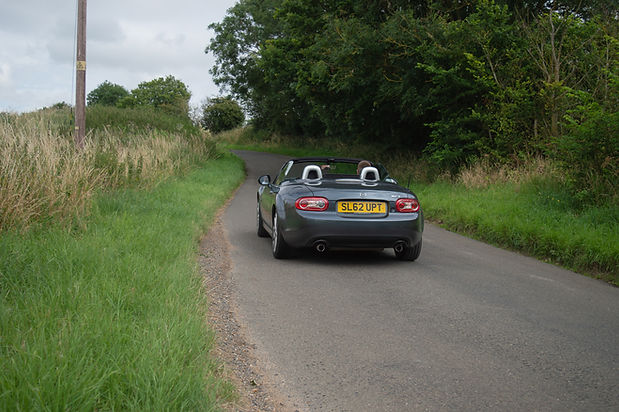
Enjoying a cruise between villages, the car quickly reverts to being a relaxed roadster that would be a good companion for aimlessly driving around the county in no hurry on a summer evening. I reach for the centrally-mounted window switches which appear to have moved since setting off so that I can make the cabin as exposed as possible without kicking the windscreen out of its frame. As far as convertibles go, the moving refinement is impressive with the small wind deflector that sits between the roll hoops doing a mighty job of reducing buffeting in the cabin. At a 60 or 70 mph cruise in top gear, the sound from the exhaust plays second fiddle to the air rushing past but that is the case with almost every convertible I’ve driven, save for the wonderful Audi R8.
Having successfully completed sharp chicanes, the next test involves my favourite sorts of corners: high speed sweepers. I wonder if this is where the Michelin e-Primacy tyres fitted to this example – designed for electric cars – will finally start to come unstuck?
Of course not, but the cheeky roadster showed me its playful side during an over-exuberant entry into a slippery, newly-resurfaced T-junction which gave me my first and only hint of understeer as the front washed out. The solution? Power! The rear end kicked out a touch, before the traction control stepped in to keep the car in check, doing so smoothly and progressively rather than completely killing the power and unsettling the car. I’m certainly not a drifting professional, but the car felt very forgiving as it broke traction before gently helping to get all four wheels pointing in the same direction, and as if it would be easy to maintain a slide with the traction control switched off if I was that way inclined.
Knowing where the limits of adhesion lie and how the car will behave when it passes them, I trust that the sweepers won’t be a problem for the MX-5. Indeed, the trust is repaid as the 50:50 weight distribution, composed body movements and progressively sharp steering are a perfect combination for a series of 5 connected bends that get tighter as we head downhill, necessitating some gentle trail braking towards the end of the sequence. The Mazda seems to revel in this particular stretch of tarmac, and invites me to lean on it and push it just a little further so that it can show how well it can take a high speed bend. With the sun reaching the highest point in the sky and my skin ignoring the presence of SPF50 on it, it’s time to put the roof back up before returning the car to its owner.
The roof takes next to no time to raise although the manual locking is something I’m struggling to get used to after years of driving convertibles that don’t require any input other than pressing a button. It’s a long-standing task to manually lock or unlock the roof to and from the windscreen frame in the MX-5; perhaps it’s like how the Porsche 911 stuck with a key-shaped starter switch long after the requirement to insert the key into an ignition barrel was done away with, and is just part of what makes the car what it is.
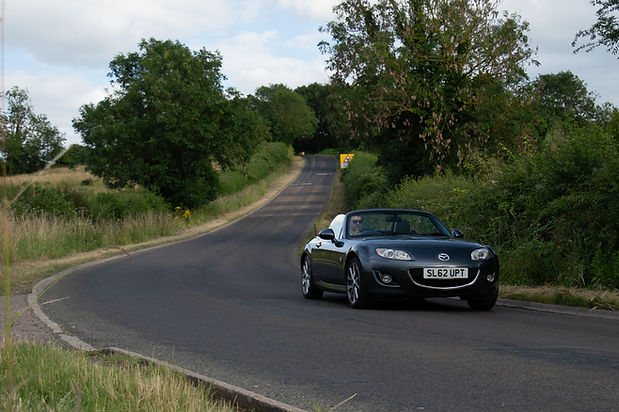
Setting off once more and heading the opposite way through the 5-bend sequence allows me to build speed through them, entering the first one slowly and leaving the last one quickly. Convertibles tend to sound rather different depending on where the roof is and this car is no different: the notes remain the same but the back-projection from the exhaust tips is switched for a more raw sound that appears to be coming from underneath the dashboard ahead of me. Owing to the rear-set placement of the engine and how close it sits to the bulkhead, it sends its sounds to the cabin before its power and torque reach the rear wheels.
My formative years of driving were spent behind the wheel of a 2009 Mercedes-Benz SLK 350 which admittedly had a much heavier roof than the MX-5, but the entire balance of the car would change when it was lowered, feeling better with that weight being over the rear wheels as opposed to floating above my head. Is that the case in the MX-5? No, and it must be down to the much lighter roof than was found in my SLK and how much further forward it sits when stowed; the result is that the car handles consistently and feels just as balanced whether the roof is raised or lowered, a lot of this must be down to having a bespoke platform as opposed to being a modified saloon chassis, and a 50/50 weight distribution baked in.
With all the elements identified and explored, it’s time I put the steering, brakes, chassis and engine to work for another blast between bends, revving the engine out to the red line as often as possible and enjoying the notchy, precise gear changes from the narrow-gate shifter. The MX-5 holds on around fast corners and is easily able to accept more power mid-bend thanks to the limited slip differential, before confidently changing direction under heavy braking, asking to be taken to the next sharp bend as quickly as possible and delivering a great high-pitched shriek towards the red line on the way there. The MX-5 has delivered, and things are starting to become clearer about this specific car along with the model’s place in the performance car world in general.
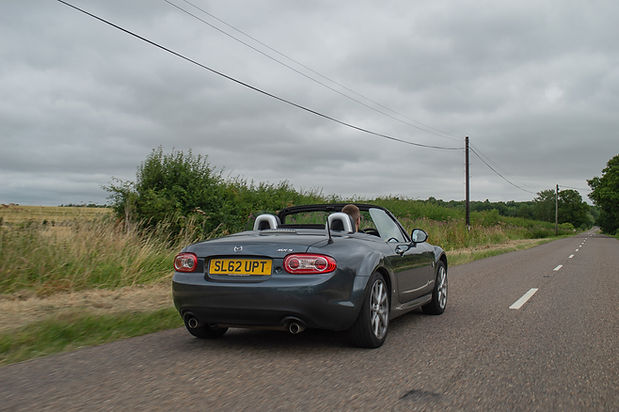
Perhaps the weirdest quirks of the car become apparent when I leave the B-roads behind and have to hypermile towards the nearest petrol station; the refinement is actually better with the roof down, as I expect there to be quite a lot of wind noise when my head is exposed to a rush of air. The window switches continue to move around and I can never find them without having to look, although I’m sure that it becomes second nature with time.
Focussing on the cabin at last, it reminds me once again of the Nissan 350Z owing to the use of high-quality, good feeling materials on the main touchpoints such as the thin-rimmed steering wheel, gear stick, handbrake lever, door handles and the two-piece seats, but harder wearing and less pleasing to touch materials elsewhere. I will immediately caveat this by saying that nobody goes looking for harder-wearing materials in obscure parts of car interiors unless they’re reviewing them, but one of the door-mounted plastic speaker covers isn’t the most comfortable place to rest a knee when the cruise control is active.
Speaking of cruising, a highlight is the car’s excellent ride which is in touch with but not ingrained into the road surface; the primary ride is compliant with the car not being phased by ruts or small potholes, while the secondary ride ensures that the car re-settles quickly and smoothly when it does encounter a larger bump. It feels as though the car moves in unison, with little pitching or rolling other than what it allows to communicate with the driver.
However, after a slipstreaming session behind an HGV, the frustration came out at one of my least favourite features in any car: a hidden fuel flap release. I first encountered this in an Aston Martin DB9 where the button is located on the transmission tunnel, hidden by the seat base. I was flummoxed by the 350Z that places its pointless button in an invisible spot on the dashboard, but the NC MX-5 outdoes them both by having an anonymous clothes peg-style lever to pull out from the storage area between the seats.
The inconvenience of this irritating necessity prompted some thoughts about practicality; there are two cupholders underneath a rolling cover which doubles up as the central armrest, along with the otherwise useful central storage area with that useless fuel flap lever, along with a reasonably sized glovebox. The door nets are good for holding slimmer items like a bow tie, but there is a larger space to be found in the boot with 130 litres on offer. This may sound tiny, but apparently it’s all the space that you’d ever need when written in the context of Porsche 911s which offer a gargantuan 132 litres, so it’s more than enough.


Collecting my thoughts on the final stretch, I realise that the approachability of the MX-5 is one of the absolute stand-out features of it; it feels good to shuffle across a roundabout at 30 mph and good to slink through undulating curves at 60. It handles so sweetly even on imperfectly specified EV tyres, but I also think that this car would still behave itself and provide a good driving experience on less than exemplary rubber too; this is the first car that I’ve ever thought this of, as there seems to be so much inherent mechanical grip that it doesn’t feel as though it needs super sticky tyres to get the best out of it.
It appears that there’s a reason why Mazda have been reluctant to create a “more hardcore” version of the model for so long and left that to the dedicated aftermarket tuners: the car is so confident in itself, its handling and engine performance that it doesn’t need an S, GTI, R, RS, GTS-RI or R-GSI-T badge (or any other combination of those letters) on its boot lid to deliver exciting, attainable performance. I like it as it is. The MX-5 delivers on the handling, engagement and usability fronts with ease and makes an incredibly strong case for itself by offering back road thrills and year-round, all-weather usability.
The issue that the car has always had is its competitors that seemingly offer more in terms of power, torque, cylinders, turbochargers, exhaust pipes, interior features and badge prowess. I’ve referred to it as a sports car no fewer than four times in this review but to some, the car doesn’t quite fit that bill. Isn’t a sports car supposed to have at least 200 bhp now? Shouldn’t it look dramatic rather than elegant? Is handling really a strong enough selling point when warm hatches are quicker to 60 mph than this roadster? They’re all valid questions and ones that I would be inclined to say yes to, if I hadn’t just spent three hours grinning at the wheel of the MX-5.
The spec sheet can sell the car short – especially when compared to the numerous 987-series Boxsters that are being advertised for similar money. They come with six-cylinder engines mounted behind the cabin and a Porsche badge on the nose, but they are a class above in terms of size and running costs so it’s not quite right to compare the German apple to the Japanese orange in my opinion.
It’d be more appropriate to throw the short-lived, front-wheel drive Mini Roadster into the mix – specifically in more spritely Cooper S or JCW forms – as this was the last small roadster that I can think of that competed in the MX-5 class rather than the Boxster/TT/SLK class. But let’s refocus on the subject of this review; the Mazda MX-5 NC offers a bandwidth of performance and usability that ranges from being a competent and comfortable car to endure work-bound traffic in, to putting the driver in touch with their surroundings while offering a relaxed gait on indirect routes home, and being able to enjoy the challenge of making swift progress when the twisty roads belong to you and you alone.
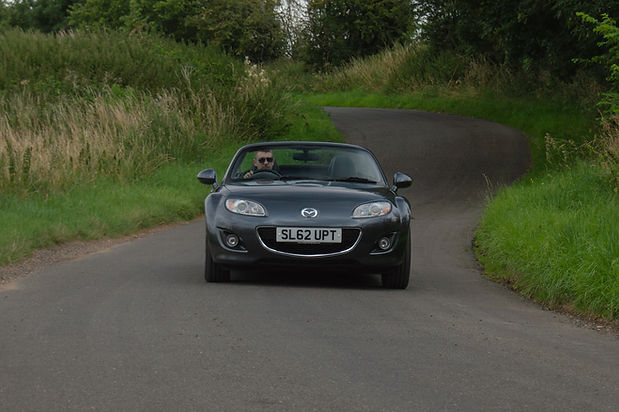
Granted, it doesn’t deliver as much measurable performance as its larger, more powerful competitors, but it doesn’t really need to do that in order to present itself as an approachable, enjoyable and usable compact sports car. It’s no wonder that the UK has always been a strong market for this car and that it has maintained its popularity throughout four generations.
Driving the car has made quite a lot of things make sense, so to put it simply, it’s obvious why the MX-5 is the obvious choice.
Good: steering, approachable and exploitable performance, ride quality, seats, overall reliability
Bad: super long gearing, ridiculous fuel flap release, potential for rust
Epilogue: Attainable Performance

This series is all about cars that have very few barriers to ownership or enjoyment. Price-wise, there can be less than 1,000 pound-shaped barriers to having an NC MX-5 on your driveway. Even at the time of writing in the height of summer, there are plenty of sub £3,000 options available, although most of them are the pre-facelift models from 2005-2008. 2008-2012 examples are on offer from around £3,000-£12,000, with prices for the last of the line specials such as the 25th Anniversary Edition being advertised for up to £14,500. There seems to be very little price difference between the soft top and Roadster Coupé hard top versions.
Our 2012 test car benefited from the first facelift, while a second facelift came in 2013, bringing a slightly enlarged grille, two small splitters on the outer edges of the bumper and reshaped headlights. The three “generations” within the production run are commonly called NC1 (2005-2008), NC2 (2008-2012) and NC3 (2013-2015). There were countless special editions over the course of the NC’s production, but the only one that really stands out to me is the 25th Anniversary Edition with its two-tone red and black paint.
As I said in the review, anyone who’s never driven or owned an MX-5 of this generation will tell you that the 1.8 litre engine isn’t worth considering and thus the LSD-equipped 2.0 litre is the only way to go. The smaller engine puts out slightly less power and torque compared to the larger engine (126 bhp and 123 lb ft vs 158 bhp and 139 lb ft), and has one less gear ratio with a 5-speed manual being the only choice. However, if the main use is going to be B-road blasting at sensible speeds, you may not miss the sixth gear all too much but I suspect you would if you plan on using the car every day and do a lot of motorway cruising with it. A conversation with a friend somehow ended up at the 1.8 litre NC and he described the 5-speed gearbox being “absolutely perfect, with perfectly spaced ratios. It’s no wonder why that specific ‘box was used in the Morgan 3 Wheeler!” An automatic gearbox was available for the 2.0 litre, but the car deserves to be a manual in my opinion.
Two things that I deem to be essential in any car are cruise control and heated seats; within three minutes of switching on the bum warmers, the seat becomes warm enough to fry a steak, and this makes the car that little bit more civilised and usable all year round.
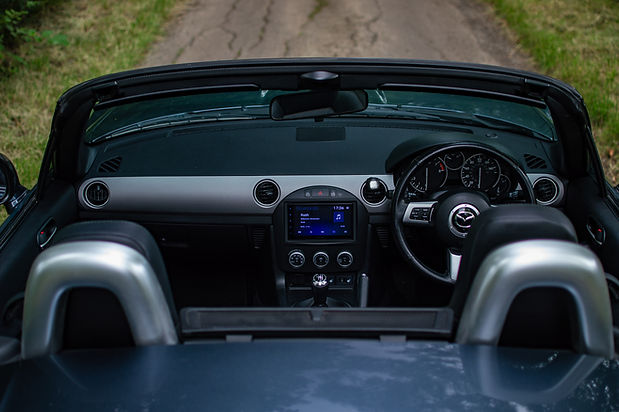

Rust is something the MX-5 has always been associated with, and the NC isn’t totally immune. The areas to check are ahead of the rear wheels behind the wheel arch lining, underneath the car – especially the rear subframe braces. Regardless of whether you opt for the fabric or metal roof, check the floor mats for any signs of moisture as this could indicate water getting through the roof or past the seals.
Other than obvious signs of lowering the local badger and pheasant population, a dent or two is probably nothing to worry about. The earliest NCs are rapidly approaching 20 years old and the youngest ones turn 10 next year, so expecting a showroom condition car may be a little bit unrealistic. Service history is always key, especially when every fifth service on the NC should be a major one. Ensure that each trip to the workshop is documented in detail, or add another few pennies to the servicing budget.
For as long as the MX-5 has been on the road, tuning firms and owners alike have been extracting more out of the powertrain and chassis than Mazda bestowed the car with. There are countless upgrades and tweaks that can be done, from air filters to intakes, exhausts to forced induction and even engine swaps – with the most extreme example being the Flyin’ Miata V8 conversions, featuring a General Motors LS3 under the bonnet.
Owner Mark has his eye on a supercharger kit by BBR GTi, which would raise power and torque by 89 bhp 66 lb ft (89 Nm) for totals of 248 bhp and 213 lb ft (289 Nm). This drops the 0-60 mph time to just 5.3 seconds and with the long gearing of the six-speed transmission, who knows when it would stop accelerating?
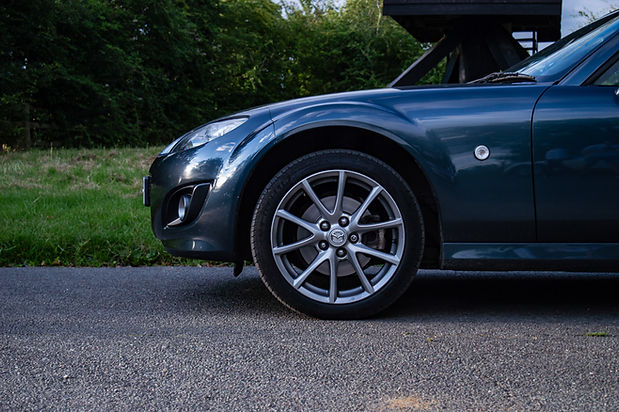
Together or independently of the forced induction, there’s no end of suspension modifications that can be made, with Eibach lowering springs constantly springing up (sorry) during a search for options. These lower the car by 30 mm and would help to make the wheels fill the arches rather than seem to be hanging from beneath them, and some of these were fitted at dealers when the cars were new. Other brands like BBR GTi, Bilstein, Koni and Öhlins all appeared repeatedly when browsing springs and damper kits for the NC roadster.
Even the interior can be easily modified, with mobile screen-mirroring interfaces slotting into the space where the original infotainment once resided. Owner Mark has opted for a Pioneer touchscreen unit which brings Apple CarPlay and Android Auto to the car while continuing to work with the steering wheel-mounted media controls. Lastly, although I didn’t find their positioning to be too much of an issue, the height of the seats can be reduced thanks to numerous lowering brackets. For drivers taller than myself or those wanting a greater sense of speed afforded by a lower seating position, this could be something to consider.
The MX-5 can be modified in countless ways to become your perfect personalised petite performance partner, or left entirely standard and to be enjoyed as intended by those that designed and engineered the little roadster in the first place. Would you stick with standard or try out tuning an MX-5?
Mazda MX-5 NC 2.0 – The owner’s perspective
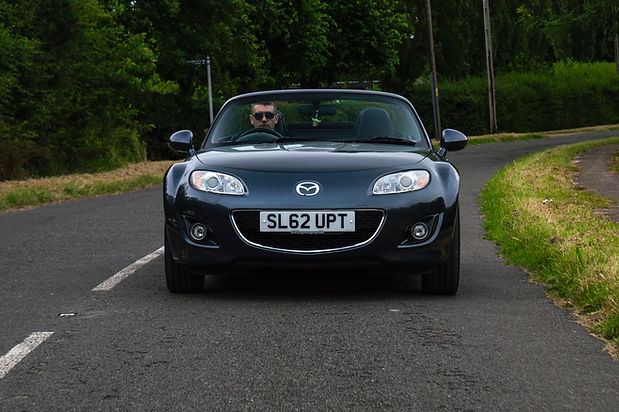
The car featured for this review comes courtesy of my friend Mark. The name may ring a bell if you’ve read our first Attainable Performance review which featured a Fiesta Zetec S with a Puma engine and an exhaust that gave me tinnitus for the following three days. The Fiesta and Mark’s former daily – a Peugeot 208 GTi – have both since found new homes and been replaced by one car: his 2012 MX-5 2.0 hardtop.
Do you miss anything about the Fiesta?
No!
Why did you choose this MX-5?
I wanted the newest one that I could afford – if I had the extra budget I’d have got an ND, but I also wanted to make sure that it was the top spec without worrying about special editions. It had to be the facelift, and it had to replace my old Peugeot 208 GTi as well as the Fiesta. This sits somewhere between the two in terms of age, tech, power and noise.
What do you like about it?
It handles like a dream, is rear-wheel drive and I love having a convertible! It’s one of the happiest looking cars on the road and I love the MX-5 owner’s wave. I get very angry when they don’t wave back though.
What do you dislike about it?
The wind and road noise is a bit loud with the roof up. It should’ve come with 180-200 bhp from stock too, as Renault were able to get that much out of a naturally aspirated 2.0 litre engine.
Do you like that ridiculous fuel flap release handle?
I’d call it a fun quirk.
If you were to make any tweaks or improvements, what would they be?
More power! Supercharging the engine is the aim, and to somehow make it quieter with the roof up…
Final say
The NC-generation MX-5 offers a lot while asking for very little in return. Yes, the price overlaps with Audi TTs, BMW Z4s and Mercedes-Benz SLKs of a similar vintage which offer more comfort and convenience features, but the MX-5 handles in a way that my favourite German two-doors could only dream of matching, not to mention being far cheaper to run and maintain. It’s light, nimble, sharp, direct, engaging, involving and crucially forgiving too. I say once more, it’s obvious why the MX-5 is the obvious choice.
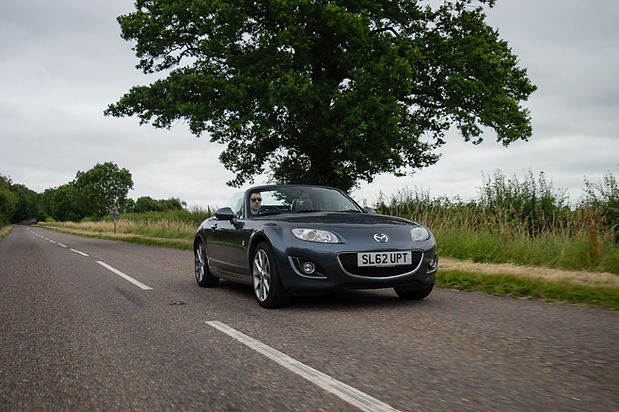
Specifications: Mazda MX-5 2.0 Roadster Coupé (NC)
Drivetrain: front engine, rear-wheel drive with limited slip differential
Engine: Mazda LF 1,999 cc naturally aspirated four-cylinder
Bore / stroke: 87.5 mm / 83.1 mm
Compression ratio: 10.8:1
Max power: 158 bhp at 7,000 rpm
Max torque: 139 lf bt (187 Nm) at 5,000 rpm
0 – 60 mph: 7.5 seconds
Top speed: 135 mph
Kerb weight: 1,153 kg
Power to weight ratio: 138.6 bhp per tonne
Weight distribution front/rear: 50/50
Length: 4020 mm
Width: 1720 mm
Height: 1255 mm
Wheelbase: 2330 mm
Front track: 1490 mm
Rear track: 1495 mm
Tyre size: 205/45 R17
Current used prices: Under £1,000 – £14,500