

Review: The Porsche 718 Spyder RS Is The Ultimate Swan Song
The arrival of the GT4 RS meant it was only a matter of time. Porsche had done what it had never before; it stuffed the 911 GT3’s 9,000-rpm naturally aspirated flat-six into a 718 Cayman. The result was dramatic.
Never mind its 493-horsepower output, an extra 79 hp over the GT4, the RS gained a close-ratioed seven-speed PDK, weight-saving carbon components, and beefed-up aero pieces complete with a swan-neck rear wing. Its intakes sat just behind your head, ensuring no conversation, tune, or lingering thought could come between you and its blaring note.
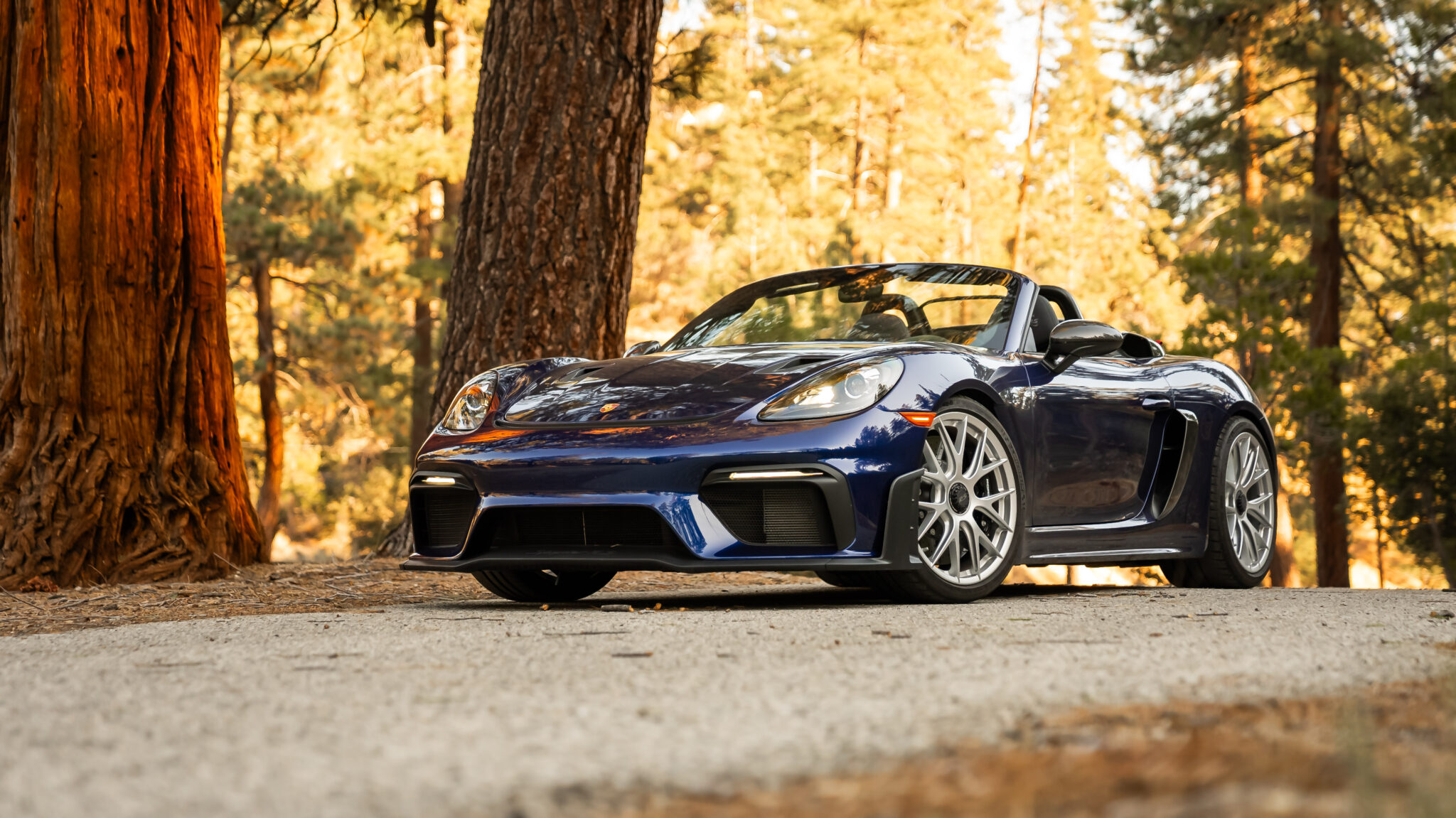
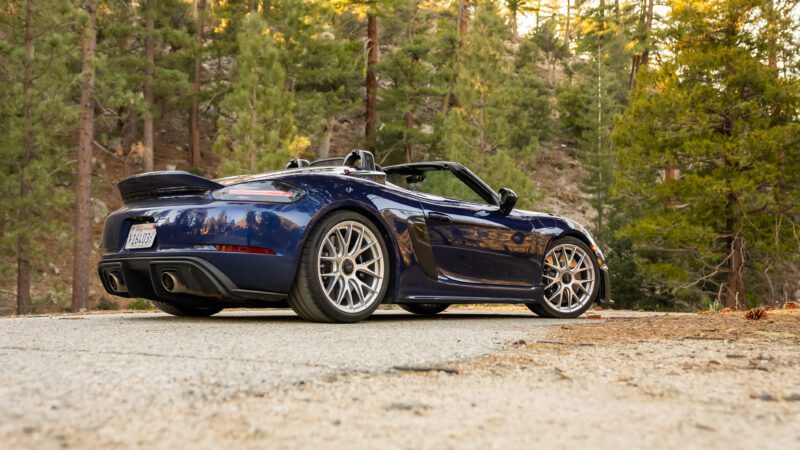
It was inevitable then that the Porsche 718 Spyder RS would come next, only that it didn’t arrive as expected. While it has the same 4.0-liter engine bolted to its back, an identical PDK, and most of the GT4 RS’ aero, its roadster form meant it could never be a fully dedicated track car.
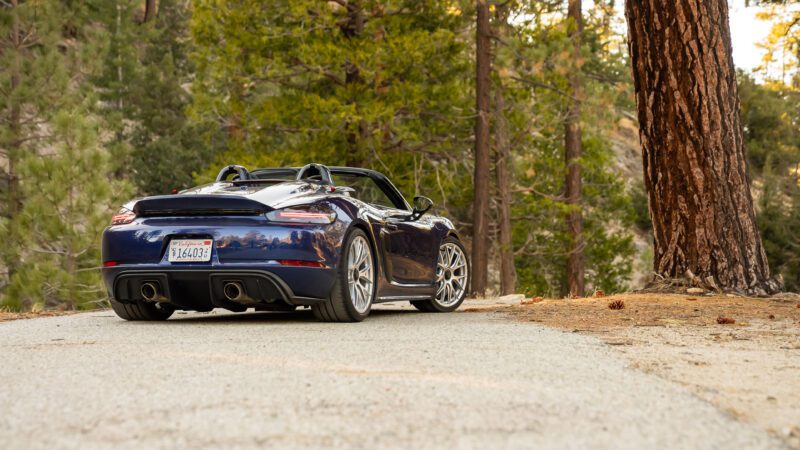
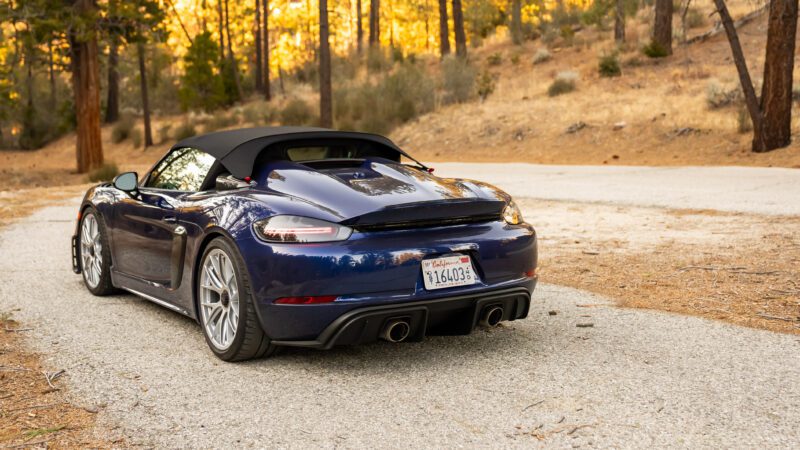
Porsche factored this in from the start of its development, designing the most extreme Boxster ever solely as a road car. As such, you’ll find softer suspension hiding beneath its arches, a modest ducktail instead of a towering wing, and a two-piece top you’ll have to break down and stow yourself.
Most importantly, its engine intakes remain tucked behind your ears, now unmuffled by metal or glass. It doesn’t sing. It transitions from a guttural bassy note at low revs to a deafening shriek as the needle on its tach approaches its 9,000 rpm redline. Yet even then, as your ears ring and your head pounds, the feeling behind the wheel is bittersweet.
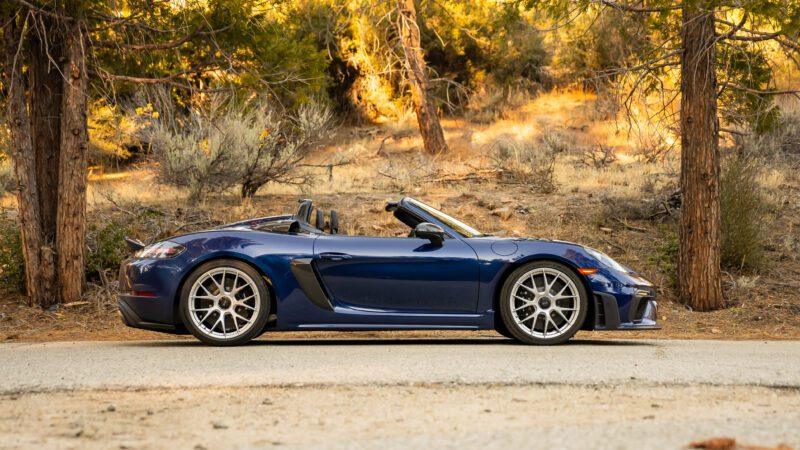
The Porsche 718 Spyder RS arrives at a crucial moment for the German carmaker and the broader sports car scene. Later this year, it will go out of production, as will all gas-powered Cayman and Boxster models, with a yet-to-be-announced electric successor expected to debut in the coming months. The fear is, of course, that it will swell in size and weight as a result of its need to make room for a battery pack.
It’s still far too early to get on the soapbox, though. If the Taycan has taught us anything, the folks at Stuttgart know how to build a thrilling EV. Still, the Spyder RS represents one of the final opportunities you’ll ever have to buy a mid-engined Porsche powered by a high-revving naturally aspirated engine. While the 911 will carry atmospheric aspiration as far as it’ll go, the Spyder RS symbolizes the end of an era.
That’s the bitter, but what about the sweet?
There’s plenty. The experience of driving a Porsche 718 Spyder RS can only be described with superlatives and melodramatic praise. It is among the most thrilling, best-sounding, and finest-driving sports cars of the last decades. It’s the kind of car you can’t live without after you’ve experienced it.
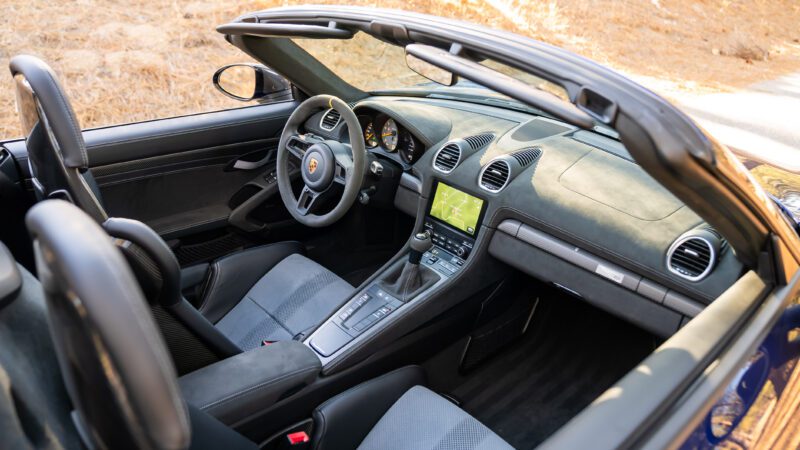
It first draws you in with its steering. Even before you pick up the pace, it chatters with feedback from the surface below. It may not convey as much road texture as a hydraulic setup in older Porsches, but it’s excellent as far as electric power systems are concerned. It’s nicely weighted and loads up well as your speed increases. The Race-Tex wrapped wheel itself is small, paired with a quick rack, resulting in an instant response from the front end.
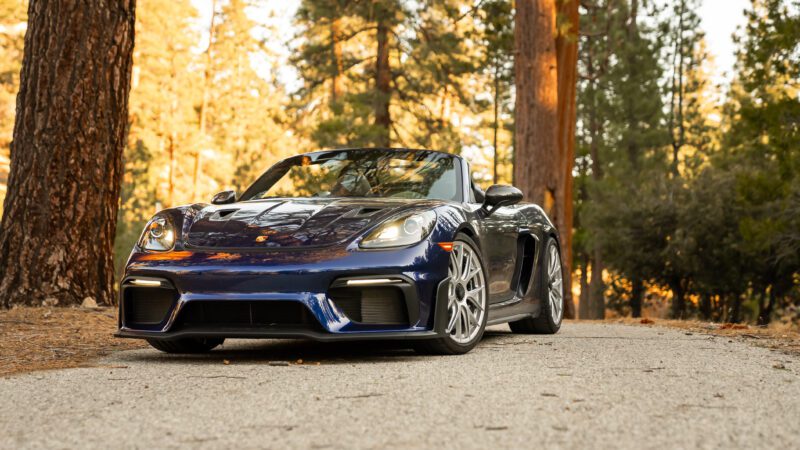
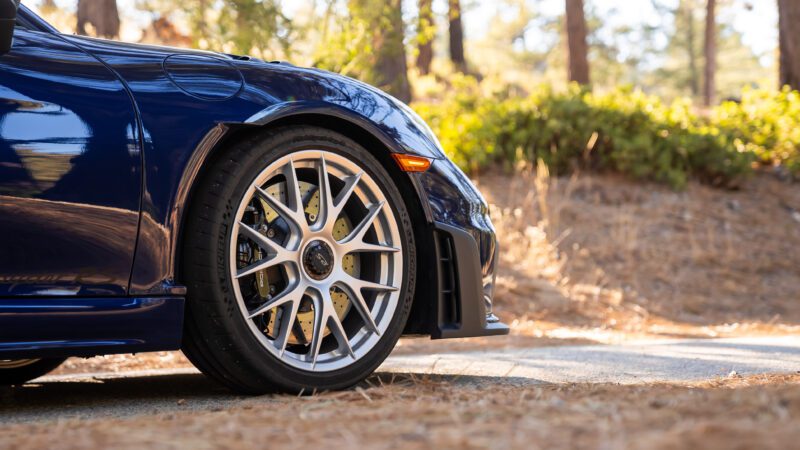
The RS sits 1.2 inches lower than a standard Boxster while its front and rear tracks widen. Peek beneath its front fenders and you’ll find a pair of MacPherson struts, each with a main and a helper spring like you would in a 991.2-generation 911 GT3 RS.
Although the Spyder gets reduced damper rates to create a more compliant ride, it comes standard with Porsche Active Suspension Management, which allows you to quickly firm things up when needed. Likewise, its ride height, toe, camber, and anti-roll bars are all individually adjustable.
You need not mess with any of it, though. The Porsche 718 Spyder RS perfectly balances comfort and performance for street use. Although still firmer than a Spyder or GTS 4.0, the roofless RS doesn’t crash over bumps like its coupe counterpart nor translate unnecessary harshness to you behind the wheel. Instead, you get the feedback you’d want pulsing through the chassis without the added roughness of driving something mainly track-oriented.
As such, the RS isn’t a car that requires a special occasion or a perfect road to enjoy. While its engine revs to the moon, it’s equally happy to putter around town thanks to its quick-shifting seven-speed PDK. It’s practical, too, retaining the front and rear storage capacity that makes the Boxster a versatile sports car. Even deploying and stowing its two-piece roof becomes second nature after a few attempts. It’s still far from a quick setup should dark clouds begin to loom overhead.
Point it towards your favorite mountain road, open the valves in its exhaust, firm up its shocks, and you’re instantly reminded that it is still the most extreme Boxster ever produced.
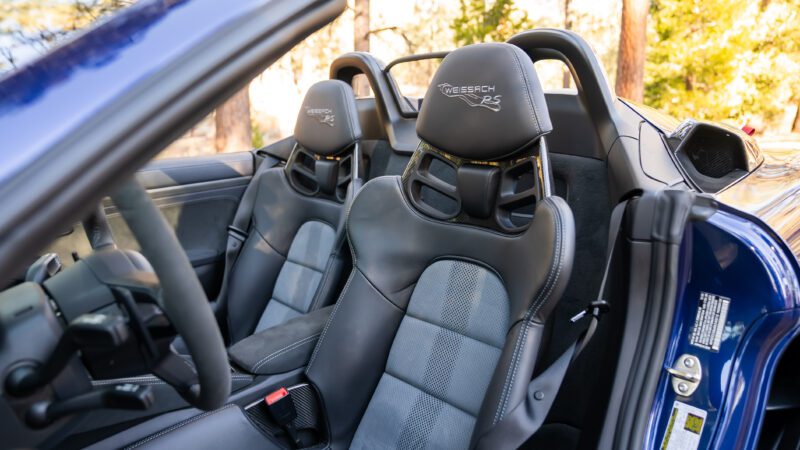
Tipping the scales at 3,214 pounds, it’s a featherweight by modern sports car standards. Thanks to its use of carbon fiber front fenders and hood, the RS is 59 lb lighter than a PDK-equipped 718 Spyder. The $12,570 Weissach Package and a set of magnesium wheels cut 22 lb of unsprung weight.
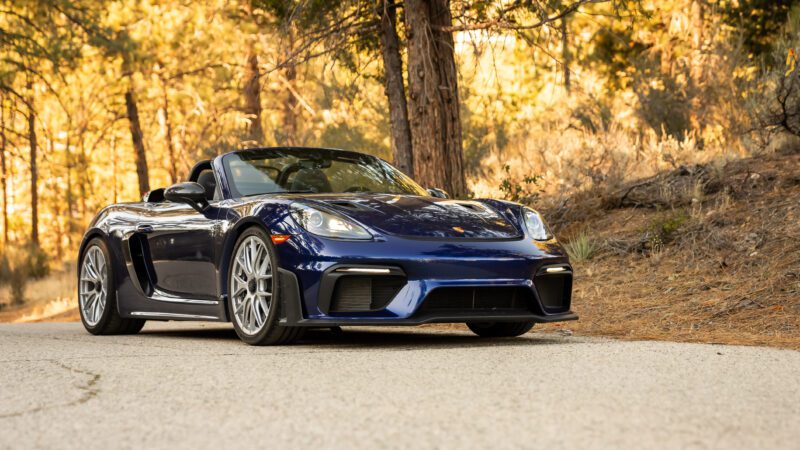
More importantly, the RS feels practically massless on a winding road. Its ultralight wheelset certainly contributes to the feeling. Still, in a space where sportscars often rely on clever tire and suspension tech to disguise their heft, the Spyder RS has nothing to hide.
Despite its softer suspension, there’s no body roll to speak of. The Spyder RS flows through a twisty road with effortless balance, constant feedback, and tremendous speed. The performance of its $8,000 carbon-ceramic brakes is excellent, and they make no unwanted noise around town. The resulting driving experience is cohesive, deeply involved, and thrilling.
Its 911 GT3-sourced 4.0-liter naturally-aspirated flat-six will go down in history as one of the greats. It revs to 9,000 rpm, a full 1,000 rpm more than a 718 Spyder, and produces strong power throughout the rev range.
Flat out, it’ll spring to 60 mph in 3.2 seconds and complete the quarter-mile in 11.3 seconds while maxing out at 191 mph.
Oftentimes, you’ll rocket out of a corner, look down at the tach, and realize the needle is only halfway there to the redline. Contrary to what you might expect from a high-strung engine, the power isn’t hidden away on a top shelf, although getting there is exciting nonetheless.
A blast up a mountain road with the top down is a recipe for the most delightful headache you’ve ever had. The buzzing shriek that comes on as the redline approaches is deafening. It’s unlike any other modern production car in that it isn’t coming from its twin pipes but from its rear-mounted intakes. It’s a noise that’s as authentic as it is loud and will be sorely missed in an electric future.
Still, there’s an elephant in the room, and that is its price. This 2024 model-year tester starts at $163,650, including a $1,650 destination and a $1,300 glass guzzler fee. If you’ve been adding up the optional extras mentioned up to now, this car’s $211,090 as-tested price should come as no shock.
Yet after experiencing it, it’s hard to fault anyone who puts up the money to have one, or even those who pay even higher sums on the second-hand market.
It’s not always immediately apparent that you’re behind the wheel of something special. As counterintuitive as that may sound, it can sometimes take a few hundred miles for a bond to form or a perfect Sunday morning drive on an impeccable winding road before the automotive epiphany comes. In other instances, a car’s greatness can remain hotly contested for decades.
Take the Lamborghini Countach as the ultimate example. It’s been over 50 years since it went into production, and while its status as an automotive icon is not up for debate, you’ll find no shortage of diametrically opposed opinions on whether or not it’s any good to drive. This won’t be the case with the Porsche 718 Spyder RS.
It is the ultimate swan song for Porsche’s mid-engined featherweight and a fitting sendoff for one of the most beloved sports cars in recent decades.
Tags: Featured
Review: The Lotus Emira 2.0T Broadens The Emira’s Appeal
by Gabriel Vega
in Reviews

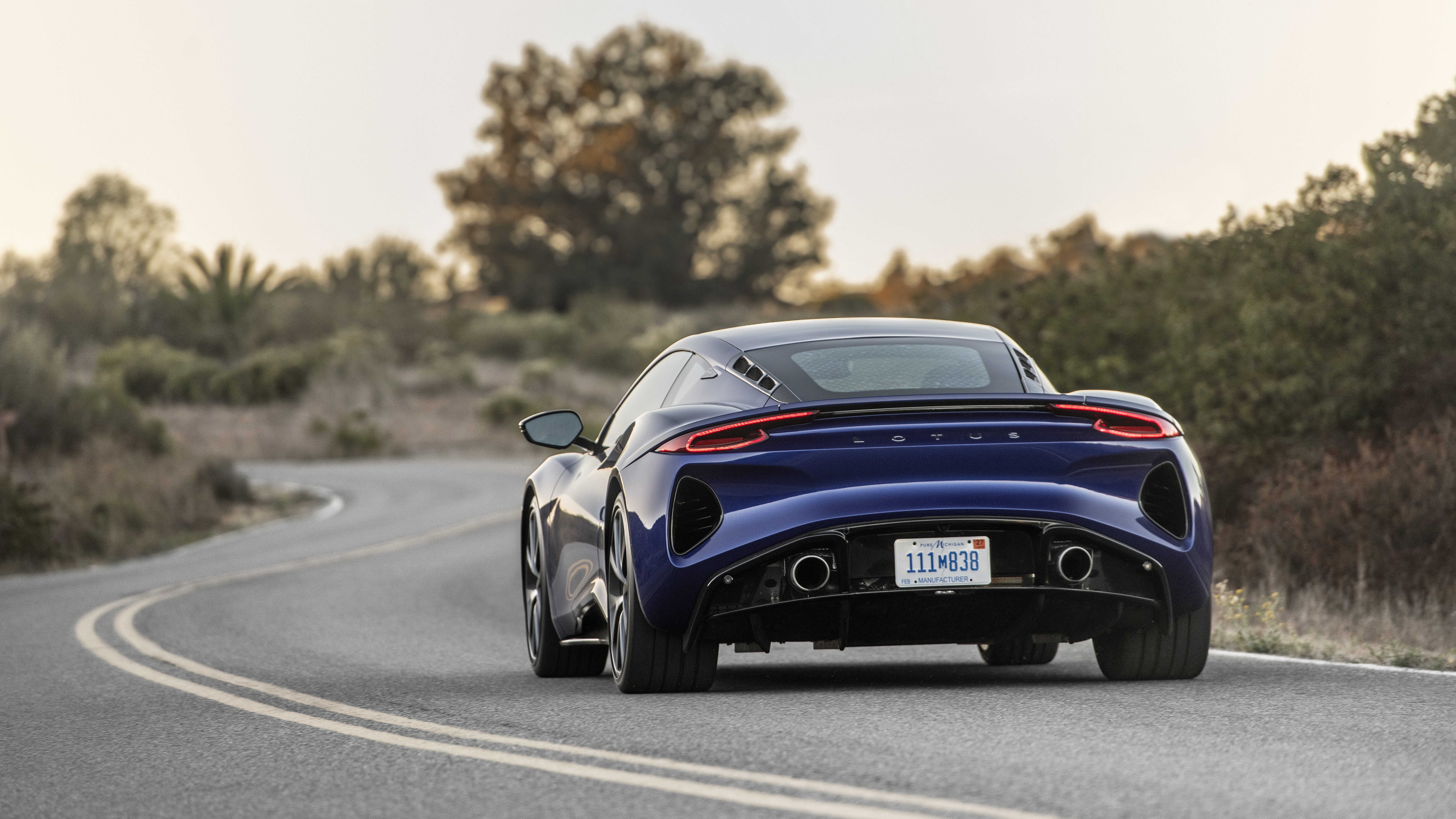
For the kind of person who makes an effort to rise before the sun to get an uninterrupted run on their favorite road, the V6-powered Lotus Emira flirts with perfection. As the sports car scene grows oversaturated with powerful giants masking as featherweights, the small Lotus reads like the product of a bygone era. A time when driver engagement, not boisterous performance stats, defined what a sports car should be.
This is nothing new. It’s this very philosophy that has defined Lotus from the start. However, today, what the British marque builds and, ultimately, its identity is changing.
I haven’t driven the Eletre SUV or the Emeya sedan because they’re not yet available for sale in the US, so I can’t get on a virtual soapbox and declare this pair of EVs to be the end of Lotus before promptly fainting and being whisked off-stage. Yet, given the disparity in powertrain choice, form factor, and sheer scale, you don’t need seat time to tell that these new cars take the brand in an entirely new direction. One that creates tension with its legacy.
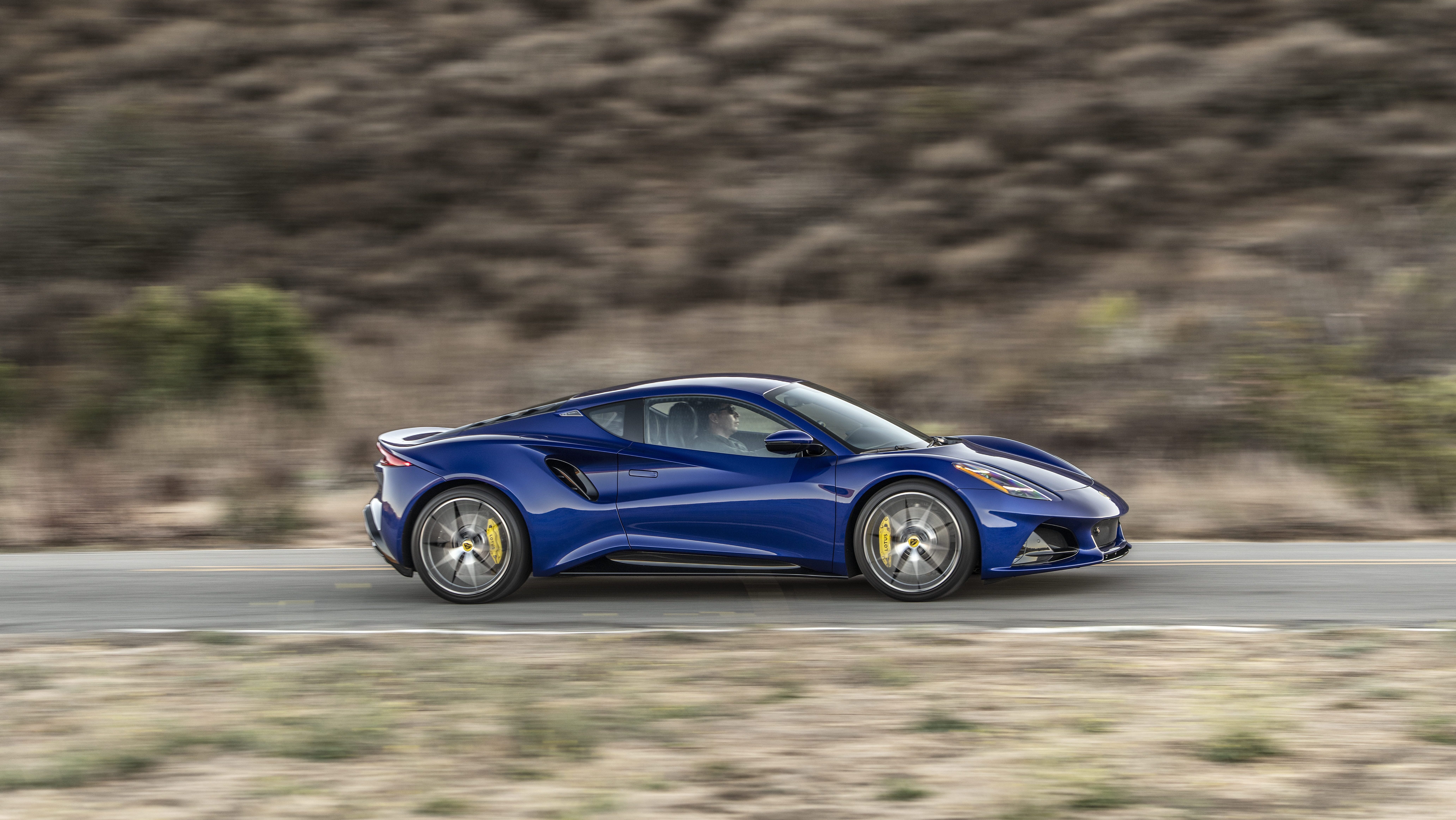
It’s at this pivotal moment that the new Lotus Emira 2.0T begins to appear in showrooms across the country. In contrast to the EVs, which in the eyes of enthusiasts are nothing short of sacrilegious, this mid-engined four-cylinder sports car arrives like business as usual. It’s genuinely light, great to look at, and surprisingly practical.
While the idea of an auto-only Lotus would’ve brought out the pitchforks a decade ago, the threat of electrification has even the harshest critics trying an open mind for once. It’s a great thing, considering that the 2.0T isn’t just the new entry-level Emira. For all but diehard Lotus fans, it’s the one to get.
As devoted as the loyalists are, the past two decades of US sales show that catering purely to the crowd for whom Colin Chapman quotes are more sacred than bible verses isn’t a great way to sustain a car brand. And while the V6-powered Evora offered an automatic option to broaden its appeal, it was a torque-converter plucked from Toyota’s catalog, not exactly a formidable rival to the Porsche Cayman’s PDK. The V6 Emira follows a similar formula and butts up against the same limitations.
In contrast, the Lotus Emira 2.0T presents an opportunity to attract potential buyers with a car that oozes character but also feels purpose-built to move through gears independently. Lotus achieves this by pulling its hand out of Toyota’s parts bin and into Mercedes-AMG’s. After rummaging, it plucks the turbocharged 2.0-liter inline-four out of AMG’s 35 and 45 models and its dual-clutch automatic transmission, transplanting them into the Emira’s back.
The results are immediately promising. Despite incorporating a heavier transmission, the four-banger’s smaller footprint is lighter than the V6 combo. Thus, the entry-level Emira’s 3,187-pound curb weight clocks in at just under the V6 car’s 3,212 lb figure. Yet it still produces 400 horsepower and 354 pound-feet of torque, surpassing the V6 car’s 400 hp and 310 lb-ft output.
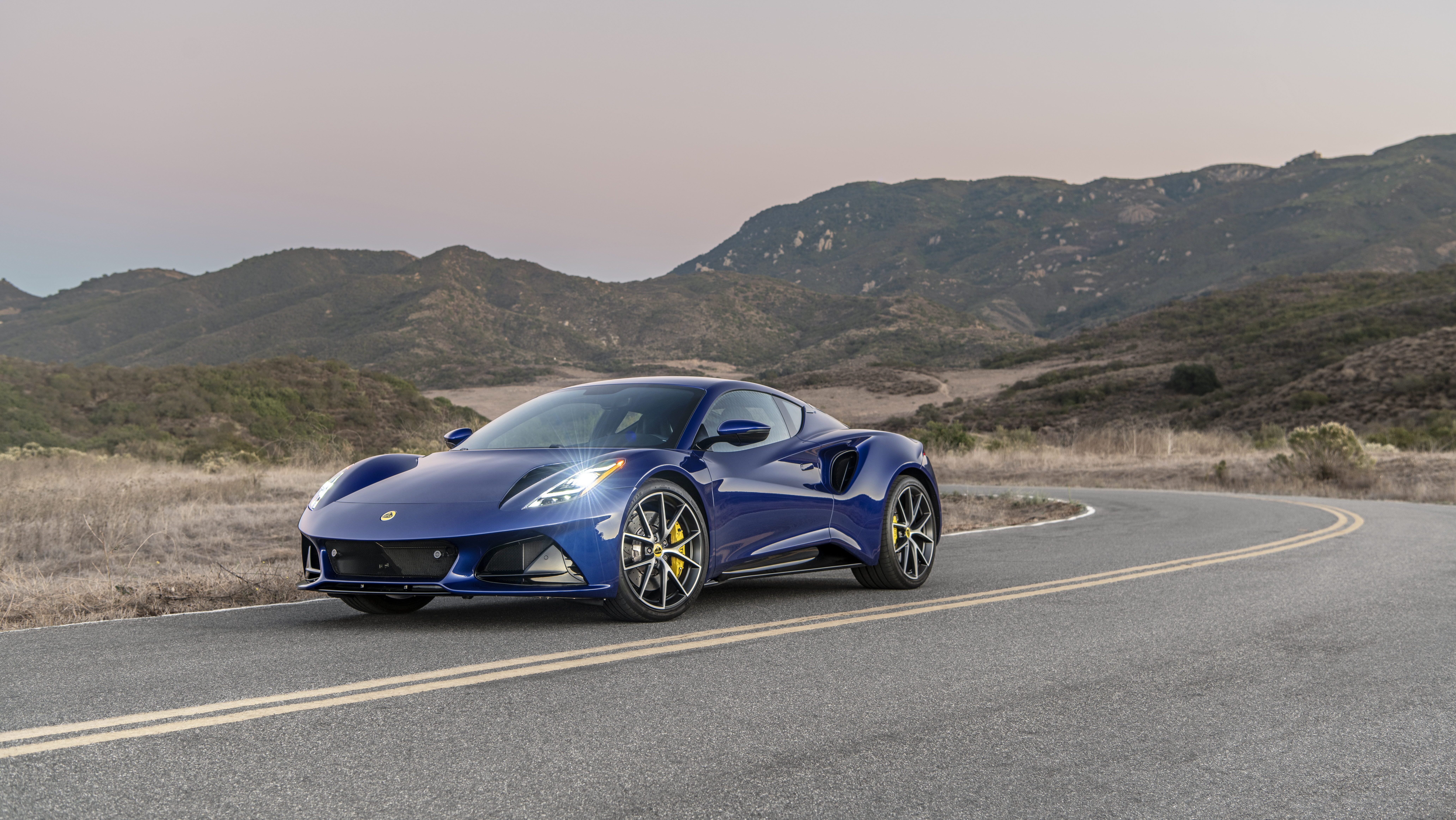
As you first get moving in the Lotus Emira 2.0T, you quickly realize that it offers an almost opposite experience to the V6 car from a power delivery standpoint. Its peak torque output picks in at 3,000 rpm, lower in the tach than its sibling, making it feel far quicker when accelerating from lower revs. Its rapid-shifting DCT makes its modest torque figure feel generously underrated. It bursts off the line where its sibling needs time to build speed.
Simultaneously, its power delivery holds fairly steady as it charges towards its 7,200-rpm redline, dropping off only as you near the top. That’s a full 400 rpm beyond what the V6 can manage. Contrary to what one might expect, if you want the highest-revving version of this sports car, you’ll need to opt for the Lotus Emira 2.0T.
As potent as this inline-four is, its sound is fairly conventional. Although some turbo noises add to the experience, you still get a fairly muffled note, helped only by the subtlest hint of buzziness. That said, the 3.5-liter V6 isn’t particularly sonorous either. Regardless of your choice, you’re ultimately in it for the performance, lightness, and responsiveness, not sound. This is one area where the Porsche 718 Cayman GTS 4.0 has the athletic Lotus beat.
However, regardless of which engine powers it, one of the Lotus’ greatest strengths is that it isn’t a Porsche. As good as the Cayman is, it’s become fairly ubiquitous, and the Emira offers a compelling counterargument for those who want something different. There’s a strong case to be made that the Lotus is the better looker of the two. It retains supercar proportions and simple yet elegant styling offered in a downsized package. There’s a hint of “Honey, I Shrunk the Ferrari” to this car, and its looks allow it to appeal to a broader audience than the firmly enthusiast-oriented Elise and Evora.
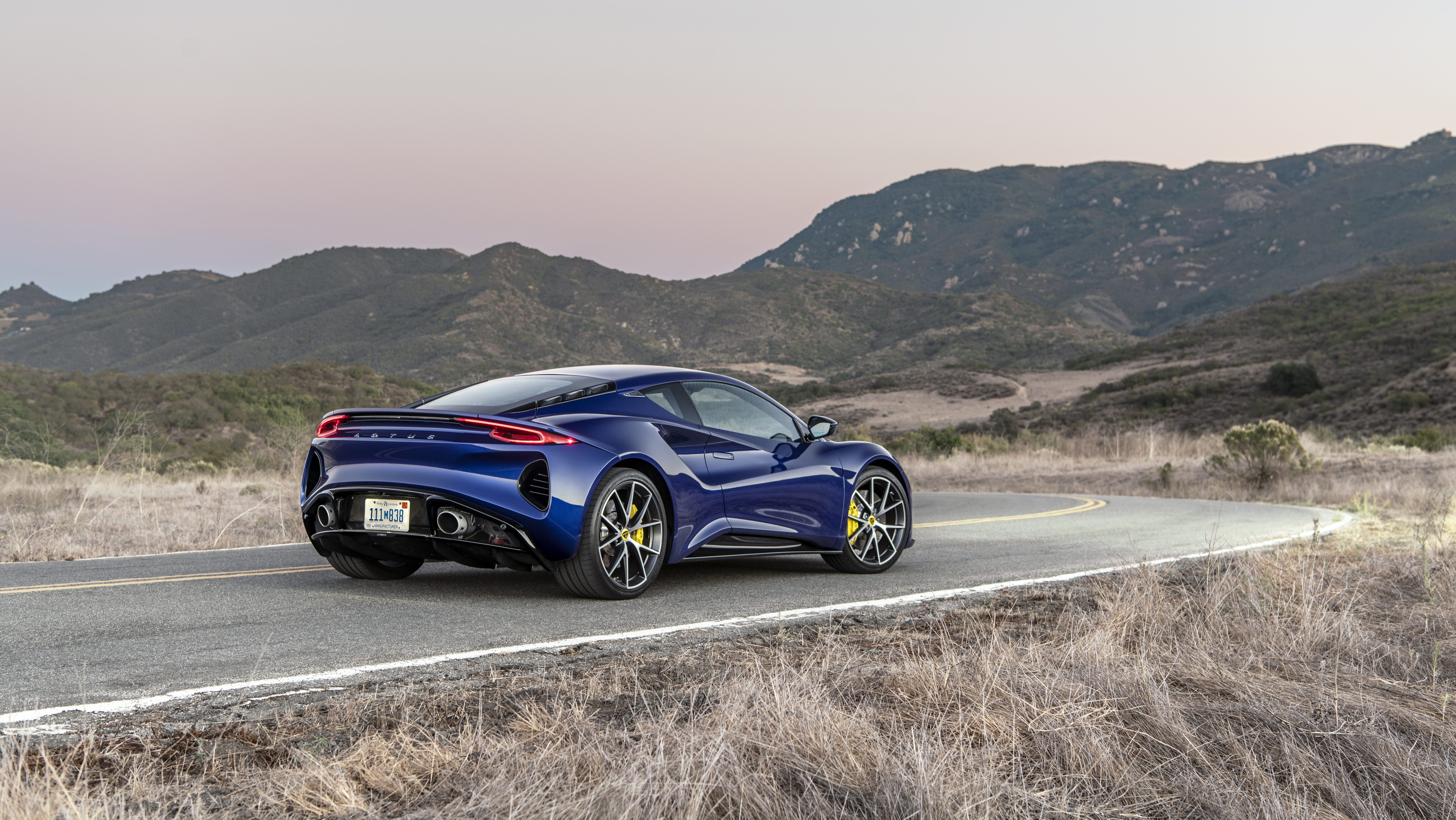
Its design draws people in, but its usability entices them to stay. If I told you that the Lotus Emira 2.0T isn’t just quick but light on its feet, agile on a back road, and delivers near-perfect handling, you’d say, “Duh, it’s a Lotus.” What you might not expect, however, is how this change in powertrain broadens its potential use case. The V6 Emira equipped with a manual is by no means challenging to drive. Still, it isn’t a compelling one-car solution for those in traffic-heavy areas. The 2.0T is.
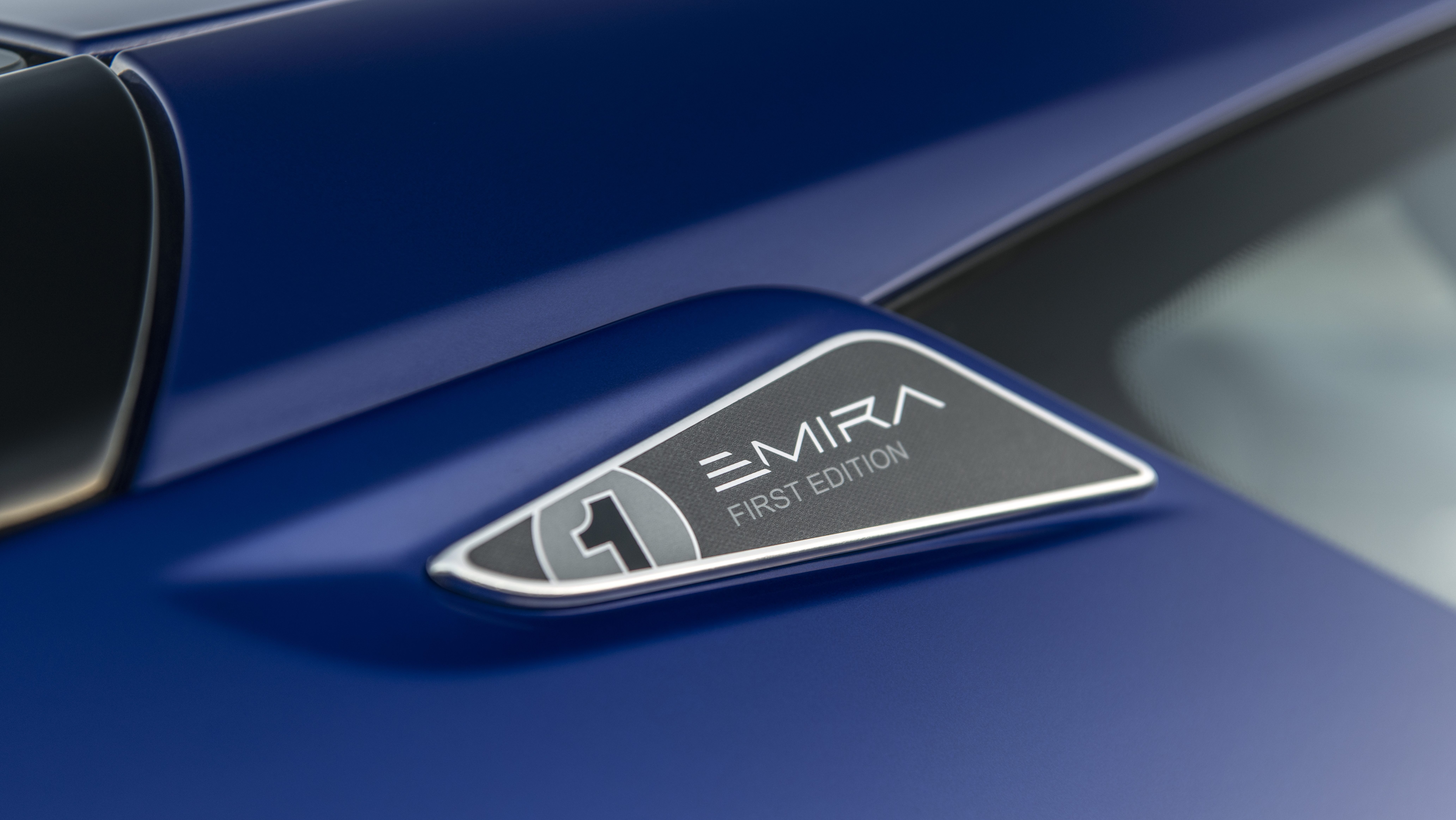
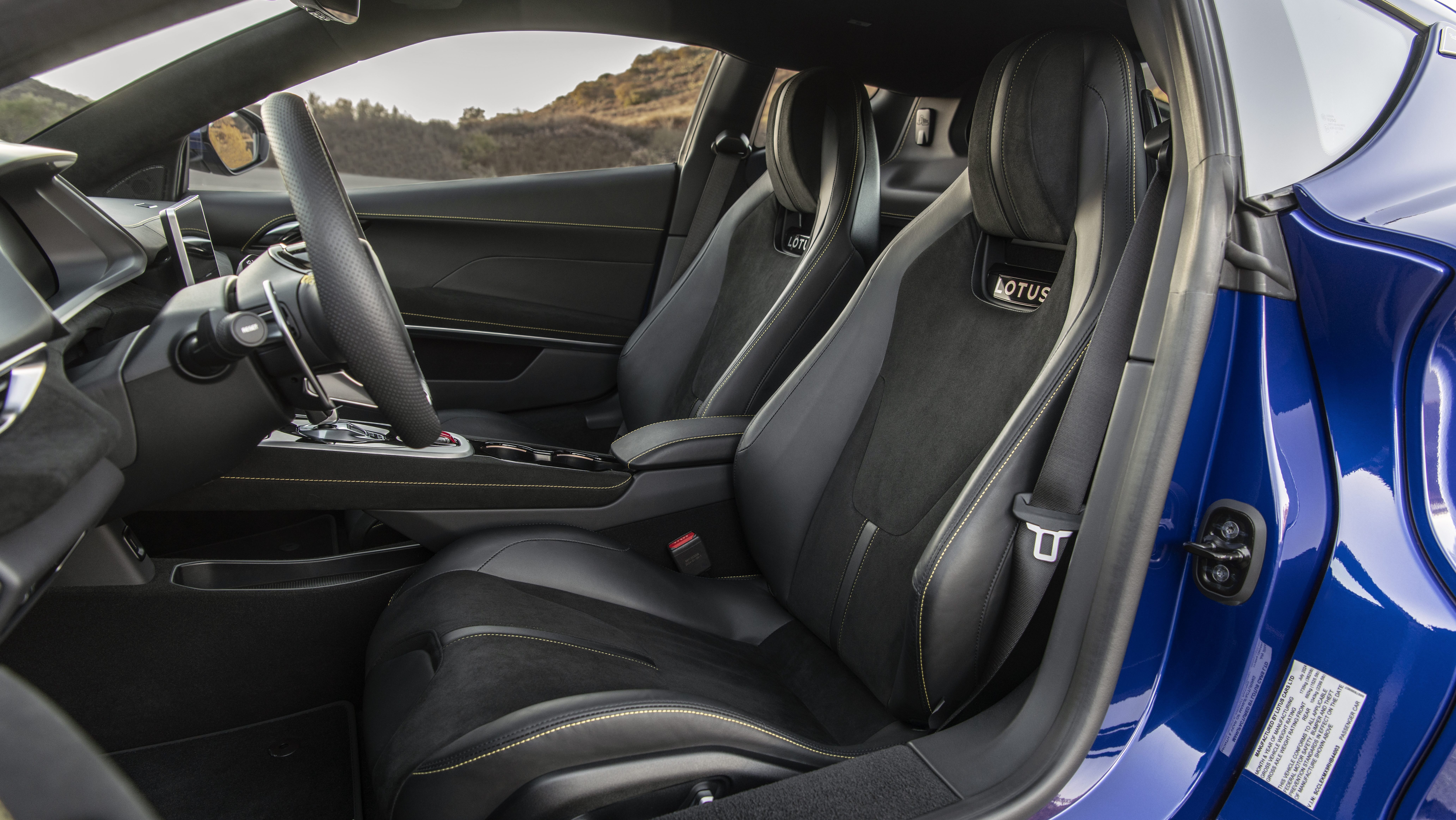
AMG’s DCT isn’t just fast on a winding road. It settles nicely around town. When you’re just looking to get somewhere, you can slot it into drive and go about your day without thinking twice. The cabin is quiet at low revs, while the Emira’s interior build quality is leaps ahead of the Evora’s. This First Edition model I’m driving is beautifully damped, delivering a compliant ride over rough surfaces. There’s ample storage space spread across a decently sized trunk and a storage shelf behind its seats. This car is primed for weekend getaways or road rallies despite its size.

As are its seats. The pair is comfortable, and finding the proper seating position is easy, given that the wheel and pedals are aligned precisely as you’d want. This cabin’s excellent visibility makes it approachable for those looking to try out a mid-engined car for the first time.
There are some quirks, however. Operating its gear selector requires careful consideration, given it requires a double input as it defaults to a central position. Its shift paddles are tiny and feel flimsy for a touch point you’re constantly in contact with.
The Lotus Emira 2.0T is a great-looking mid-engined sports car that is still exciting despite sporting an automatic transmission. However, there’s still an elephant in the room, and that’s its price.
A 2024 Lotus Emira 2.0T like this one starts at $99,900, not including destination fees. A comparable 2024 Porsche 718 Cayman GTS 4.0 starts at $95,200, not accounting fees, while the current 2025 model comes in at $99,700 following a recent price increase. Considering that the Porsche matches the Lotus from a usability perspective at a similar price point while offering a more compelling flat-six engine, the Emira has strong competition. Spend a little more, $113,795, to start, and you’re in Corvette Z06 territory.
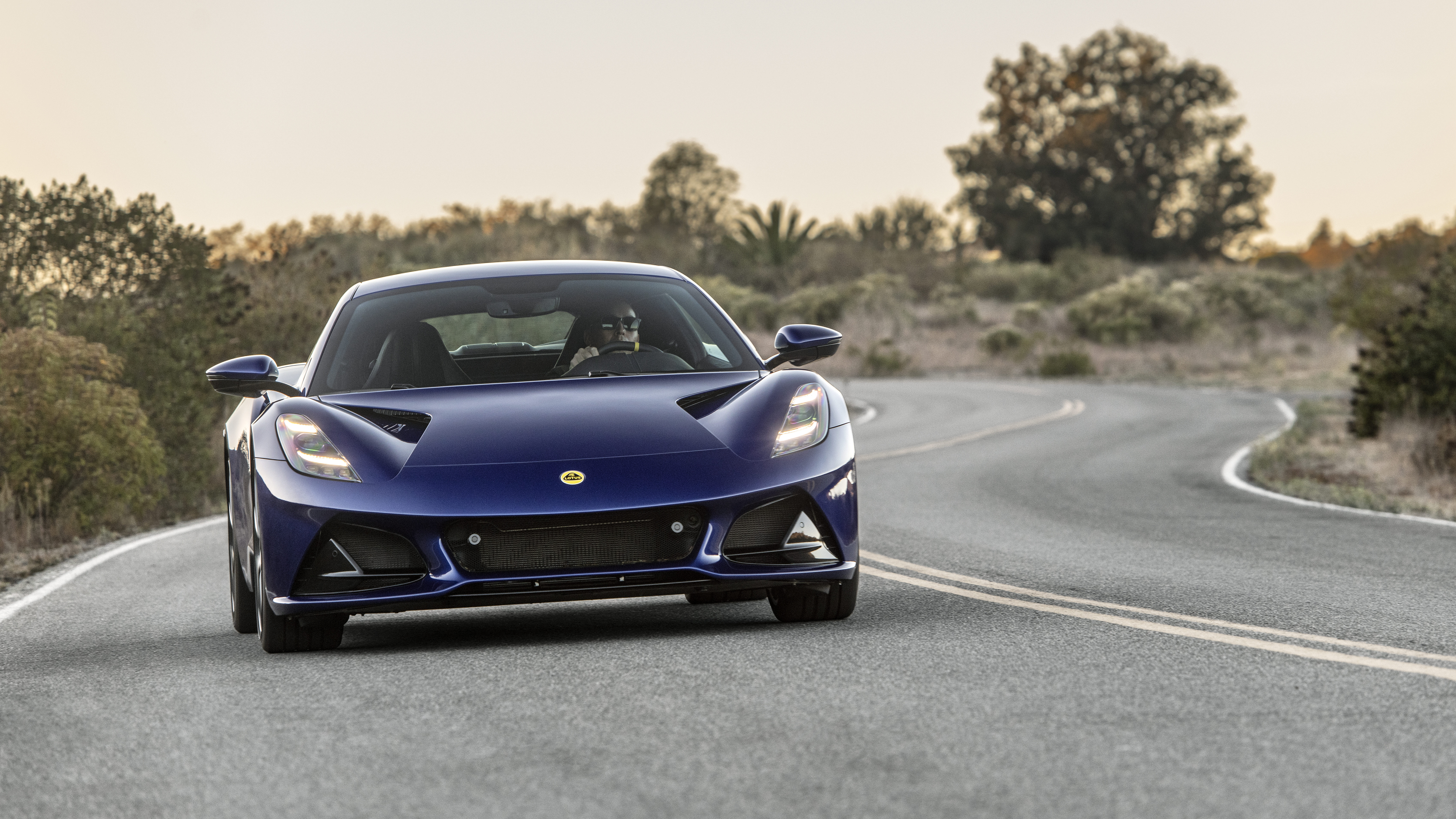
Yet as the British carmaker navigates this strange era where it offers lightweight sportscars and full-size luxury EVs, Lotus Emira 2.0T feels more tied to its legacy than its future. However, unlike the Elise, Evora, or even the V6 manual Emira, its appeal extends beyond those willing to get up early for a perfect drive. Enjoying it doesn’t require ideal conditions. Its most significant achievement isn’t that it’s a thrilling sports car but an automatic Lotus you’d want to have over the manual. It’s finally capable of being a proper one-car solution.
How The Hispano Suiza Carmen Sagrera Is Made: 5 Steps To Build The Ultimate Hypercar
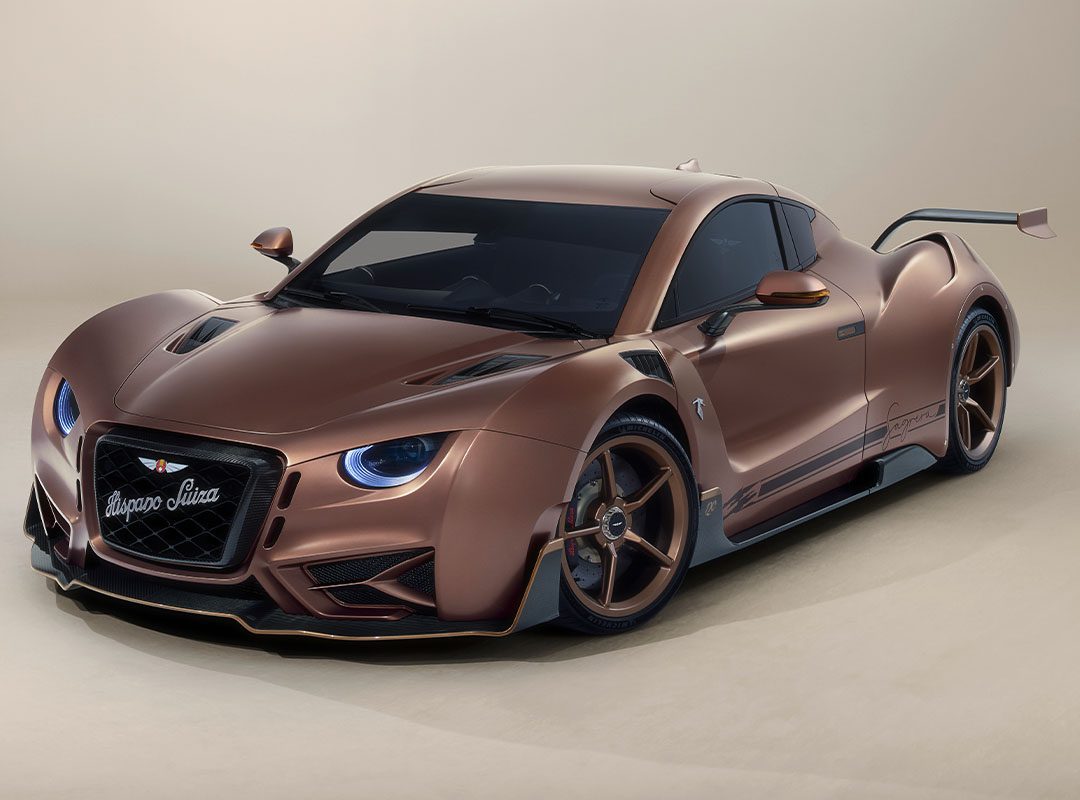
These are the five fundamental steps in its creation.
With well over a century of expertise in automotive manufacturing led by four generations of family-owned operations, hypercar brand Hispano Suiza continues to preserve its Spanish roots with modern marvels that compete with the industry’s biggest names. First debuted last June to honor Hispano Suiza’s 120th anniversary, the Carmen Sagrera stands out as a step forward in performance, efficiency, and driving range. The hypercar is powered by four electric motors that deliver 1,114 horsepower and an impressive 0-60mph time of just 2.6 seconds for true gentleman drivers. Handcrafted at its headquarters in Barcelona, Hispano Suiza is proud to showcase the five-phase production process of crafting a car better described as a true work of art on wheels.
Step 1: Pre-Assembly of Components & Battery Production
Building the Hispano Suiza Carmen Sagrera starts with putting together parts like subframes, suspension, and the dashboard, plus making its powerful 103 kWh battery. The design team works closely with owners to customize every detail, making each car totally unique and perfectly tailored to their style.
Step 2: Assembly of the Chassis
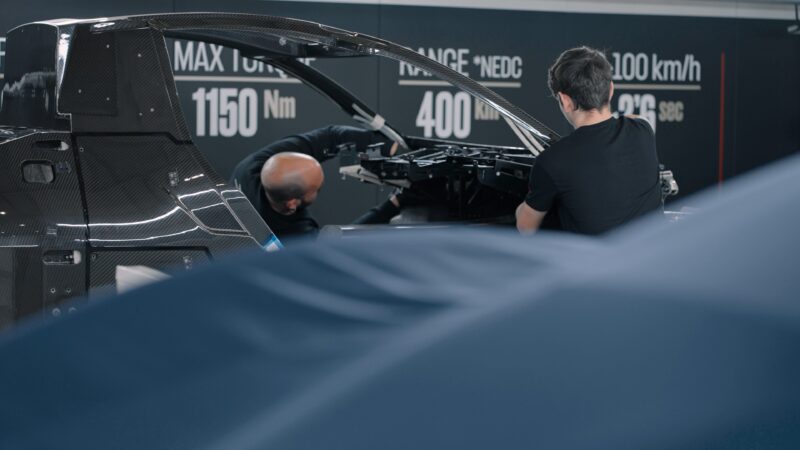
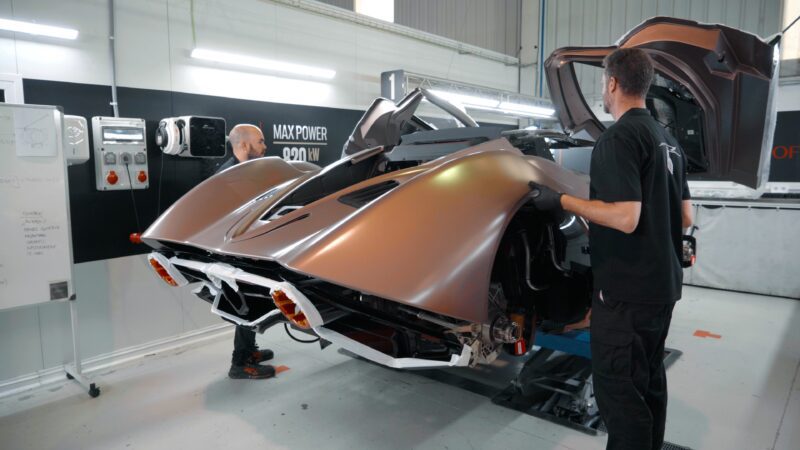
The next step in building Hispano Suiza’s latest hypercar is fitting the body parts onto the carbon-fiber monocoque. Every piece is carefully installed by hand to guarantee a flawless fit. At the same time, some interior features are also added, keeping the process as meticulous as ever.
Step 3: Painting, Upholstery, & Rolling Chassis Assembly
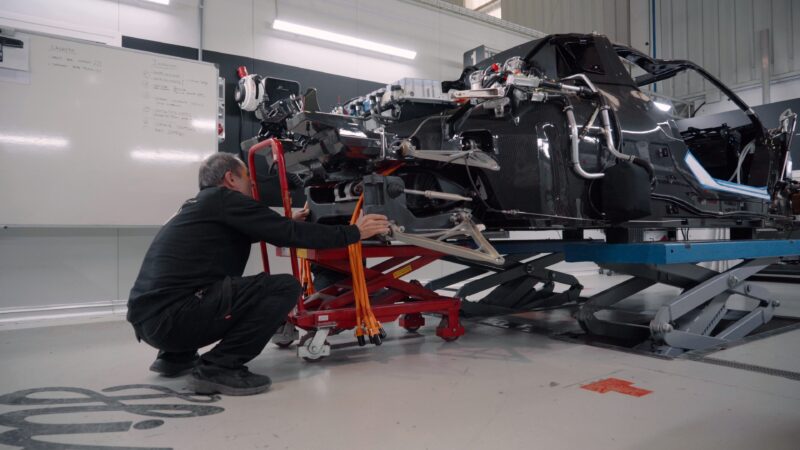
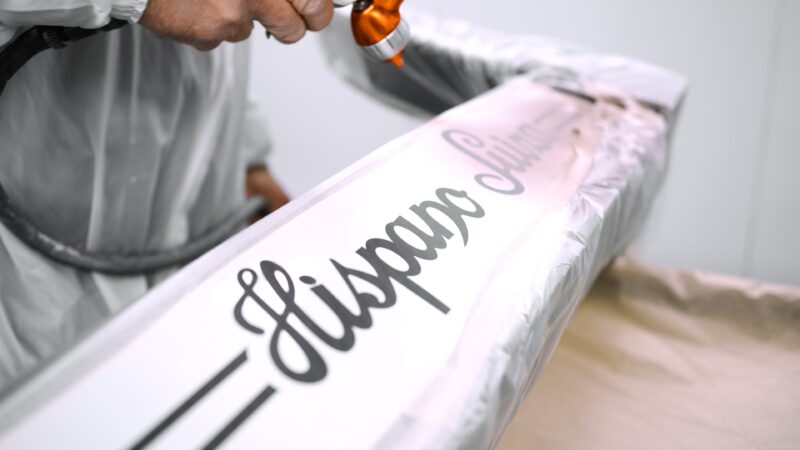
Once all the parts are pre-fitted and adjusted, the painting process begins, with the customer choosing from nearly endless color options offered by Hispano Suiza. Each coat is carefully applied by hand while the final touches to the body are also completed during this stage. Meanwhile, the wiring, cooling system, steering, and brackets are installed, along with the front and rear subframes and the rolling chassis components like suspension, brakes, and wheels. At the same time, the interior starts coming to life. Using premium materials like Alcantara or leather, the upholstery is hand-cut and sewn to perfectly match the owner’s personalized options.
Step 4: Final Assembly & Infotainment
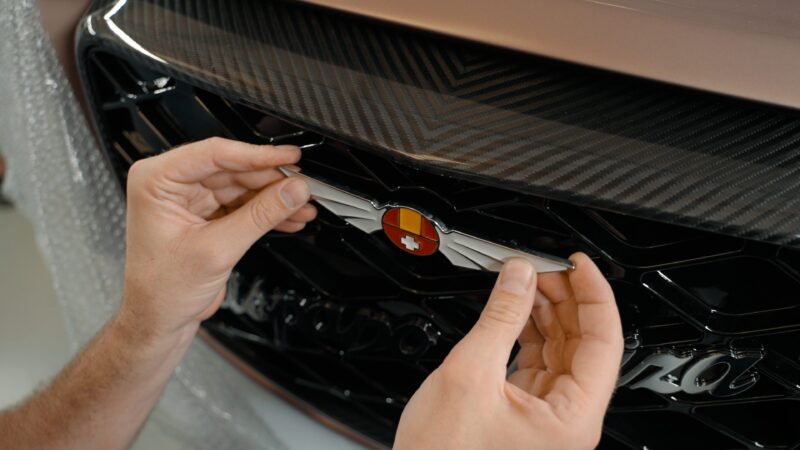
With the chassis assembled and ready to go, the team is now focused on finishing up the interior, including installing the infotainment system and all the comfort features. The final touches to the exterior are also being made, like adding the emblems and the iconic stork logo that truly brings the car to life.
Step 5: Final Validation & Handover
After about eight months of meticulous work, the Hispano Suiza Carmen Sagrera is finally ready for delivery. Before handing over the keys, the car goes through a final test drive on both the road and the track at the Circuit de Barcelona-Catalunya, right next to the brand’s facilities. Once everything is thoroughly checked and running perfectly, the car is delivered to its new owner.