


NC500 Road Trip – Taking the High Road in a BMW M2 Competition, Mini JCW & BMW m135i
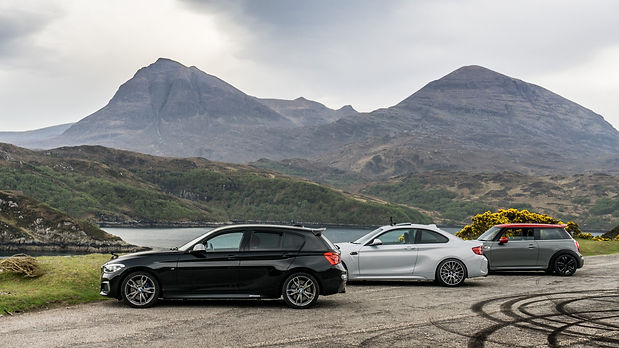
Our very first article, one that pre-dates the magazine but proved the inspiration for the entire project and its name – an ambitious 1,500-mile road trip into the heart of the Scottish Highlands and along the best of the North Coast 500, driving a BMW M2 Competition, modified Mini JCW and a BMW M135i.

It doesn’t matter how many sheep I count. The anticipation of the days ahead wins out, and the phone next to me constantly buzzing confirms the insomnia is contagious. All went to bed hours ago, eager to be of fresh mind and body for the road. I had even invited the members of our Motley Crew over to my house under the false pretences of saving time, thus extra sleep, but they saw right through my snake oil – the pub would have come calling and this trip is far too important for that nonsense. Still, the WhatsApp group would not stop pinging its excited messages across the airwaves, even the Witching Hour passed without a ceasefire in transmission.
There’s a good reason for our enthusiasm. Ahead lies a road trip of epic proportions – fifteen hundred miles over four days and three nights in a mission to sniff out the best roads Scotland has to offer. This isn’t a road test, it’s an adventure with the best possible company – bucket list stuff. The three cars we are taking certainly aren’t rivals, more like a progressive ownership curve. A finishing order isn’t the objective, but it doesn’t mean a few questions can’t be answered along the way. Copious amount of tea and biscuits were sacrificed refining the details of the plan, a route that pierces through the heart of the Trossachs before slingshotting around Ben Nevis and tracing the coastline to the Isle of Skye. The best of the NC500 follows, and then it’s an abrupt turn South at Kylesku, seeking out the Cairngorms and the challenging Old Military road.
The warm night air is making it even more difficult to settle, but it would be wrong to curse it. We are about to be blessed with the hottest spring on record, yet a week ago the trip was in jeopardy due to gloomy weather reports. A Nürburgring pilgrimage, the Isle of Man and even Ibiza were floated as alternatives. The cutting 4.15 am alarm call will be the least pleasant experience of the trip – whilst the urge to abuse the snooze button is strong, abuse from a late arrival would be stronger so I leap out of bed and hit the road. But already the night has claimed its first victim as I leave the house. Paul sits in the BMW M2 Competition, waiting for his co-pilot to rise. Soon a bleary-eyed Chris emerges, muttering something about a faulty alarm clock.
News relayed, I dial back the cruise control of the Mini JCW to 65mph and enjoy seeing the mpg counter climb north of fifty, impressive for a car loaded with the essentials of highland survival – sandwiches, snacks, water and fermented hops. Fifty to the gallon is certainly a number that won’t be seen again over the next four days.
Somewhere over the North Pennines meanwhile a third car is making progress, our meeting point and breakfast awaits. Only it’s heading in the wrong direction – the night has claimed a second victim as Marek, the man behind the lens, is on the phone apologising profusely for forgetting his cameras and having to turn around. A second round of sausage and egg butties is ordered. Thirty minutes later a sheepish-looking M135i pulls into the car park, its owner craving caffeine. Addictions and rumbling bellies satisfied, the convoy settles into an EcoPro cruise along the M6 for the long journey north…

The adventure proper begins at Aviemore. The tourists head for Loch Lomond, but we have an ulterior motive for coming to the Trossachs. The A809 & A81 have acted as the perfect palette cleansers after the motorway, but now our target is in sight – The Dukes Pass.
The innocuous turn-off Aberfoyle High Street didn’t show much promise, but immediately the forearms are given a workout as we’re pitched into a series of wide, sweeping hairpins, constantly climbing. Once scaled the road levels off but undulates with constant direction changes, never letting the cars settle. Any straights are short but sweet, the speedometer acquiring a quick thirty mph before the brakes are tasked with scrubbing it back off again. The corners keep coming, a kaleidoscope of turns of all shapes and angles.
Up front in the M2 Chris is using all his race craft but the hyper agility and low mass of the Mini are what count up here, and despite the difference in skill it’s easy to maintain touch. The Mini is aided by a couple of tricks up its sleeve – the car is both lower and wider to the tune of 30mm thanks to the fitment of the optional KW coilovers, 15mm spacers all-round and 17” wheels wrapped in performance-orientated Michelin Supersport tyres. The new suspension set-up and stickier footprint have combined beautifully to eradicate the standard cars’ floaty behaviour, locking down any pitch, dive and body roll.
Beforehand, the centre of gravity felt as if it gathered at a point around the driver’s shoulder line, giving a distinctive and unpleasant top-heavy feeling to the handling balance. Now, however, the Dan Tien is significantly lower, the mass of the car pivoting into a turn from your hips, each axle sharing the load rather than rolling into submission.
“Any straights are short but sweet, the speedometer acquiring a quick thirty mph before the brakes are tasked with scrubbing it back off again. The corners keep coming, a kaleidoscope of turns of all shapes and angles.”
The steering’s glassy initial turn-in has been eradicated and the chassis now makes sense of the quick steering rack – command and the car responds to the exact degree and tempo, with an economy of movement the others simply cannot match.
This isn’t a complete transformation, however. For all its accuracy the finer details remain elusive. A change in surface? Seen and heard but not felt. The transition from grip to slip? Not well telegraphed. You end up searching for alternate answers, learning to extrapolate the limit of adhesion through the seat of your pants and the oration of the tyres, assuming you can hear them over the racket of the JCW’s sports exhaust. Another optional extra party piece, the carbon-tipped pipes emit a riot of pops and bangs that ricochet back off the rock face and chase you up the road. It’s little wonder the Bluetooth fob to operate its valve comes with an anti-social behaviour warning.
As Loch Achray comes into view the exhaust valve is quietly closed to avoid disturbing the Lady of the Lake. Glencoe is the next port of call and I slip behind the paddles of the M2, but it’s an uneventful, if scenic, commute over to our first overnight stop of Fort William.
In this environment the M2 reigns supreme, picking off traffic with absolute authority, its companions no match for the rapid-fire gear change or top-end reach of the additional turbo. If only the voice generated in the process had more personality. All around us gentle slopes give way to towering jagged peaks and every side road shows promise – it takes considerable willpower to resist their siren call but tiredness and range anxiety curb our enthusiasm. One detour we do take is to Appin, where Castle Stalker stands isolated on a small island, stoically guarding the coast of Loch Linnhe.

A swim, steam, sauna and shower later we’re sat in the hotel bar with a beverage in one hand and the menu in the other. After some hangry bickering, a small high street bistro is chosen and seafood, burgers and fries are washed down with Peroni and a side of car chat.
Chris steers the conversation in-between a mouthful of fries “The Dukes felt like a rally super stage. Short in-gear bursts then hard on the brakes for the next bend. Left-right, left-right. The M2 felt like it was on a Scalextric track that you’d put together without any thought. The car defied its weight, tyres grabbing at the tarmac pushing us into the bolsters with every turn of the wheel and twist of the road”.
Marek, after grabbing the last onion ring “I bravely fought with the law of physics trying to move the mass of the M135i from right to left quick enough, to stay behind that nimble Mini and more powerful M. Then the brakes started losing the battle, increasing in heat with every corner. Over this rollercoaster road, the car felt like it reached its limits and started showing its weaknesses. No matter how hard I hustled, I simply couldn’t keep up.”
Back at the lodgings, the cabaret act is in full swing, the dancing on display straight out of the Phoenix Nights playbook. We leave Les Alanos and the young at heart to it and shuffle off to bed.

The next morning we wake up the entire hotel with booming cold starts. The Mini fires up first, followed by the M135i, exhausts amplified by the courtyard. When the M2 rumbles into life several curtains twitch. Time to make a hasty exit north.
It’s a striking morning, the sun has risen against a crisp, azure sky but the world remains asleep. Free from the responsibility of shouldering commuters, the A82 comes alive, a short fifteen-minute stint taking us to the commando memorial, where the gaze of the soldiers falls upon Ben Nevis, the last of the snow clinging to his peak, defying summer’s advance. We linger a little longer than planned – nobody complains.
Back on the move we’re making progress but taking our time. Inputs are measured and deliberate, short shifting through the gears, letting torque do its thing. We navigate around a series of breathtaking lochs under the watchful eyes of the Five Sisters of Kintail, each shoreline influencing the road in its own unique manner. Only one car is passed, German tourists who cheerily wave us through. If only the real world had such etiquette.
I finally manage to wrestle the keys to the JCW back off Chris after a couple of choice jujitsu moves at the foot of the Applecross Pass. This stretch has a reputation not for the faint-hearted with a warning sign speaking in bold of 1 in 5 gradients and tight hairpin bends.
But narrow width aside, the initial encounter is friendly – a sedate climb overlooking the beautiful bay of Kishorn. Then the compass needle swings north into the mouth of a dramatic glacial valley, typical in its U shape but somehow larger in scale. As the cliff faces tower above us, we get the same feeling the crew of the Pequod must have felt as they were swallowed whole by Moby Dick.
Battling the vertigo, we thread the needle through the signature zig-zag hairpins that deliver us to the 2,054-foot summit. The Inner Hebrides are scattered in front of us, their outline distorted in the heat haze. We all agree that we’d like another crack at the pass, preferably at 7 am with only the highland cows for company, or as Paul quips “where the steaks have never been higher”.


Tumbleweed cleared, all the day’s action has seen us work up quite a thirst and it’s amazing how people can suddenly find an extra gear when there’s a beverage at stake. Marek declares the last one back to the hotel buys the beers and does a Le Mans start into the M2. I’m left with the keys to the M135i with no complaints, for it’s the perfect combination of size, gearing and grunt for the Isle of Skye.
The engine takes centre stage after the Mini, its throttle response a highlight, even if it lacks the extra 500rpm lung capacity of the M2’s bespoke motor. It counters with a more cultured note emanating from the sports exhaust, easily putting the monotone M car in the shade.
Despite the car being hailed for its RWD layout, when the pace inevitably quickens it’s the front axle that impresses – faithful to inputs and gripping tenaciously, but offering little by the way of information to the palm of my hands. Traction isn’t an issue in these optimum conditions, but an off-camber left-right combination approaches with a hidden ridge. It’s telegraphed by a contained wiggle from the M2 in the lead so I keep my foot in, but the M135i ties itself in knots, the shockwave producing an odd corkscrewing sensation from the rear. It shakes my confidence in the chassis and from that point onwards I back off, wary of getting an encore. I pinpoint it to the bushing at the rear axle, which is just too soft for an engine of this magnitude. Unfortunately, as the trip goes on I won’t be the only one to notice the M135i’s twerking.
The other two have disappeared over the horizon but it doesn’t matter. Free of the peer pressure of trying to keep up, I strike up a rhythm with the baby M – running with the windows down, the warm breeze mixing with the aroma of salty air and the occasional whiff of tortured rubber and acrid brakes, all underlined by the soundtrack of the sonorous straight six.
Driven at seven-tenths, the M135i is fine company. I’m eventually reunited with the group in Kyleakin, where I pay my forfeit and our thirst is quenched whilst overlooking the stunning Skye Bridge and Kyle of Lochalsh. We are treated to a stunning molten orange sunset as dinner is devoured – more fresh seafood. With jutting bellies, we walk back under a sky of a thousand stars. Paul makes his excuses and heads to his hotel – he’s being a lone wolf tonight, staying in plusher surroundings, no longer able to cope with the group’s collective snoring.

The morning sees us rudely awakened by the feral cry of a wild animal. Soon Paul is on the phone howling over a breakfast mix-up, in that he doesn’t get any. We explain how we’d love to come and help him find some, but our bacon is as thick as gammon and we may be some time. We smuggle a ham and cheese croissant past the army of waiting-on staff, saddle up and cross the bridge back onto the mainland.
After another lap of Applecross, we pick up the NC500 which takes us out to the Atlantic coast before retreating inland towards Ullapool. The roads are fast and open, the corners requiring steady hands, quiet feet and a calm head. The M135i and M2 are in close quarters, the advantage of following playing into my hands, the M2 ahead announcing every hesitation whilst I’m being decisive on the throttle, using every last revolution available and shifting that little bit harder. The pretender proves to have the speed but not the endurance and I’m forced to call the chase when the brakes expire.
The further north we press the more the traffic thins and our jaws slacken. Gairloch & Kylesku flash by in a blur before the team re-assembles at the foot of the A838, which follows another glacial valley cut across the spine of Scotland.
It’s at this point we feel the most isolated of the entire trip – between small off-the-grid settlements there’s little sign of human presence. The M2 maintains point duty, the others tucking into its slipstream. The road is single file but well-sighted, and save for the occasional road train, swift progress is made towards Inverness. After dinner, we take up position in the ski lodge and the Cairngorm craft lager starts flowing.
As it’s our last night the conversation is animated, and the rounds keep coming. After one too many pints, Paul lets slip “I admit it, I respect that Mini, bloody brilliant” and in the car equivalent of a drunken bromance, the compliments keep coming. “It feels like a baby touring car, it’s the great basis for a project.” Hiccups Marek.
“You never go full project” interrupts Chris, who wants to talk about the M135i “Sure it tails off just as the M2 is getting into its stride, but break down the nature of a day’s driving – only around one hour spent at maximum attack, the rest in the making progress zone, and it starts to make a lot of sense out here.”
Marek is also keen “You could close the dynamic gap to the M2 by modifying it like the Mini, fit some springs, a differential and maybe even a tuning box, but honestly it’s quick enough, and that means you’d have less money for trips like this, and I know what I’d rather do.”
Paul, banging his shoe on the table, slurs “M performance exhaust!”
Chris, nursing his pint brings the focus back onto the JCW “The Mini is the most fun, it constantly eggs you on. You can really lean on the tyres thanks to the stiffer sidewalls of the Michelin, trusting the grip, taking liberties due to the friendly nature of front wheel drive”. But then the tone changes to a more serious one “There was one nasty point however where I had to stand on the brakes mid-corner on a rough surface and the car leapt to the left, following the camber. The rear went alarmingly light.”
“I don’t think the M2 has shown its hand yet. It’s spent most of the time in fourth gear, gobbling up the long sweepers. We’ve saved the best till last – the old military road, and tomorrow I think it’s going to come into its element”
Marek has a different axe to grind “It’s not the best-looking car, but the new stance goes some way towards toughening up the kerb appeal. One critique is the engine, there is no doubting its ability from a performance standpoint, but on an emotional level I find it lacking – look past the demented exhaust and you’ll realise it never reaches a truly engaging climax, the mid-range offering the meat of the performance.
“You can tell it’s been plucked from the BMW parts catalogue, this engine feels like it has a much higher ceiling – it doesn’t strike you as the apex predator of small hot hatches. The rev counter is also far too small, I found myself running into the meek limiter too often with the shortest gearing here.” The consensus is Mini should make the optional heads-up display standard equipment.
As the last order bell tolls, Paul rises “I don’t think the M2 has shown its hand yet. It’s spent most of the time in fourth gear, gobbling up the long sweepers. We’ve saved the best till last – the old military road, and tomorrow I think it’s going to come into its element”. Hat thrown in the ring, he gingerly heads towards the bar.


After a predictably late start, the final day brings my chance in the M2, but like some of the humans on this trip, it takes longer to wake up than the others. As we set off the car is hesitant, the brakes sharp, the gearbox engaging ratios with a clunk. The fluids are yet to warm, and the car imposes a cold rpm limit. I like this process, it’s a subtle hint that the M2 operates on a different plane from the others here. Perhaps there’s still some truth to that Motorsport badge.
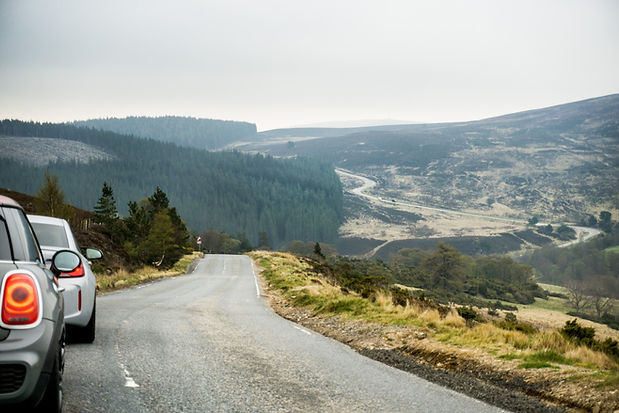
It’s a process that also means I’m positively foaming at the mouth by the time we get to the Old Military Road. The electronic shackles are finally released the moment we crest the first rise, which promptly stops me in my tracks. I pause for a look around, studying the tarmac ahead as it bobs and weaves its way down into the glen, before reappearing across the other side, meandering invitingly across the moorland before finally disappearing into the next valley. But let’s not stand on ceremony too long, the fluids have gained their vital viscosity and the tyres have some heat in them, and I now have a JCW and M135i to catch.
Picking up speed, one of the first things you notice about the M2 is just how solid the structure feels. The M2 amplifies bumps in the road more than the M135i but the chassis seems to absorb them without consequence. The chunky steering wheel feels appropriate as it’s easily the meatiest to operate here, and straight away the feedback elevates itself above the others. Where the Mini & M135i are concentrating on filtering out NVH, the M2 begins to load up in a wonderfully linear manner – you can really admire the road holding, the car performing the double trick of absolute stability with rapid reflexes.
I’m leading but the pursuing JCW is right on my tail, close enough to clock Chris wearing his game face behind the wheel, but my confidence has grown and I’m now secure enough to activate the M dynamic traction control setting. An open chicane allows the M2 to play its trump card. I leave the braking late and lean heavily on the (optional) M5-sourced six-piston callipers, clicking off a couple of ratios. The M2 turns in with precision and dismisses the hard direction change with the balance of a lighter vehicle. I’ve got full traction and a clear view of the exit so I push hard and the rear arcs out naturally as I apply the slightest, instinctive amount of counter steer, feeling the absolute hero as the big six digs the fat Michelins into the ground and fires us up the next hill. It’s a task that asks too much of the little upstart chasing.
There hasn’t been any divine intervention by a flickering yellow light – the microchips computing the yaw as playful rather than excessive – but for a fleeting moment, I’ve tapped into that magical progressive handling balance at the limit that’s a hallmark of all truly great M cars. The noise of the S55 straight six remains a complaint but the trade-off is a throttle response that makes the other two here feel asthmatic, with just the right amount of forceful performance that can be exploited on the public road – you question the need for anything faster.
“I listen to the duelling straight sixes storm the glen, the rhythm eventually distorting, signalling one driver has gained the upper hand.”
As we keep climbing the heatwave of the past few days becomes a memory, for the Cairngorms seem to have their own microclimate, and heartbrakingly the iconic ascent to Lecht Ski Station is shrouded in fog. Fortunately, on the other side, the valley is clear, the mountains blocking the progress of the pea soup. Past Ballater the road tracks the River Dee and dances in and out of a lush pine forest – we’re on the floodplain now, moving in two dimensions rather than three, but are no less entertained.
The treeline recedes at Braemar before a steady climb towards Glenshee Ski Centre, the cars making light work of the gradient. The huge car park is deserted, so we make it our base for the next couple of hours. A game of musical chairs occurs as we each sample the cars and retrace our steps north. After a blast in the M2 Marek jumps out, utters some expletives in his native tongue, mimics oversteer and wanders off for a lie-down. Chris claims the keys to the M135i, Paul giving pursuit in the M2. I listen to the duelling straight sixes storm the glen, the rhythm eventually distorting, signalling one driver has gained the upper hand.
It’s a good opportunity to form some conclusions. Each car has unique properties – the M135i is the standout grand tourer of the bunch that’s ultimately let down by having too much Autobahn and not enough B-road in its suspension. We mourn its passing however as its successor has joined the 2.0 litre, turbocharged four-wheel drive imitation game – more practicality, less Petrosexuality – its USP of creamy straight six and rear wheel drive propulsion killed off by a marketing survey in which the participants stated they didn’t care if their premium hatch was pushed or pulled.

The Mini has won us over with its flame thrower exhaust and gung-ho attitude to corners. The conversion to bring it to this level isn’t cheap, but the rewards are rich. This is exactly how a JCW should feel from the factory, putting clear air between itself and the Cooper S, filling the classic hot hatch brief to a tee. Of the three it was certainly driven the hardest, harassing the more expensive metal with its rabid cross-country pace and playful balance. Chris describes it as a modern version of the Honda DC2 Integra Type R, with turbo punch – if you know the man praise doesn’t come any higher. We wonder if the oxygen-lite mountain air and excessive Iron Bru consumption have gone to his head (Chris actually went on to buy and modify his own F56 JCW).
In the end, the truth is the M2 had any thoughts of a giant-killing sewn up within the first 500 yards. It feels special in a way the other two can’t and never lets you forget it. Sure, it can cruise as well as the M135i save for a little more tyre roar, but it never becomes mere transport like the 1-series can. One glance at the vast hips in the mirrors or the 7,500 rpm redline is all that it takes to quicken the pulse.
The engine transplant from original M2 to the Competition’s bespoke M Division unit might steal the headlines, however, BMW should be praised for having the confidence to stick to a passive damping arrangement. When a set-up is this good, you question the need for any complicated electronics. It’s exactly how a 21st-century M car should feel – as serious as you want it to be, or as silly with its drift-on-demand alter ego…should you have the talent and the space.
Whatever the approach, it always involves the driver in the process. Perhaps it should be named an Evolution, for this is far more than a tweak of the suspension geometry and a mild ECU tickle.
“When a set-up is this good, you question the need for any complicated electronics. It’s exactly how a 21st-century M car should feel – as serious as you want it to be, or as silly with its drift-on-demand alter-ego”
The descent from Glenshee feels endless, the throttle of little use, gravity alone providing enough momentum which remains unchecked as we level off. Wild moorlands fade into manicured lawns as suburbia creeps towards the fringes of the national park. Then just like that it’s over, no fanfare, no climax or salute – just the bitter embrace of the bloody A9, where ominous-looking dark clouds release a deluge of monsoon proportions.
The highs of the past four days give way to overwhelming feelings of melancholy and it’s not long before we hit roadworks. Despite the conditions other road users still tailgate each other whilst simultaneously hogging lanes, only serving to remind us how special this journey has been. It’s on the final stretch home when the inception of this whole magazine endeavour occurs. There’s a burning desire to turn around and do the trip all over again, and to do it elsewhere – a wanderlust via the road.
I finally pull onto my driveway and switch off the engine, but it’s me that lays idle. Tired but wired, I take a moment to relive the adventure, the cars, the company, the warm hospitality but above all the stunning combination of tarmac & topography Scotland has to offer. Walking towards my house, contracting metal clinking away, I cannot resist another look back over my shoulder, feeling the Rush once again.

Track and Trace – Renaultsport Megane R26.R Review
.jpg)
There had been other track-leaning hot hatches before the Megane, but with the R26.R Renaultsport went all in. Welcome to the hot hatch that thinks it’s a Porsche 911 GT3 RS.
Depending on the context, the word ‘tolerance’ has multiple definitions. In engineering terms, it’s an allowable variance from a specified quantity – tight enough to have no effect on performance. In human terms, it’s the capacity to endure continued subjection to adverse conditions, or thought, without reaction.
We all have different levels of tolerance, be it physical or emotional. So, too, do car manufacturers – based upon brand values, target markets, fiscal responsibilities and global legislation. This leads to inevitable compromises – no car is perfect, some just get closer to perfection than others. Occasionally, however, a manufacturer chooses to tighten all tolerances in one specific direction – the pursuit of driving pleasure and performance – and to hell with the consequences. With every tweak comes a subtle shift in the equilibrium towards the more focused and extreme experience, but how far should the boundaries be pushed before the balance reaches a tipping point where the added driver appeal breaks the roadworthy sensibility?
The Renaultsport Megane R26.R is a good candidate for a case study. For many, basing a stripped-out track warrior on a humdrum family hatchback seems like an inevitable recipe for a flawed and compromised machine. For a select few, however, it’s a rolling advertisement for what can be done when talented people are truly let off the leash.

When launched in 2009, the R26.R moved the goalposts for an already title-contending hot hatch so far over to the extreme end of the spectrum that it started appearing in comparison tests with dedicated, ground-up sports cars from the likes of Lotus and Caterham. Motoring publications tripped over themselves to praise it and started to mention its handling dexterity in the same sentence as the DC2 Integra Type-R… Some journalists even went as far as saying it was superior.
A hardcore diet of 123kg, revised spring rates and dampers, plus super sticky, semi-slick Toyo R888 tyres, gave the Megane a lick of speed no 227bhp car had any right to possess down a twisting road or racetrack. A scorching Nürburgring lap record of just 8:17 underlined the car’s pace and ability. Yet many cars languished in showrooms unsold – the buying public unconvinced by something so extreme with ‘wrong-wheel drive’, silly stickers and a basic list price of £23,815. Perhaps they didn’t understand – or have the stomach for – the six-point harnesses, plexiglass rear and side windows, deleted climate control or blank fascia of plastic where you’d normally expect to find a radio. Or maybe it was the blood-red roll cage lingering in place of the back seats that scared them off.
Further sacrifices included the front fog lamps, rear window wiper mechanism and heating, and nearly all sound-deadening. The only concession to safety was driver and passenger airbags – a big call for a regular car that was the first to be awarded a Euro NCAP five star safety rating. The bonnet was now crafted from carbon fibre and, underneath, the 2.0 turbocharged engine block has more exposure than an Only Fans channel – looking completely naked, shorn of any plastic dressing.
I imagine a lot of potential sales recruits failed to graduate from basic training as a result of this car. The rigmarole involved in shimmying into the seats and bolting up the six-point harnesses makes solving a Rubik’s cube look like child’s play. And then you realise you’ve left the door open and can’t reach the handle so you have to start the process all over again.

Once upon a time, I’d have fitted comfortably into aggressive seats like these, but nowadays it feels like only those with snake hips could fit between the Boa Constrictor grip of the side bolsters. The good news is the pain from my newly dislocated hip wears off as soon as the adrenaline kicks in. Up the ante as the fangs of the harnesses bite down and you immediately feel utterly connected to the machine and the drive – it’s as if you’ve become a stressed member of the chassis.
This completely re-frames your mindset. Every corner becomes a challenge to clip the precise apex and put fresh air between the inside rear wheel and road surface. The trouble is, the chassis is so capable and exciting that the standard 227bhp no longer seems to cut it – despite the weightloss upping the bhp/tonne by almost 20. You just know that the car can handle more without upsetting the apple cart.
Perhaps that’s why this particular car has been mildly breathed upon to a conservative 260bhp. Despite Renault claiming power was unchanged from the regular R26, the exquisite optional titanium exhaust has to be worth a few horsepower as well as decibels – not to mention adding a healthy contribution to the weightloss too.

The engine seems possessed in this state of tune and there’s value in seeking out the redline, where it closes in on the limiter with a real hunger over the final 1,000 revolutions. The outright acceleration is very strong but the in-gear thrust is rabid – the echo chamber behind no doubt enhancing the feeling of thrust. Even coming off the throttle is fun as the wastegate releases an angry series of hisses and whistles.
Sadly, the sharp throttle response is heard, rather than felt, due to a rubbery throttle pedal with two-tier pressure resistance. During the initial travel, the pedal is far too light; then 50% of the way down, it firms up, almost like a computer prompt asking if you are sure you wish to proceed. Similarly, the other foot is also let down by the clutch with its skyscraper biting point.
However, both these pedal characteristics are typical of fast Renaults. Yet you never notice these minor flaws when pressing on – there is no hindrance to a well-executed heel and toe. Mercifully, the brake pedal escapes a similar fate by offering almost delicate progression and immediate anchorage when summoned with force. In comparison to the clutch and throttle, the brakes are a joy to modulate.
You’ll initially file the steering in the flawed control weights category too – but spend more time with the car and you’ll begin to appreciate it. The geometry is unchanged from the R26, so the .R is no great communicator, and the steering is certainly very light, with a nanosecond of built-in slack just off-centre that should’ve been eradicated in a car like this. Thankfully, the no-compromise rubber with its granite side walls increases the precision.
Placing the car quickly becomes second nature and, eventually, you’ll realise you prefer the slower gearing of this early EPAS over many current systems, which choose to mask their deficiencies with instantaneous reflexes. The featherlight weighting also fades into the background when pressing on enthusiastically – much like the awkward pedals. You wouldn’t, however, say no to another minor tweak: a retrim of the wheel in full Alcantara.

The steering gives you the confidence to lean on the car elsewhere too. The operation of the limited slip differential is a world-class highlight. It’s simultaneously both subtle and aggressive – subtle in your hands, yet aggressive on the line of the corner. Initially, the rear end feels rather skittish – like its skimming over the surface rather than gripping it – but work some much-needed heat into the rear tyres and the sensation disappears and the back axle also becomes a directional asset.
A gentle lift to tuck the nose in ever-so-slightly still happens very sweetly and progressively, despite the high level of grip. A benefit of the low mass combined with the stability of a wide track and that bolted-to-the-chassis feeling. Has a front-wheel-drive car ever offered so much exploitable adjustability on and off the throttle? A 205 Gti is – unquestionably – more tail-happy, and the differential in the mk1 Focus RS is far more aggressive, but few cars combine the two so harmoniously and with such driver encouragement. Afterwards, I realise all these multiple angles of attack have occurred with the dynamic stability control still on – I’ve been having so much fun I completely forgot it existed. Renualtsport’s ESP calibration certainly has some wide tolerances dialled in.
The weakest link at speed is the gearbox. Renaultsport isn’t renowned for robust gearboxes – ask any Clio 197/200 owner – and the one in the Megane has pitiful resistance. As such, the throw across the gate is limp and loose but, thankfully, it doesn’t object to being rushed.

You can’t help but imagine how much more enjoyable the car would be with one further extreme: an aggressive touring car-style CAE shifter. Still, it’s not like you need to be rowing through the gears to get this R26 shifting. Save for some low-down sluggishness, the power delivery is very strong; whilst the car tracks true and straight at full-tilt, no matter the surface. Furthermore, there’s also zero axle tramp, unlike some high power front-wheel-drive cars.
It’s not just the technical ability that elevates the R26.R. It’s the assault on all the senses: the plexiglass windows buzz in traffic and the unladen passenger harness zings to the rhythm of the titanium exhaust. The R888s pick up every loose stone available before firing them into the arches like tobacco buckshot. These are elements of driving that are increasingly being snuffed out across the board – ones that create another dimension of interaction with the drive and amplify the sensation of speed.
In the end, only 364 of the planned 450 production run for the R26.R were bolted together. Renault UK was bold in reserving 230 of that original allocation but, when the curtain fell, only 159 travelled across the Channel. It’s good to see, however, that Renaultsport hasn’t been burned by the experience – churning out two successors, even if the numbers produced decreased and the price massively inflated.
Owner Kristian has had the car for several years now and covers around 2-3,000 miles in the car annually – most of which is spent on or travelling to a track day. He praises the behaviour of the car at the absolute limit:

“In slower turns, you can lean on the brakes heavily and use trail-braking to alter your line and, as long as you aren’t heavy-footed, exit speed can be kept high and accurate. The car will understeer if you do get on the power too early, but you will rarely experience it on the public road.
“Where the R26.R really excels is on entry to fast corners. Why? The chassis is so neutral there is never any fear about what it might do. if you go in too fast, the car will drift with absolute neutrality, with all four corners moving in unison. And trail-braking at this pace? You can certainly adjust the car nicely – particularly in the wet – but, again, it’s all so controllable you can constantly play with how you drive to get the most out of the car.”
What’s great about the R26.R – after you’ve gotten past all the impracticalities of strapping yourself in – is it doesn’t eliminate over 80% of the U.K’s road network – despite its track leanings. Its suspension – whilst not as supple as I’ve read to believe – still operates at a bandwidth that can just about cope with a ragged B-road. There’s no doubt the Megane prefers a smooth surface, but at no point does the body control become overwhelmed. The famously backed-off springs are clearly being counteracted by the rock hard sidewalls of the Toyo tyres and, although it might lose some of the outrageous grip, it would be interesting to try the R26.R on some more pliable modern UHP tyres. Renault in fact offered Michelin Pilot Sport rubber as an alternative to the Toyo’s on the order form.

Whatever your stance may be on the room-for-two-only hot hatch, the good news is you can feel every penny invested by Renault in this car – the expense in each and every modification and what it brings to the party. Yes, entering and exiting the car is a faff and, yes, it’s very tiring and wherever you go you always seem to be accompanied by the distant roar of a jumbo jet thanks to the tyres. It’s unlikely to be appreciated by a non-car-loving partner either and, during our brief stint, the driver’s electric window threw in the towel.
You could also argue that a regular R26 offers enough of the thrills without sabotaging its civilised manners. But that misses the point. It’ll never hit you with the single-mindedness, the physical rawness, nor get the heart pumping, like the car with the extra dot R. It’s like comparing filtered Kentucky Bourbon to pure white dog moonshine. Some cars are designed to make you feel comfortable; some are designed to make you feel alive. This Megane is certainly one of the latter that’s absolutely worth tolerating.

Renaultsport Megane R26.R stats
Engine
1,998 cc turbocharged inline-four,
DOHC 16v, max 6,500 rpm
Output
Power 227 bhp @ 5,500 rpm,
Torque 229 lb-ft @ 3,000 rpm
Layout / Transmission
Front engine, FWD
6sp manual, Torsen LSD
Weight
1,230kg,
Power-to-weight – 185 bhp/ton,
Torque-to-weight – 186 lb-ft/ton
Performance
0.60 mph – 5.9s,
1/4 mile – 14.8 @ 97 mph,
Top speed – 148 mph