


Alternate Take – SEAT Leon Cupra 290 Lux Review
In the market for a VW Golf GTI or R? Kotto Williams thinks there is a close relative that combines the best of both worlds for less money, offering up his SEAT Leon Cupra review.
There comes a time in a man’s life when his penis stops working the way he intends it to. It no longer stands to attention in the morning, coitus requires three weeks’ notice to prepare and when you step away from a urinal, pull up your zip, it keeps on peeing. At this point in life, you probably need a sensible car, a big boot, five doors and comfortable suspension, and an automatic gearbox so you only have two pedals to worry about. Things like the 0-60 sprint become 460l of boot space, torque vectoring becomes trailer tractoring, 6-speed H pattern gearbox becomes 8-way electric memory seats and the only handbrake you pull up is the foot-rest on your Lay-Z-Boy.

But you don’t really want this, you’re reading a magazine for car enthusiasts. So, is there a way to get a family car that flies under the radar of sensibility but allows you to indulge in high-speed frivolity? You clearly need a mk7.5 Golf GTI Performance Pack in your life. Sure, a Focus ST may out-corner it or a Megane RS will put seconds on it on a track day but the fact is, the Golf can hold its own whilst being comfortable, well equipped, well built, fairly priced, retaining its value and look good whilst doing it. It remains the default choice.

But should it? I present to you the rather large, and self-inflicted, thorn in the GTI’s side – the even stealthier, but potentially far more exciting – Seat Leon Cupra R 290. The Seat Leon Cupra Gen-3 5F model is the very last Cupra badged Seat, models going forward using the Cupra moniker alone. It’s an odd trend that seems to be increasing in middle-tier manufacturers, a lack of confidence in their brand. The new Fiat 500 in particular doesn’t have a Fiat badge on any surface.
Anyway, I digress – what makes the Cupra special is what sits within its angular snout – the formidable 2.0 TSI EA888 turbocharged engine from the Golf R. However, the SEAT forgoes the R’s heavy Haldex four-wheel-drive, effectively creating a GTI-R. This means it’s lighter on its feet – not to mention significantly lighter on the wallet, because the Spanish iteration listed for £5,000 less than the GTI.
What a Cupra isn’t light on is its tyres. Such power through the front wheels is more than contained by the excellent and essential differential, it’s just that the Cupra is so bloody accelerative that you can’t help but giddily turn them to smoke. As fitted with the DSG gearbox, the Cupra will dip below six seconds in a scrabble to sixty from rest, and once rolling it will pull away from even the R. It still has today’s GTI Clubsport covered, and that’s before we get into the favourite VAG club past time of tuning potential. Even standard, you have to get up very early to come across a hot hatch that’ll outrun it.

So it’s got the exciting angle covered, yet at the same time, it looks completely anonymous. There is a reason so many Police forces are adding unmarked Cupra’s to their fleet. It’s certainly not a dour car – you’d almost call it handsome – but Joe Public wouldn’t be able to complete a round of spot the difference with a regular Tdi on smart alloys. A petrolhead would know though. I quite like this, it almost harks back to the discretion of early M cars – you might even call the Cupra 290 a Q car.
It’s time to cue some corners though. You’ll be grateful for the gigantic brakes as they wipe off the easily accumulated speed with the minimum of fuss. The retardation is strong enough to pressure massage your kidneys, and the pedal feedback is adeptly judged – there is no front-loaded bite, just sweet progression. Even when you trigger the ABS, the kickback is minimal. Before you know it, left-foot braking becomes second nature.
The steering is of the Chornobyl variety…not great, not terrible. It’s well geared and weighted – and the nose responds to inputs with vigour – but the feedback is as evasive as a Boris Johnson office Christmas party. Because of this lack of dialogue, during acclimatisation, I kept having to make micro corrections to the steering angle. There’s zero feedback at your fingertips, and the steering weight itself is perfectly good but until I got used to the car, I found myself making micro-corrections during corners before I could find the car’s limits at about 80% ability.
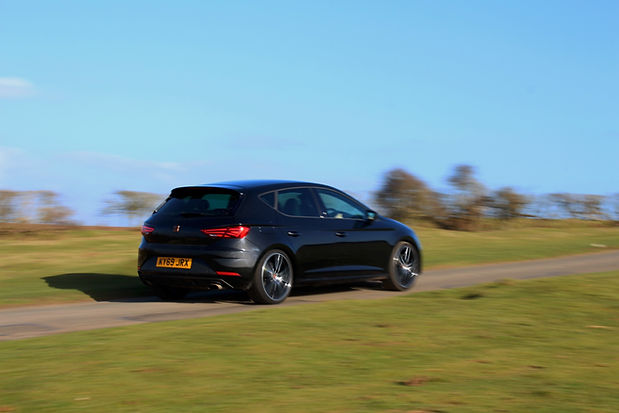
Perhaps that’s a compromise for sweeter everyday manners or a method of dulling the side effects of the remarkable differential. It doesn’t so much as tighten the line, it yanks the whole car towards the apex like a Darth Vader force choke. The application of such power without any tragic torque steer is nothing short of witchcraft. Progress is always fluent unless you purposely troll the chassis or it’s wet.
I must mention that differential again – in this car is something else, it locks right when you’d want it to, as soon as the steering under hard acceleration begins to wander the diff sets it straight again. I tried to provoke understeer and failed, and that’s largely because of the laser-guided diffs effect on steering – it feeds the power beautifully, never awakening the traction control or letting the wheels slip.
Remember this is a car where the back axle is merely along for the ride, and the front tyres have to deploy nearly 300bhp and pathfinder at the same time. This is one of those cars that can silence the anti-FWD crowd easily, RWD may be a purist powertrain but in the real world with real people, the Leon is just as fast as a comparable BMW and you won’t develop beads of sweat on your forehead from the effort.
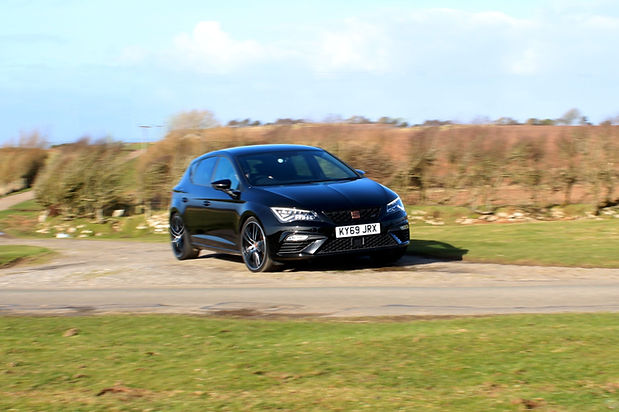
The handling repertoire also seems to have no concept of body roll either. Turn in, activate diff, summon turbocharger, and repeat. It takes everything in its stride and you’re back onto the straight stretch of road unsure of how you got there without a battle. The rate you fire down a road is deeply impressive, the road-holding operating at an almost unsettling level of equanimity, but where is the drama? I’m not feeling like I’m a part of the action as much as I’d like to be. I’m left a little cold.
Part of it is how easily the EA888 acquires speed – look down and you’re always travelling faster than you think – but the soundtrack doesn’t move you like the turbocharger does. It’s not a bad noise, and there’s sufficient volume (which may be augmented), however, it lacks fizz. It’s an engine you rev out for the buzz of the performance rather than the reward of how it’s delivered.
Objectively it’s an engineering marvel, there’s barely a trace of turbo lag and the pull never relents. It’s also remarkably fuel-efficient and for a four-cylinder, it’s very smooth indeed. It just gets on with the job with no chinks in the armour. Want to warp from 60mph to 90 in seventh on the motorway? The mid-range has you covered. Want to explore the upper reaches of the redline? It’s game. But that very competence leaves you craving a more Latin soul and fire – it’s not hard to see why so many end up with an ABT or aftermarket tune.

Another factor is the DSG gearbox. It’s so slick and unflustered it’ll change up bang on the last rpm rather than headbang into the limiter, and the only way you’ll notice is the change in engine tone. You’ll forgo the paddles eventually because you can’t dial up some extra aggression (unlike in the GTI), and then when you get to town, you’ll forget you’re in Cupra mode and it’ll hold onto gears far too long making you look the complete tit.
You can put it into manual mode with the paddles, which is fun but I quite enjoyed letting the car change the gears as the box is genuinely really good (out of Cupra mode) and I focused on seeing how fast I could get around a bend without becoming one with the Bristol Channel. The paddles are a very horrible scratchy plastic and just feel unpleasant to use – even those on a Toyota Yaris have better tactility. An alternative solution could be the shifter itself, you can use it like a sequential gearbox but it’s back to front – push forward to change up, which completely goes against your instincts.
The driving modes didn’t affect suspension damping, in comfort mode at best the rebound rate of the shocks was reduced, softening the ‘bounce’ of speed bumps and the crenelations frequently found on British roads. The ride itself despite the huge 19” wheels is supple, it’s firm as expected but it doesn’t feel as jiggly as many other cars in non-hot spec such as the Audi A3 or Ford Focus ST-Line. The driving modes are pretty much unnecessary thanks to the individual mode – the only shortfall of that is you can get comfort suspension and full power out of the engine but you can’t alter the DSG’s change pattern, unlike the Golf.
To be frank, the car’s so well engineered for fast road or cruising that it doesn’t need modes. SEAT seems to have found the sweet spot of giving a firm chassis a fairly supple ride, which made for great fun around fast bends – and then a wonderfully comfortable wind-down drive, I’ve had more exciting naps.

The interior of the Lux version is fantastically judged. You sit in Alcantara and leather tombstone front seats, matching Alcantara and leather in the back, nicely trimmed door cards with just the right amount of ambient lighting. The door card’s strip of blue downlighting is a beautiful touch, a league ahead of a boring red strip-light like you get in the comparable Golf. The finish on visible surfaces is like you’d get in a BMW, no crap vinyl with hideous pretend stitching: just good-quality rubber, plastic and Alcantara.
I was pleased to see that the rear seats have air-blowers in the central armrest too, having spent a summer being ferried around in friends’ cars, if it’s hot out you’d want an A/C feed in the back. Up front, the dual-zone climate control and heated seats as expected from a VAG car are excellent, though on this frozen winter day, the inside fogged up constantly despite the blower being set to windscreen. The solution to this was to have the screen-clearing A/C mode on – which is wasteful and fairly loud – but a more suitable solution than holding my breath.

Getting your head around the infotainment is a struggle however, the main menu is a bit samey – it’s difficult to distinguish what you want at a glance but this is remedied by simply mating your iPhone to it and using Carplay where you can access Google Maps, Waze, Pokemon Go or Pornhub. The dial cluster is of course an LED screen, with many different dial layouts available but I settled on the one that looks like it came out of a Lamborghini Huracan, with a big rev counter smack bang in the middle.
The new haptic Golf proves the VW group has always been better at designing stylish infotainment over functional, and it’s an issue that stretches back to the older Leon I’m sat in. There’s now a lot of wasted space on such a big, useful screen. The sat nav stayed put on the big dashboard screen but a directions list or a mini-map on the blank spaces on either side of the dial would’ve been a nice touch. I’m not sure if you can change it, I certainly couldn’t find out how. It’s good but I can’t help but feel that with such a badly designed LED cockpit, is there really any merit over analogue dials?

Despite the sensibilities, SEAT should always be the VAG group’s more left-field, exciting entry to the stable. The majority of people will likely go for the civilised Leon or Golf because sometimes a Megan RS or Civic Type R is just a bit try-hard and uncool. Yet the Leon’s quiet, dignified performance approach is its ultimate undoing. It’s all a bit too German gene pool and capable. Its most exciting feature is a very satisfying ‘pop’ on upshift at pace which is a thousand times better than Volkswagen’s tragic DSG ‘farts’.
The Leon would be a worse car if it torque-steered into a tree and leaned a bit more as it exited the road surface, but it would be more exciting wrestling it on the way to your demise. Shouldn’t a Cupra be a Spanish interpretation of an Abarth, or dare we say it – an Alfa Romeo Cloverleaf?
I don’t wish to sound like I have a downer on the Cupra. It’s rapid, discreet, well-built, stupendously capable and great value for money. It nails its brief as a family haulier and secret hellraiser. To the layperson a lot of the negatives I picked on won’t even appear on their radar, they’ll enjoy the crisp, anonymous styling and the mountain of power available to them.
However, it’s a car you admire rather than crave. It doesn’t have those quirks that allow you to form a personal bond. Previous owners speak fondly of the Cupra, but I haven’t met one that regretted moving on or pines for another. And that’s what this magazine is about – cars you desire and ones that get the blood pumping to all the right places.

Ready Player One – Mini John Cooper Works GP Review

The original R53 Mini JCW GP broke new ground in the hot hatch sector. Can the pioneer still cut it, or has the supercharged track hatch been left behind by those it inspired?
That whine. I’ve consumed too much and now I’m driving under the influence of the supercharger, hanging onto the throttle a little bit longer and braking later, pushing the boundaries of mischief in the greatest of hot hatch traditions. The hyperactive chassis ducks into another apex, the diff gently tugs at the wheel and the tyres squeal in duress but all that matters to me is topping up my glass with another dose of vintage Eaton M45.
Another straight, another opportunity, the dinner plate speedo fades into my peripheral vision and the sole rev counter mounted behind the wheel is where I take aim. It might as well be a dart board with a giant bullseye at the redline. Super, smashing, great.
The Mini GP could be considered a bit of a landmark car. Not necessarily in terms of iconic status, but because it drew a new line in the sand – given the current plethora of stripped out, track focused hot hatchbacks kerb hopping their way around the Green Hell, it’s difficult to recall it arguably all started here.
Sure, there had been fasting French hatches beforehand in the form of a Peugeot Rallye or Clio Cup, crucially none had gone to such extreme lengths as sacrificing the back seats in the pursuit of speed, and none of the Mini’s size possessed anything close to 218 bhp. It opened the door for other manufacturers to take the basic recipe and throw in some chillies – without the GP, there might not have been the Megane R26.R or Golf GTI Clubsport S, everyman cars that can take the fight to low slung supercars around any racetrack.

Yet despite the JCW badge adorning the rump of this spicy little Mini, Mr. Cooper & Co had little to do with the GP. It would be romantic to think the car was the product of a dedicated, after hours skunkworks team, but the reality is BMW had pulled the plug on its oddball C1 roofed scooter manufactured by Bertone, leaving a contractual obligation to fulfil. A halo Mini was thrust into the void.
When the GP was introduced in 2006, the regular JCW was an optional extra, dealer fit conversion, but the GP was purchased as a complete car because for the first time its development had been completed in house by parent company BMW. A donor car was taken off the Cowley production line and sent to the Italian coachbuilders for the conversion.
Still, despite the smoke and mirrors badging the engineering team didn’t mince its words, talking up the GP as ‘a baby M car, maybe even a CSL’ at launch. A bold claim, with a bold CSL style hike in price – the GP was yours for £22,000, or the equivalent of £32,000 accounting for inflation. Even so, it didn’t stop all 492 examples offered to the UK market from finding homes. Today you can pick up a tidy, 40,000 mile GP for around £14,000, and prices are on the rise.

Given the lack of rear seats, did the GP follow the now commonplace practice of less is more, for more? The modest hike in power of 8 bhp, courtesy of a larger and faster acting top mount intercooler suggests this is the case. Mind you, nobody ever complained about the way a standard 210bhp John Cooper Works ever got down a straight in 2006.
The intercooler sat on top of existing JCW package, which used good old fashioned tuning to make its numbers – a new air intake, revised supercharger with Teflon rotors and a smaller, faster spinning pulley for more boost, larger 380cc injectors, a ported and polished cylinder head and finally a cat back, stainless steel exhaust.
If the increase in power was modest, the body kit certainly wasn’t – there’s little chance of you mistaking the GP for a cooking Cooper. At the time the in your face attitude of the GP attracted its fair share of detractors, but in the age of the Banzai turbocharged Civic Type R, those opinions have mellowed – on the way over to the Peak District the GP is attracting its fair share of thumbs ups and knowing nods.
Yet the attention seeking front splitter, side skirts and rear wing only added similar, marginal gains in downforce, whilst the red mirror caps look like an afterthought without matching lipstick around the snout intake and fog lamps. The signature 18” four spoke alloys would have looked better with an extra pair of braces to these eyes, but at least they save 2kg a corner over the regular Cooper S or JCW offerings.


Delve a little deeper and there are further weight saving measures in important places. More unsprung mass has been shaved from the suspension courtesy of bespoke, aluminium rear control arms with conical washers – an impressive 7.5kg per side lighter than those found on the production line and a serious & expensive trick usually reserved for the M division. These are mated to new springs which cut 10mm from the ride height and firmer dampers, although the standard anti-roll bars remained in situ.
Inside there’s a bit of an identity crisis going on. Yes the rear seats no longer exist and the rear window wiper, mechanism, speakers and air con have all been jettisoned, but the Recaro bucket seats are trimmed in leather, at odds with the track aesthetic. There are no slots for harnesses either, and can I spy plush carpets down in the footwell? The dashboard has received a lift in this car courtesy of the JCW carbon panels, which really should have been standard fit, but where is the paddock worthy alcantara clad steering wheel? Only the dials have changed into Nomex, their dark grey background and unique font are a welcome addition. Otherwise, the ‘baby CSL’ schtick looks more like marketing stardust at this point.
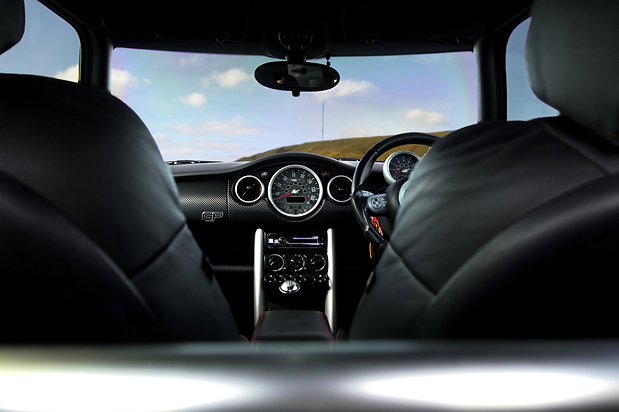
That said, the GP is an undeniably fun place to spend time. The driving position is excellent – the seat is mounted on the floor and the scuttle is high meaning there’s a definite feeling of sitting within the car. Throw in the funky toggle switches, rotary air vents, Goodyear blimp indicator stalks and frameless windows and you could almost convince yourself you’re sat in a coupe. It’s unapologetically retro, but penned by the Jetsons. Its a quality reflected in the tightness of the cabin build, which lacks any of the slack Franco-Italian hatches are so fond of.
Despite such solidarity, at 1180 kg the GP remains a featherweight car by present standards, resulting in a competitive 182 bhp/tonne and a traction limited 0-60 sprint of 6.3 seconds – enough to make a current Fiesta ST owner think twice at the traffic lights. Its 184 lb. ft. of torque at 4,600 rpm is certainly down on modern metal, and whilst the SOHC 1.6 litre Tritec motor was already Jurassic technology when adopted by the Cooper in 2001, it keeps pulling right until the 7,150rpm limiter, underscored by that distinctive supercharger whine and unburnt fuel igniting down the exhaust like popping candy on the overrun.
The amusing racket from the exhaust isn’t artificial – the GP simply doesn’t care for driver modes, it’s already in a high state of alert. But its that famous MINI whine that’ll see you increasingly driving under the influence of the supercharger, hanging onto the throttle that little bit longer and braking later, pushing the boundaries of mischief in the greatest of hot hatch traditions.
The hyperactive chassis can tuck into as many apexes as it wants, with the diff gently tugging at the wheel and the tyres squealing in duress, but all that’ll matter is topping up your glass with another dose of vintage Eaton M45. One charge through the gears is enough to know the GP is the complete antidote to the modern copy & paste hot hatch formula, it positively drips with character and purpose.

The steering has that trademark Mini keenness and lightness – simply flick your wrists and you’re turned in, but there is precious little feedback from the chunky rim due to electro-hydraulic assistance. Aside from that, there’s a real feeling of piloting a mechanical device to the GP that belies its retro-cute image. The gearbox in particular has a satisfying heft to its action that can’t be rushed, whilst the throttle and clutch pedals both offer levels of unexpected resistance. It’s quite the workout.
Sadly, the Achilles heel of the GP is the brakes, which despite being a four piston Brembo upgrade lack the aggression and pedal feel needed for B-road omnipotence. The GP does have a limited slip differential, however the linear delivery of the belt driven Eaton ‘charger means it acts more like a guiding hand than the pint in one hand and arm wrestling challenge to the other of something like a Focus RS. Its action works much better with the DSC deactivated – stability control coding was in its early days and this one unfortunately acts upon the whim of an overbearing conscience.
You can also detect the compromise of adopting early run-flat technology for the OEM tyres in the suspension calibration. Why BMW chose to persist with granite reinforced sidewalls in such a focused machine when its M cars were free to equip as they pleased is a mystery, and something the company rectified in the second generation GP. Whilst owner Imran has long since ditched the Dunlop’s, you can still feel the trade off in the damping, particularly in the choppy low speed ride quality. It’s much less boisterous than a standard JCW however.

In fact, the GP starts displaying a level of poise that’s most unexpected the harder you push, the benefits of the reduced unsprung mass and being lighter on its feet coming to the fore. The low seating position and lack of body roll adds to the feeling of agility, although despite the compact wheel at each extremity set-up, it’s in the solid state, high speed turns where the chassis truly excels. The sophisticated rear multi-link Z axle prioritises grip over slip – the GP remains glued to the surface no matter what – there isn’t the instant, up on its tiptoes adjustability of a Renaultsport Clio or EP3 Civic Type-R, but neither of them would see which way this Mini went.
It’s not perfect however. Whilst you wouldn’t exactly call it turbo lag, the supercharger exerts a certain amount of drag loading onto the engine and throttle response in the lower rpm, whilst the heavy flywheel is reluctant to shed its hard earned momentum between gear changes. A lack of packaging space, a combination of iron block with an aluminium cylinder head, forced induction and a pre-cat in close proximity to the exhaust ports means the Chrysler sourced engine tends to run hot.
BMW compensated by over endowing the injector system and running a rich map – the additional fuel soothing the cylinder temps. But the side effect is the GP likes a drink and is in possession of a demon thirst that would convince Charlie Sheen to get back on the wagon. You’ll be hard pressed to average better than 26 mpg driving with baby gloves. Driven hard you’ll be lucky to better fifteen to the gallon.

Get enough spin in the compressor though and you’ll happily indulge the Mini’s appetite. The GP does its best work in third, which stretches just shy of 100mph despite the six ratio’s. The ram air effect of the bonnet scoop seems to endow the engine with extra horsepower once into three point territory. It becomes difficult to imagine the car in the original brief – the Cooper S was set to get the 1.8L naturally aspirated Rover VVC. The Prospect of a VHPD John Cooper Works is food for thought, but the supercharger has already gotten under my skin and won me over.
The Tritec does possess at least one similarity to the K-series however – its ability to get through head gaskets. That being said, you’re unlikely to find a more reliable first gen BMW-Mini than a GP, last off the line status means all the niggles that plagued early cars have been eradicated. The bonus sixth ratio also puts a sock in the supercharger as I retrace my steps home, but any thoughts of distracting Imran and hot footing it to the Nürburgring are sadly stymied – the thirsty consumption and miserable 40 litre tank means he’d catch me before I even boarded the ferry.

In the end, there’s a slight feeling of unfulfilled potential with the GP that’s hard to shake off. I can’t help but imagine the car with a tight ratio gearbox, sticky rubber, adjustable suspension, buttock clenching buckets and a half cage. Putting all the glamour of the unique look to one side, in pure handling terms I’m not convinced the GP offers something you can’t get from a regular JCW with a set of trick coilovers fitted for a third of the price. If a manufacturer is going to rip out the rear seats to shave tenths around Silverstone then they are committing the car down a certain path, a fate that’s sealed when the heavily debated rear strut brace is revealed to be purely cosmetic. Its non load bearing, not serving any purpose.
It appears Mini themselves reached a similar conclusion too, because the GP2 that followed was far more focused, faster and much rawer – if less characterful. So it fails the track warrior brief, but thankfully we are left with a very sweet little road car to come out to play on a sunny weekend, and I can’t help but plant the throttle one last time for another tasting of whine.

MINI JCW GP 2013 Specification
Engine
1,598cc supercharged inline four, SOHC 16v, max 7,250 rpm
Output
215 bhp @ 7,100rpm, 184 lb. ft @ 4,600rpm
Weight
1,090kg, bhp/tonne 197, lb. ft/tonne 169
Transmission
6sp manual, fwd, torsen LSD
Performance
0.60 mph – 6.3s, 1/4 mile – 15.0 @ 97 mph,
Top speed – 149 mph
Value
From £15,000-£25,000 (June 2022)