



Top Cat: Ford Racing Puma Review
The Racing Puma is one of the most overlooked Fast Fords – unfairly written-off by the power hungry. Ignorance, as former owner Kotto Williams argues, is bliss
F
lying off the handle is a brilliant phrase, it’s something I do frequently with cars. And nothing threw me from the handle more than Ford making a fat pudding car and calling it a Puma, they should’ve called it the hippo or the porpoise. What vexes me even more is the puma is selling well which goes to show how hopeless the general public are when it comes to cars. There’s even an ST version, a bit like a green hippo GTI. But when you cast your mind back to the original, lithe with silken flanks Puma, any thoughts of the new Puma looking back to the original knockout will soon be forgotten.

The original Puma was essentially a rebodied 1999 Ford Fiesta with uprated suspension, bigger brakes, generous standard equipment and a remarkably pretty bodyshell based on the “new edge” styling philosophy. At the time Ford was struggling globally – the MKVI Escort was long in the tooth and the outgoing Mondeo was suffering from the cessation of tax-free company cars causing a dramatic slump in sales. The brand seemed to be surviving on the seemingly endless turnover of the Fiesta in Europe and the F150 in America.
The Ford boardroom came up with many schemes and projects to reignite the fire, including the astonishing Ford Focus – but that’s a feature for another day. One cancelled project led to a dilemma because it was rather advanced, with Yamaha already contracted to develop a 1.7 petrol engine with VVT; Variable Valve Timing. Ford had a tricky choice, lose the contract and pay the fine, or honour the contract and find something else for the 1.7 engines…A lot of 1.7 engines.
With a butterfly effect decision we should all be grateful for, they decided to make a car worthy of this technical new engine and developed the Ford Puma coupe. Its sharp engine, critically acclaimed chassis, precise gear change and keen pricing policy resulted in Ford being unable to keep up with demand. In order to satisfy the public’s appetite, the blue oval introduced 1.4 & 1.6 litre iterations. The marketing campaign alone was gold – Steve McQueen photoshopped into the driver’s seat of a silver Ford Puma, racing around the iconic streets of San Francisco mimicking the iconic car chase from Bullitt. No, it’s not weird, I’m aroused too.
How did Ford build upon this tour-de-force of success? The answer is obvious, you enter into motorsport and develop a hot version, but the one that filtered down to customers wasn’t your usual half-hearted stickers & spoiler special. The process was a unique one. Imagine the scenario – Mr & Mrs. Jones walks into their local Ford dealership to sign for a Ford Puma, but at the last-minute spy the Racing Puma brochure. Seduced, they order one, which isn’t actually a production-car but an optional extra.
AUTHOR

Rush Iconoclast
Photography by;
Ben Midlane
Published on:
TBC
OUR PRINT MAGAZINE

CATEGORIES

D
Once the ink had dried on the order form, a small but consummate workshop by the name of Tickford sends their heavies to Neihl in Germany, where they effectively kidnap a Ford Puma and bring it back to Daventry. A team of mechanics thereupon ripped the Puma apart, throwing anything not welded in place into a skip. They widened the front track by 35mm aside, replaced the front wings with bespoke aluminium ones, fitted extended driveshafts and custom suspension arms complete with Eibach springs and dampers.
Then they bond on the Kardashian spec steel rear arches, made necessary by a huge 90mm increase in rear track girth, just 15mm behind the full-bore rally car. Next comes racing spec Alcon 4-pot brakes – 295mm diameter at the front, 270 at the rear. Inside, Tickford fitted bespoke Ford Racing Sparco seats, reclaimed the remaining interior out of the skip and covered it in unique royal-blue Alcantara.
The final piece of the puzzle was fettling the Yamaha 1.7. The original plan involved some light pressure turbocharging with 180bhp in mind, but Ford blew all the budget on making it handle as well as physically possible, and therefore resorted to good old-fashioned engineering – more aggressive camshafts, a custom alloy inlet manifold, a Janspeed exhaust with 4-2-1 manifold and sports catalytic converter, and a re-calibrated ECU.
The result was 153 bhp at 7,000rpm and 119 lb-ft. of torque available from 4,500rpm, combined with the 1,174kg kerb weight it was just enough to dip below eight seconds from zero to sixty. There was even an optional Quaife limited-slip differential but very few had this (I’m dubious of their effect in a modestly powered lightweight car, but some swear by it). Even the gearbox couldn’t escape fettling, Ford’s proven IB5 five-speed is widely known for its reliability and precise changes. Tickford fitted shotpeened first and second gears to ensure reliability with the power increase.
Performance junkies sniggered and sadly the Racing Puma didn’t have the same sales success as the regular model, because the major surgery required for the conversion resulted in a steep £22,750 asking price. It was a tough sell given the Subaru Impreza Turbo had already arrived on the scene harassing Porsches and BMW M cars with its four-wheel-drive WRC pedigree and banzai turbocharged 215bhp output, complete with £2,000 change. Perhaps the final nail in the coffin would be the parallel debut of Renault’s Clio 172, which was a substantial £8,000 less, offered higher power and insult-trading, argument worthy levels of comparable handling.
Should it have been an RS? The press raved about the Racing Puma upon it’s release, however the competition was fierce and the bespoke build hiked the price.


D
Alternatively, for those committed to corners and rear-driven wheels you could have an original Lotus Elise for a list price of £23,000 – you had to be a very dedicated fast Ford fan to opt for the Puma over either of those two. Consequently, less than half of the planned UK production run of 500 actually made it into genuine customers’ hands, with the balance of cars distributed amongst Ford’s senior management via the company car scheme.
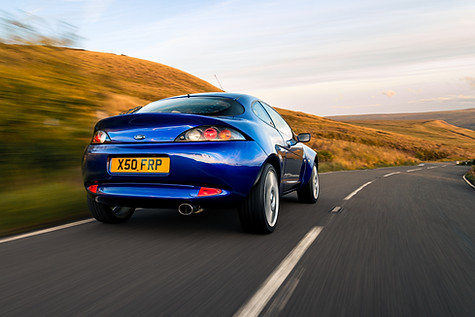
But those rules don’t apply today, the only thing that matters is the driving and boy did Richard Parry Jones and company smash it out of the park. Succinctly; the chassis is beautifully judged with the squared up, wider stance capable of generating an incredible amount of grip. Almost immediately you’ll be pushing harder, and harder, turning in with reckless aggression, applying the throttle sooner and sooner, generally acting the tit and still the Puma complies and finds drive, going exactly where you point it.
Even the modest performance ceases to be an issue because the Puma has that same ability to maximise every single bhp, stimulate the senses and take abuse as an Integra Type-R. It feels unburstable and completely over-engineered, just like the Honda. You can give it death and it loves it, bounce off the rev-limiter, flat shift, stay in second or third gear with the revs hanging at around 6,000rpm with the exhaust crackling away. It’s a rush equal to any Japanese four-wheel-drive homologation special or track-bred hyper hatch.
Yet there is an underlying security and trust in the car carrying such momentum – you never feel like the Racing Puma is waiting for an opportunity to bite. The chassis permits just enough body roll to allow the tyres to key into the asphalt, but not so much that the weight and balance of the car is constantly shifting.
You’re far more likely to find the limit of the suspension than that of the tyres; the dampers are on the firm side and a particularly rutted surface will see you backing off long before the front axle slips wide. If you’re determined to experience how the Racing Puma will behave at the limit, find a smooth, wide roundabout and build up the pace. Eventually the nose will push wide, and so long as you ease off the throttle smoothly, the backend will tighten your line in a progressive manner. In the wet the car becomes even more playful – show enough commitment and it’ll four wheel drift, controlled by steering with the throttle and minute wheel adjustments.

D
The hydraulic steering is worthy of particular praise; the feel through the corners is that of precision and heft, you’re always aware of exactly how much load is on the tyres. Of course, in many areas you can tell the Puma is getting on – the brakes are old now, they lack the power when new but you still won’t see the ABS icon flash no matter how hard you stand on them. Yet everything else that truly matters – the gearbox, the engine response – even the handbrake – still feels taught and box-fresh.
The control weights are just right, the gearbox is precise without being notchy and overly mechanical and despite the modest output, the power delivery is devoid of flat spots – where a Honda K20 suffers from VTEC lag, the Ford is already on cam, powering through. Tickford turned Yamaha’s already lively engine into something which positively fizzes with excitement. You feel every part of the action, every vibration backed up by the rasping exhaust.
On the flip side, if you drive the FRP sensibly it settles down, there’s no need for any pointless driving modes because it was conceived exceptionally well from the start. The aggressive, stiff suspension actually has some give to it. The driving position is excellent and the racing inspired seats are comfortable enough to make on a long road trip a reality. It has everything you need and more for mundane duties – air con, heated front screen, electric windows and mirrors, ESP, traction control… And it all works. Follow the standard servicing routine and it’ll outlive any Ford Ecoboost powered car.
It’s a far-cry from spartan hot hatches of the 90s where you’d be overjoyed to have fog lights and electric windows. It’s even cheap to run, with 30mpg is easily attainable, but the reality is you’ll be driving everywhere with your foot welded to the floor. You’ll only stop when the police arrive.

“Visually the Racing Puma turns a base car that’s as friendly as a kitten into something more befitting of a real Puma – only a Clio V6 can outshine it in the shopping trolley gone rogue stakes”
D
And then you step out of it and the love affair blossoms even further. The extended track makes the Puma appear fantastically low and wide, the arches stretched and smoothed like blown-glass over the 17” MiM Speedline alloy wheels. The Puma is just perfectly proportioned, the only thing that shows its age is the slightly tucked rear arches and halogen headlights. The Imperial Blue Mica – Paint code 93 for the anoraks – was the only factory colour choice available but I do hope whoever chose it got a well-deserved promotion. It’s a combination that’s so right it’s hard to imagine the car in another hue. Visually the Racing Puma turns a base car that’s as friendly as a kitten into something more befitting of a real Puma – only a Clio V6 can outshine it in the shopping trolley gone rogue stakes.
So, what are the drawbacks? Well, rarity means they’re very expensive. £17,000 is now the price of a good Racing Puma – about £15,000 more than a normal 1.7 Puma. A concours example will set you back north £30,000. With a decent DC2 Integra Type-R available for around £18,000, this means you have to be even more convinced of the charms of a Racing Puma than you did when it first came out.
Not only that, the exotic coach-built body means parts are either hugely expensive or simply no longer available from Ford. See that left front wing? £800. The Eibach suspension strut underneath it? Just name a price because you can’t get one anywhere. Owners have become so exasperated they’ve even created their own memes.
The Puma can carry deeply impressive speed across country once wound up, however the lasting memory is the cars’ tactility and polished dynamics.

D
If you crash a Racing Puma the sad reality is you’re probably better off breaking it. Any repair to OEM standards will involve a very long time spent waiting and searching for parts to come up for sale. The brake-callipers also need frequent attention – annual servicing and regular maintenance is wise due to the likelihood of erosion to the unpainted aluminium within the callipers. Happily, some companies such as Ex-Pressed Steel Panels have begun making weld-in repair parts for rust or damage affiliated Racing Pumas.
On the flip side, prices won’t go down so it’s fair to say you’ll probably make back whatever you spend on routine maintenance and petrol if you keep it for a year. Servicing is no different to any Ford 16v petrol at the time, with the cambelt and water pump cropping up every ten years. All the major mechanicals are as robust as any Fiesta’s, you’re unlikely to open the garage to find a puddle of oil underneath the car, nor will it ever leave you stranded.
The only caveat is they’re prone to rust – those bonded rear arches are a breeding ground for oxidisation, so inspect any possible purchase closely and make sure you have somewhere warm and dry to keep your new pride & joy.
I’ve mentioned the lack of performance versus France and Japan but to pigeonhole it is to miss the point of the Racing Puma, but the issue of the low power output needs addressing. The FRP is very much a product of its time and even back then 150bhp could at best be described as adequate when Renault offered a Clio with another 300cc and 20bhp. It’s the sort of power you can get today from a middling hybrid supermini.

D
Yes, it’s slow compared to the turbocharged hot hatches you get now, but it does have an ace up its sleeve that’s not the fantastic handling and brakes – but the lack of a turbo.
No Puma will ever win a traffic light Grand Prix but it’ll surprise a competitor, especially when exiting a corner, and there’s 7,200 glorious naturally aspirated rpm to play with. The true reward is just how good it feels to drive, the loutish exhaust and zealous throttle response making the car feel a lot faster than it really is. It endears you to it in the same way old cars did.
In some sense, the Racing Puma was well ahead of its time. Imagine the car never existed, but was released today by Tickford in the form of a restomod. In a world of £100,000 classic Minis and six-figure 205 Gtis, the Racing Puma would fit right in because the recipe and result is precisely the same – take an already excellent base car, spare no expense and elevate it to a higher plane. Column inches would be filled with praise, YouTube videos would be gushing in their reverence and the outright performance wouldn’t matter one jot anymore. And to think all this special re-engineering was done for a fee less than a carbon penis extender on a new Ferrari or McLaren.
To give you a taste of what the Racing Puma is truly about, this is a direct quote from Peter Beattie, the mastermind behind the Racing Puma – “I remember one evening following Richard Parry-Jones home, he was driving one of the development cars, so a support car always had to go along in case it broke down in the middle of nowhere…
“It was too dangerous for us to try to keep up with him. When we eventually arrived at his house, he told us there were two things we should never change: first were the pops on the over-run that sounded like rally car anti-lag, and second was that we should never put a rear wing on it.”
Would the new Puma ST beat it on track? Sure. Would you care that your Racing Puma is slower than both the new Puma ST and the old Fiesta ST200? Not for a single nanosecond. It’s simply one of the best handling cars of all time in my opinion and it’s been almost forgotten about in the modern power race. It’s a shame, but because of that, it’s become a secret weapon. To own one is like being a member of an exclusive club that when others find out about it, they’d want in. But if too many people found out it’d be spoiled.
And that’s the way the Racing Puma should be – unspoiled. It’s a pure driving experience that can’t be replicated in another car. It features old-school rawness but modern reliability and comfort. It’s like having a pet and not a car: your time with it may be fleeting in the grand scheme of things. But you’ll always, always remember and cherish your time with it. Special car, this.
Engine
Inline-4, naturally aspirated
Displacement: 1,679 cc (1.7 litres)
Bore x Stroke: 82 mm x 83.5 mm
Compression Ratio: 10.3:1
Valvetrain: DOHC, 16 valves
Power Output: 153 bhp (113 kW) at 7,000 rpm
Torque: 162 Nm (119 lb-ft) at 4,500 rpm
Transmission
Transmission: 5-speed manual
Gear Ratios:
1st Gear: 3.42:1
2nd Gear: 1.95:1
3rd Gear: 1.37:1
4th Gear: 1.10:1
5th Gear: 0.83:1
Final Drive: 4.25:1
Differential:
(Standard) open differential
(Optional) viscous limited slip differential
Brakes
Front Brakes: 280 mm ventilated discs
Rear Brakes: 253 mm solid discs
Callipers: Alcon 4-piston callipers (front)
Tyres
Front Tyres: 215/40 R17
Rear Tyres: 215/40 R17
OEM Brand: Michelin Pilot Sport
Chassis
Layout: Front-engine, front-wheel drive (FWD)
Front Suspension: MacPherson strut with coil springs, anti-roll bar
Rear Suspension: Torsion beam with coil springs, anti-roll bar
Dimensions
Length: 3,984 mm (157 in)
Width: 1,673 mm (65.9 in)
Height: 1,320 mm (52 in)
Wheelbase: 2,444 mm (96.2 in)
Track (front/rear): 1,443 mm / 1,441 mm (56.8 in / 56.7 in)
Weight
Kerb Weight 1174 kg
Power-to-Weight Ratio: 130.4 bhp per ton
Torque-to-Weight Ratio: 137.9 Nm per ton
Performance
0-60 mph: 7.9 seconds
Est. 0-100 mph (0-161 km/h): 21.8 seconds
Est. Standing Quarter Mile Time: 15.6 seconds
Est. Terminal Speed: 88 mph (142 km/h)
Top Speed: 126 mph (203 km/h)
30-50 mph (4th gear): 7.2 seconds (est.)
50-70 mph (5th gear): 8.4 seconds (est.)
RUSH RADAR
Steering – feedback & responses
Drivetrain – throttle response, power delivery
Performance
Value – running costs & residuals
Chassis & Handling Balance
Ride & damping

_edited.jpg)
Ferrari 430 Scuderia Review
The Ferrari 430 Scuderia has always lived in the shadow of its 360 Challenge Stradale and 458 Speciale stablemates. But, as Craig Toone explains, that needs to change.
D
uring Pulp Fiction, the extended-cut, Mia Wallace informs Vincent Vega that: “There are only two kinds of people in the world: Beatles people and Elvis people. Now, Beatles people can like Elvis and Elvis people can like The Beatles, but nobody likes them both equally. Somewhere you have to make a choice.” The implication being that whoever you choose defines who you are and your personality.
You can apply Quentin Tarentino’s logic to the world of cars: you’re either a Ferrari acolyte or an advocate of Porsche. I’ve always considered myself a Beatles guy (insert your own appropriate quip about the 911’s origins here). The more subtle, under the radar qualities of the products of Stuttgart have always held greater appeal than those of flamboyant Maranello. A Porsche just gets on with business. It doesn’t need to shout about it. It doesn’t need a theme park.
I was mulling over the rich history of these two fierce rivals on the eve of popping my Ferrari cherry, yet I remained steadfastly dug in in my Zuffenhausen trench. That was until the next morning, when Maranello struck with such force that I felt like slicking back my hair and growing sideburns in tribute to The King. There I was, on the edge of Kielder Forest, aiding snapper Ben in his preparations for the day ahead and surveying the peaceful glen below, when suddenly I heard the sound.
It starts off faintly – the ears straining to capture dulcet tones dancing on the wind – before fading back to silence and tranquillity. Then: Whaaaaarrrp! Without warning, the sound returns. Inexplicably closer, louder and more feral – and utterly hypnotic and seductive. It wails and climaxes to a crescendo, pausing for breath before angrily reaching for the high note once again.
The glen morphs into a living entity, amplifying each scream of the onrushing V8. A flash of red is glimpsed between the pines: nature’s warning of a hunter closing in. The sound comes at us from all directions now, reverberating around the valley. The topography is a willing accomplice – playing tricks on the senses and disorientating the vulnerable prey.
Then, out of the treeline, the beast appears, pursuing a path towards us at breakneck speed. It dances around a series of corners with breathtaking agility. In the final approach, the sonic assault climaxes once more, before the beast is brought to a sudden and dramatic stop inches before us. Its beating heart slayed.
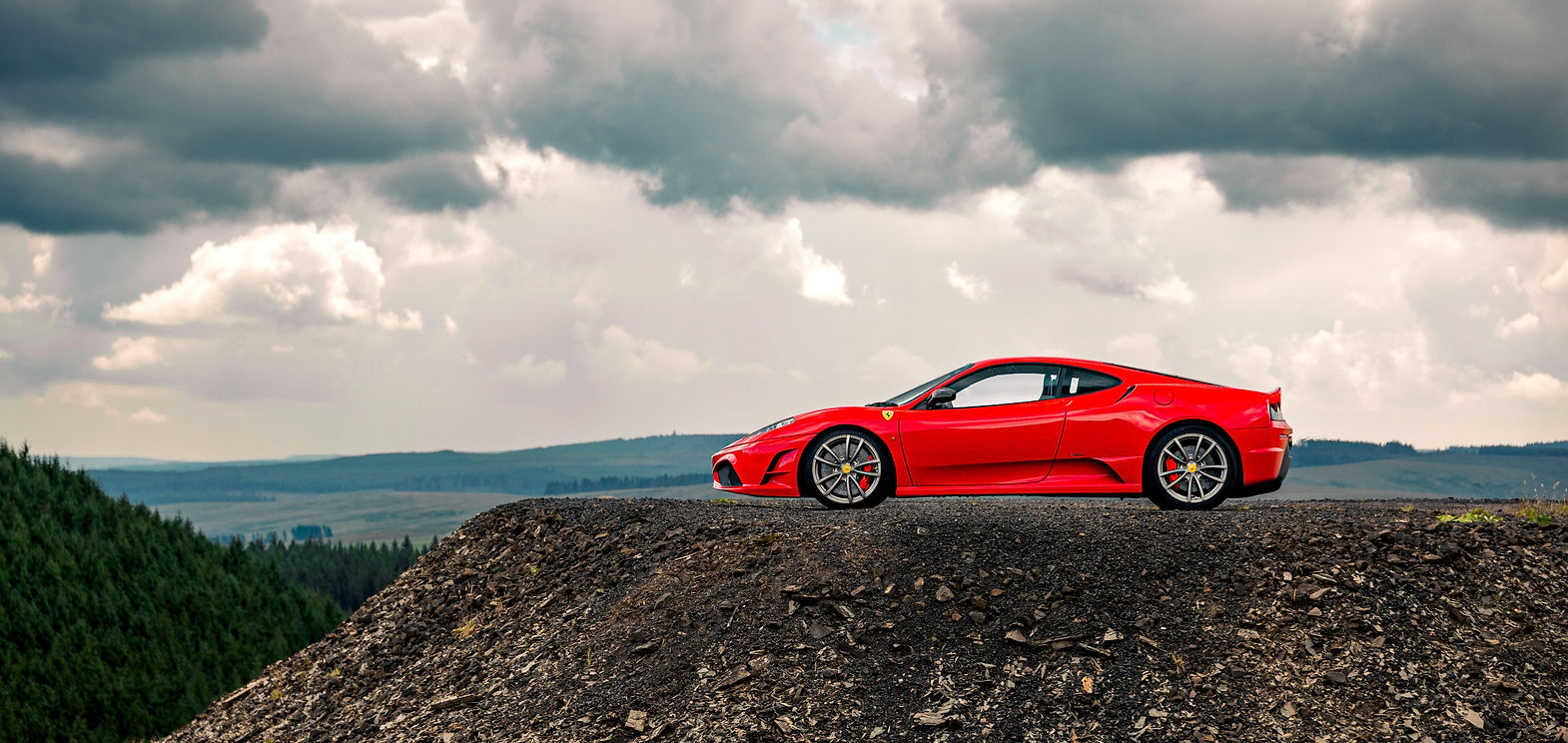
Our meeting point above the Caddroun burn provides a uniquely-acoustic setting, suited to this dramatic display. Long, deep and narrow, cushioned by a pine forest on the opposite side, you’d christen it nature’s own amphitheatre… If it wasn’t for the tell-tale efficient rows of the original saplings and the uniform ambition of their reach into the sky. The perch I’m standing upon is man-made too – a shale pedestal protruding outwards, jolie-laide in design. It should be an ugly blight, yet somehow it works: man and nature melding together.
Mark – the owner of this particular Prancing Horse and disturber of the peace – emerges from the car, donned in shades and sliders. There is just enough time for a hearty “what a fucking road” greeting before we hear the sound once more – this time refracted off the valley head miles away – and we all fall to silent contemplation. I thought the speed of sound was supposed to be faster than any mere production car. Clearly it plays second fiddle to the 430 Scuderia.
AUTHOR

Rush Founder
Photography by;
Ben Midlane
Published on:
18/8/2024
OUR PRINT MAGAZINE
CATEGORIES

D
I’m sure everybody has a fantasy about driving their first Ferrari but I must admit I was more than a little intimidated to drive the Scuderia – a hyper-focused, stripped-out version of the F430 Berlinetta with the wick dialled up to over 500bhp. This wasn’t due to a lack of faith in my ability but simply my respect for somebody else’s property – a mental block created by the £200,000 value of the car. Up until this point, the fastest mid-engined motor I’d driven was a Porsche Boxster S of the 986 vintage. Doubling the horsepower and increasing the value twentyfold is quite the step up.
Even parked up, it’s clear the Scuderia means business. The engine sheds excess heat through cover vents like a sleeping dragon ready to breathe fire. I’ve never been the biggest fan of the regular F430 Berlinettas styling, feeling that it lacks the cohesion of Pininfarina’s finest, but there is a purpose to the Scuderia that’s alluring. There’s art in the engineering of this car: from the hunkered down stance, to the reformed aerodynamics and cooling, to the obsessive use of deeply glossy carbon fibre at every opportunity. The gorgeous, lightweight forged alloys are bolted over the top of enlarged carbon ceramic brakes (up ¾” to 398 mm) and the calliper clearance features the sort of tolerance only used by NASA. Speaking of bolts, those on the wheels are fashioned from titanium – as is the majority of the suspension componentry. Super strong, super lightweight – it’s a theme that runs through the entirety of this car.
The hardcore aesthetic continues to gain momentum when you swing open the driver’s door and lay eyes on even more carbon. The weave is used for the door cards, seat shells and as a housing for the shift lights in the steering wheel. The dashboard is clad in alcantara instead of leather and the glovebox has been replaced by a net. Still, what is by far the most evocative element is the bare aluminium floor and the exposed welds in the footwell. The welds aren’t even particularly well-finished, but jettisoning the carpets not only saves weight – it harks right back to the F40 and speaks directly to my inner child. The one pressing his nose up against the window of Stratstone Ferrari Manchester. In total, 100kg has been cut from the regular F430 – resulting in a kerb weight of 1,349kg.
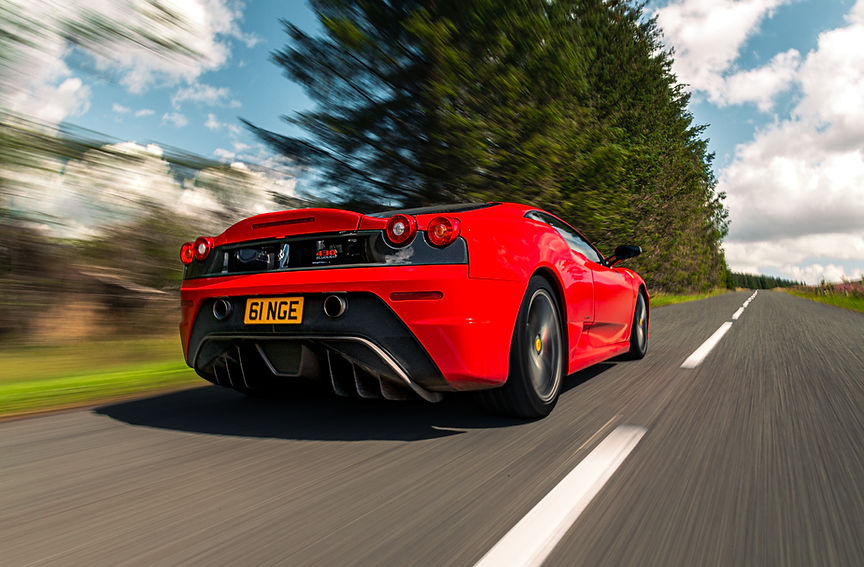
What you can’t see through that bare floor pan is the extensive revisions to the car’s underbody. Ferrari claims downforce is up to 300kg at the Scuderia’s top speed of 198mph, yet the drag coefficient of the standard F430 is maintained. At the back, the new rear diffuser has gone full-blown alien invasion sci-fi and the rear grill, again fashioned from carbon fibre, takes heavy inspiration from the Challenge racers.
The Scuderia benefits from a power-to-weight ratio increase of 42bhp/ton over the regular F430 Berlinetta
D
It’s all so easy that it almost robs you of the cerebral moment of contemplation before you turn the key and thumb the starter button, giving life to all eight cylinders and 48 valves. I can imagine the Ferrari powertrain engineers smiling wryly as they calibrated the slightly-too-long starter motor sequence, that seemingly eternal inhale you take before the ignition fires and the exhaust blares and settles into an impatient idle.
The gearbox is a doddle to operate. There is no BMW SMG nonsense, with 42,000 settings to grapple with, and the car creeps forwards obediently with a brush of the throttle. Yet the Ferrari is already egging me on – and it all stems from the ridiculous tractability of a mesmerising naturally-aspirated motor. Honestly, as cliche as it sounds, the throttle pedal behaves as if connected directly to the synapses in your spinal cord – so instantaneous is the response, so telepathically judged is the thrust received, and so sweet is the vocal approval from the 90 degree V8. Outright traction is also indomitable. As long as you’re not a complete gorilla on the throttle, introducing the pedal to the bulkhead with a smooth arc, full-bore acceleration and maximum attack upshifts are possible from first gear all the way into fourth without a hint of complaint from the rear tyres.
You might wish for a Ferrari to emit a creamy symphony, one that evolves with every single revolution. But honestly, the V8 spins so fast, there isn’t the time – the tone simply changes in stages. First, the exhaust valves come over all antisocial at 3,000 rpm, then the note hardens again as the needle rockets past 6k – at which point the shift lights start giving you epilepsy and you’re closing in on the 8,640 rpm redline faster than an avalanche freefalling down the side of Mont Blanc. It’s like VTEC on acid.


D
Obviously, it comes as no surprise to find more horses in the V8’s stable – pun intended. We’ve gained 20 of them but, more importantly, the powertrain team has also played with the torque curve – widening the reach of the 347lb-ft peak. Liberating the extra power from the 4.3 litre engine is a revised intake plenum, a Challenge-derived exhaust system – new pistons with a higher compression ratio (11.88:1) and a tweaked ECU. The specific output is now up to 117bhp/litre.
The “F1 Superfast 2” gearbox also fights hard for your attention. It maybe even eclipses that manic engine – it’s that exciting. Banish any thoughts about a lurching 360 Challenge Stradale or E60 M5, this gearbox is in another dimension – changes happen as fast as you can pull a paddle. The headline 60 milliseconds shift time is only accessed above 50% throttle or north of 5,000rpm. For perspective, the regular F430 shifts in 150 milliseconds – almost three times as long. Even the FXX clocks in at 80ms. F1 cars of the time were banging home 40ms shifts.
This gives the gearbox the speed of a dual clutch; however, it still maintains the heavy metal, mechanical fury of a single clutch change. Despite such aggressive shift times, swapping cogs at such a rate never upsets the back axle, and you don’t receive a heavy dose of whiplash or motion sickness with every full bore upshift. From where I’m sitting a dual-clutch transmission seems redundant. This gearbox is so sublime, so addictive, you’ll catch yourself shifting gears just for the hell of it, like you would in a manual. It is central to the entire experience of the car.
I always dreamed my first Ferrari experience would centre around stirring one of those iconic, open gate H-pattern manuals, but I’m going to commit it to paper: fitting a manual gearbox to the Scuderia would ruin it. Want a metaphor? I’m sorry, only an expletive will do: changing gear in the Scuderia is fucking life affirming. Days afterwards, I would find myself clawing at an imaginary paddle as I bumbled along my commute. Sadly, Ferrari perfected the F1 transmission right as it went out of fashion.
.jpg)
“The overwhelming feeling is of a car with a sublime balance and practically zero inertia – from the way the V8 spins to 8,000+ rpm, to the ability of the carbon ceramics to shed big numbers with a typically Italian shrug of the shoulders…”
D
Once you have become accustomed to the head rush of the powertrain, you can concentrate on the rest of the car. The turn-in is another high point. The steering is very light, super direct and oh-so-perfectly geared. Some may assume this lightness might be a little disconcerting in a mid-engined car, especially if big speeds are introduced, but honestly – at road pace – the car is so planted. If you need it, the nose will dart for an apex with complete commitment, or change direction as quickly as the fast twitch muscles in your forearms can react. And it’ll stay completely flat whilst doing so, for the Scuderia simply refuses any form of body roll.
The overwhelming feeling is of a car with a sublime balance and practically zero inertia – from the way the V8 spins to 8,000+ rpm, to the rate the car can change direction with complete composure, and the ability of the carbon ceramics to shed big numbers with a typically Italian shrug of the shoulders. Mark likens it to a big Lotus Elise and I completely endorse the extrapolation.
The sensory assault is constant. Your fingertips buzz with feedback and your spine tingles to the pulse of that V8. But the key is this: it is never tiring. This is because the car is surprisingly comfortable. Save for the clinking rose joints, you’d swear the Scuderia is no more taxing than the regular F430. The Lexan rear window reduces mass – high up mass – yet it doesn’t rattle or vibrate. The seats are perfectly moulded, but you won’t need to rearrange your vertebrae to appreciate them. The fabric is grippy and they remain comfortable after hours at the wheel. You’ll even forget you’re wearing harnesses after a while.
Speaking of touring, the V8, for all its noise, is never harsh and, despite being naturally-aspirated, torque is plentiful. At one point, I was cruising along the sweeping A68, stuck behind a pack of motorbikes. Maintaining their rhythm was no hardship using the impressive mid-range urge of the V8 – I was doubly impressed when I assumed I was loping along in fourth gear, only to look down at the digital readout and see a five flashing back at me.
Famous glass rear screen showing off the mighty V8 has been switched for a Polycarbonate item saving weight.

D
And then there’s the brakes. You read online horror stories about carbon-ceramic brakes when cold but, across mixed driving, the brakes on the Scuderia were never anything more than completely faithful and powerful. In fact, so well-judged was their operation, I genuinely remember little about them. You might see that as a backhanded compliment, but it’s just that the rest of the car is so bloody raw and unhinged, some assets fade into the background.
One of the assets you’re constantly appreciative of is the damping – specifically bumpy road mode. It doesn’t suddenly mean the S in Mercedes S-Class stands for Scuderia – what it does is give the damping incredible poise, smoothing off all the rough edges and opening up even the most weathered of B-roads for play. It’s underpinned by a reassuring firmness, but is never harsh. All this despite the car riding 15 mm closer to the ground than the Berlinetta. Witchcraft.
What’s interesting is, whilst you’re enjoying yourself, there is some seriously sophisticated technology plying its trade in the background but, so seamless is its interaction with the chassis, you’d swear everything was natural. I’ve always taken the whole “F1 technology for the road” line from Ferrari with a pinch of salt, but it seems the Scuderia really can back this claim up.
There is enough electronic wizardry occurring here to baffle Alan Turing. Central is the E-diff – the first of its kind pioneered on the regular F430, but revised and sharpened up to suit the higher grip capabilities of the wider, stickier tyres and bigger brakes. Its action is integrated with the gearbox and programmed in unison with the F1-Trac stability and traction control systems. Ferrari claims the technology offers 40% more acceleration coming out of corners than a traditional mechanical set up and, given how well the Scuderia hooks up, I can believe it.


D
It’s a hardware and software unison that is enough to see the Scuderia lap Ferrari’s fabled Fiorano test track in an Enzo-humbling time. A mere four years prior, the Enzo was Maranello’s flagship hypercar, the very best it could do with money no object. The £172,500 asking price of a Scuderia made it a comparative bargain – at least in performance terms.
Much has been made of Michael Schumacher’s input into the development of the Scuderia. One specific request Herr Schuey made was the ability to operate the above traction and stability controls independent of the suspension setting. If this hadn’t been taken on board, I might’ve been writing about a very different feeling car. Everything is dialled in via the Manettino switch on the steering wheel. It could’ve been a gimmick, but it genuinely works intuitively – although in the real world, you’ll quickly default to the Race setting (loosens intervention, but still gives maximum drive forwards) combined with bumpy road mode, and pretty much leave it there the entire day. If you want to be a hero, you can have traction off with stability on, or make the cross of the Holy Spirit and turn it all off.
Flaws? Of course the Scuderia has some – every car does. The most noticeable driving glitch is some mild understeer present in low-speed corners. It wasn’t unpleasant or scary – the nose just washed a little wide of my requested line. Twice it happened to me, and both times the otherwise excellent steering failed to telegraph it.
Mark informs me the car is rather sensitive to set-up and tyres. Before a recent thorough fettle by The Supercar Tech in Edinburgh, Mark had the Scuderia up for sale because he hadn’t fully gelled with it – unable to trust “a disconnected and wandery front end when pressing on” and a driving position that felt far too high for a car of this ilk.
“At TST, the car got a new set of Continental SportContact 7’s to replace the 10-year-old P Zero Corsas, and what a difference this has made – the ride quality and grip levels are night and day improved. I chose a more road-biassed tyre because that’s where the car spends the majority of its time. Paul also replaced some worn suspension components that would account for the loose front end. Finally, we lowered the driver’s seat to its lowest position – I wasn’t even aware this was something that could be done, but the car is absolutely transformed.

D
“I can’t quite believe what these three changes collectively have done to the driving experience. It now feels like I always wanted it to: steering and suspension feels as tight as a drum, with a lovely supple ride quality and huge corner stability from entry to exit. The lowered driver’s seat means that, all of a sudden, it feels like I actually fit in the car and the driving position is now perfect. I’m actually pretty gobsmacked at the difference.”
I’ve no doubt a BMW M3 or Alfa Romeo Giulia Quadrifoglio – with their equally fat tyres and steroidal mid-ranges – could keep pace with, or even outrun, the Scuderia. I know for certain a 488 Pista would make mincemeat of this car in an airfield drag race on YouTube.
But that completely misses the point. The V8 doesn’t just turbo torque from 20-120mph in the blink of an eye, with a turbine suffocating the soundtrack. The Scuderia is still a thrillingly fast car – nought to sixty takes 3.6s and 100mph will flash by in eight – yet extended periods of full throttle can still be safely used, exploited even, on the public road.
The Scuderia is a car that transcends the physical art of driving. Where the perfect apex is forgotten about and acceleration times and peak lateral-g numbers fade away. Yet within the storm, you – the driver – are calm. The heart is pumping and the adrenaline is firing, but it’s not a fretful or nervous energy. You’re happy – revelling in the moment. You feel in control and that the car is working with you, rather than judging you.
There is so much texture to driving the Scuderia. It feels like the essence of Ferrari: capturing all of the emotive drama and distilling away any of the old-fashioned compromises. I want to drive it until the oil fields run dry and all the petrol stations across the land are derelict. And, when that happens, I’ll just close my eyes, access my hippocampus and download the memory of the sound and stick it on repeat. I’m rather fond of my new sideburns and I’m now on the look-out for a Ferrari-embroidered rhinestone jacket if you happen to know a place…
Scuderia rides 15mm lower than the regular F430. Manettino switch offers five modes; Icy, Sport, Race, CT Off (disables traction control while leaving the stability control active) and CST Off, which turns off every driver aid.
Ferrari 430 Scuderia Stats, Performance and RUSH Rating
Engine
4,308 cc 90 degree V8, 48 valves, max 8,640 rpm
Bore and Stroke 3.26 x 3.19 in (92 x 81 mm)
503 metric horsepower / 510 PS @ 8,500 rpm
347 lb-ft. @ 5,250 rpm
11.88:1 compression ratio
117 bhp/litre
CO2 – 360 g/km
Transmission
6 speed paddle shift single clutch automated manual
Electronic differential “E-Diff2 (E-Diff + F1-Trac)
Brakes
Carbon-ceramic, front 15.6 x 1.4 in (398 X 36 mm)
Rear 13.7 x 1.3 in (350 X 34 mm)
Tyres
Front 235/35 19”
Rear 285/35 19”
Chassis
Rear wheel drive, mid engine layout
43:57 front/rear distribution
Double wishbone suspension all-round
Adaptive “magna-ride” dampers
Titanium springs
Wheelbase 102.4 in (2600 mm)
Front track 65.7 in (1669 mm)
Rear track 63.6 in (1616 mm)
Weight
Kerb Weight 2975 lb (1350 kg)
Power-to-weight 373 bhp/tonne
Torque-to-weight 257 lb-ft/tonne
Performance
0-62 mph (0-100 km/h) in 3.6 s
0-124 mph (0-200 km/h) in 11.6 s
0–1000 m in 20.9 s
Maximum Speed 198 mph (320 km/h)
RUSH RADAR
Steering – feedback & responses
Drivetrain – throttle response, power delivery
Performance
Value – running costs & residuals
Chassis & Handling Balance
Ride & damping

NEVER MISS AN ARTICLE
Subscribe to our newsletter
Email*Submit
RUSH MAGAZINE
Driving Enthusiasm
GET IN TOUCH
© 2019-2024 by ZERO TWO SIXTY PUBLISHING LTD
SITE MENU
Deep Dive Features & Personalities
FOLLOW US
FRIENDS OF RUSH
We don’t share our cookies. We keep them to ourselves. They’re only used to track popular content.Privacy Policy